Follow us on Twitter
Oxford Mathematics now has its own Twitter account to keep you up to you date with all things mathematical.


Follow us on TwitterOxford Mathematics now has its own Twitter account to keep you up to you date with all things mathematical. |
|
Searchable videos and scrubbing your floors - mathematics working with industry

What if you need to search through months of video files to identify a red car that was in shot for just a few seconds. Or how long do you have to scrub something before it can be considered clean? No big deal if it is the washing-up but what if there are hazardous chemicals in your workplace? The answer to both problems is mathematics. Demonstrating this fact was the driving force for the 100th European Study Group with Industry which took place in Oxford from 7-11 April. Nine companies from sectors as diverse as chemicals, logistics, data processing, government and retail presented problems to a range of the world’s best mathematicians in an intensive week of brainstorming. The mathematicians’ brief was simple. Prove that mathematics can work in the real world and have a commercial application and value.
We often hear that mathematics underpins science. We hear less how it underpins industry. The 100th Study Group and its predecessors demonstrate that mathematics is a crucial industrial resource and that industrial R&D can provide fantastic challenges for mathematicians. For more information please contact Chris Breward (@email). |
|
Dr Jonathan Pila among the winners of the Carol Karp Prize 2013The Association for Symbolic Logic has announced Dr Jonathan Pila as among the winners of the Carol Karp Prize 2013. This prize is awarded every five years for an outstanding paper or book in the field of symbolic logic. It is made by the Association on recommendation of the ASL Committee on Prizes and Awards for a "connected body of research, most of which has been completed in the time since the previous prize was awarded," and consists of a cash award. Sharing the prize with Dr Pila are Moti Gitik, Ya'acov Peterzil, Segei Starchenko and Alex Wilkie. Alex Wilkie is presently a Logic Group visitor to the Mathematical Institute in Oxford and was a faculty member for many years before moving to Manchester. |
|
Bugs Bunny as mathematician
|
|
Public Lectures in May - the Oliver Smithies LecturesOliver Smithies LecturesProfessor Tara Holm will give the Oliver Smithies Lectures for Balliol College in Weeks 2 and 4 of Trinity Term 2014 here in the Mathematical Institute, Radcliffe Observatory Quarter, Woodstock Road, Oxford. Attendance is free and booking is not required.
'The Geometry of Origami: How the Ancient Japanese Art Triumphed over Euclid' on Thursday 8 May at 5.00pm 'Act Globally, Compute Locally: Group Actions, Fixed Points and Localization' on Tuesday 20 May at 5.00pm Professor Tara Holm is Associate Professor of Mathematics at Cornell University. The lectures are funded by a generous benefaction from Professor Oliver Smithies, which enables Balliol to bring distinguished visitors to the University of Oxford. |
|
Oxford Mathematics Interviews: 'Jim Murray - Reflections on a Life in Academia'Jim Murray is one of the leading mathematical biologists of our times and the Inaugural Hooke Lecturer here in Oxford. In this wide-ranging interview with Philip Maini, Professor of Mathematical Biology in Oxford, Jim talks about his career, the range of his work, his successes and failures and his hopes and expectations for a subject that is the pointing the way for the future of applied mathematics. This interview is the second in a series of interviews with distinguished Oxford Mathematicians, intended to shine a light on the work they do and the beauty and power of their subject. The first interview with Bryce McLeod is also available. |
|
The mathematician as all-rounder
A limited edition Gömböc, labelled #2013, the year of the opening of the Andrew Wiles Building in Oxford, was purchased with generous support from Otto Albrecht and Tim and Leona Wong and can be found on display in the building. The Gömböc in Alain's photograph, a gift from Otto Albrecht, is made of plexiglass which generates intricate and intriguing light patterns. The mathematics of the Gömböc can be seen in the background. |
|
Privacy possible even in a world of spies and mistrustAdvances in quantum cryptography mean that we can protect our secrets even when our communications are being spied on or we are using devices built by our enemies, according to an Oxford University researcher. Revelations of the extent of government surveillance have thrown a spotlight on the insecurity of our digital communications. Even today's encrypted data is vulnerable to technological progress. Writing in this week's Nature, Professor Artur Ekert of Oxford University and the National University of Singapore, and co-author Renato Renner of ETH Zurich, explore what physics tells us about keeping our secrets secret.In the history of secret communication, the efforts of code-makers have been matched time and again by the ingenuity of code-breakers. It is already believed that one of today's most widely used encryption systems, RSA, will become insecure once a quantum computer is built. But that story need not go on forever. 'Recent developments in quantum cryptography show that privacy is possible under stunningly weak assumptions about the freedom of action we have and the trustworthiness of the devices we use,' says Professor Ekert of Oxford University's Mathematical Institute, who is also Director of the Centre for Quantum Technologies at the National University of Singapore. Over 20 years ago, Professor Ekert and others independently proposed a way to use the quantum properties of particles of light to share a secret key for secure communication. The key is a random sequence of 1s and 0s, derived by making random choices about how to measure the particles (and some other steps), that is used to encrypt the message. In the Nature Perspective, Ekert and Renner describe how quantum cryptography has since progressed to commercial prospect and into new theoretical territory. Even though privacy is about randomness and trust, the most surprising recent finding is that we can communicate secretly even if we have very little trust in our cryptographic devices – imagine that you buy them from your enemy – and in our own abilities to make free choices – imagine that your enemy is also manipulating you. Given access to certain types of correlations (form the quantum world or elsewhere), and having a little bit of free will, we can protect ourselves. We can even protect ourselves against adversaries with superior technology that is unknown to us. 'As long as some of our choices are not completely predictable and therefore beyond the powers that be, we can keep our secrets secret,' says Renner, Professor of Theoretical Physics at ETH Zurich, Switzerland. This arises from a mathematical discovery by Renner and his collaborator about 'randomness amplification': they found that a quantum trick can turn some types of slightly-random numbers into completely random numbers. Applied in cryptography, such methods can reinstate our abilities to make perfectly random choices and guarantee security even if we are partially manipulated. 'As well as there being exciting scientific developments in the past few years, the topic of cryptography has very much come out of the shadows. It's not just spooks talking about this stuff now,' says Ekert. The authors conclude: 'The days we stop worrying about untrustworthy or incompetent providers of cryptographic services may not be that far away'. The Perspective article, entitled ‘The ultimate physical limits of privacy', is published in this week's Nature |
|
Monsters, tumours and divorce - watch the Inaugural Hooke LectureEarlier this month Professor Jim Murray, Professor Emeritus Mathematical Biology, University of
Oxford & Senior Scholar, Applied and
Computational Mathematics, Princeton University, gave the first Hooke Lecture here in Oxford. Entitled “Why
there are no 3-headed monsters, resolving some problems with brain
tumours, divorce prediction and how to save marriages” Jim described three very different problems: the development of the mechanical
theory of morphogenesis and how it was used to move evolution backwards; a
model for quantifying the growth of brain tumours and individual patient
treatments: and an example from the social sciences that is used to predict
marital stability and divorce. The Hooke lectures are part of a series of Public Lectures
intended to display the power and beauty of mathematics to a wider audience.
|
|
Christian Yates wins Silver Award at SETCongratulations to Dr Christian Yates, Research Fellow at the University of Oxford, who has won the Silver Award in the mathematics category of the SET for Britain awards for his work on locust swarming. Find out more about the devastating consequences of locust swarming, how, counterintuitively, randommness helps swarms of locusts stay together and how understanding cannibalism in locusts might be the key to dispersing the swarms. |
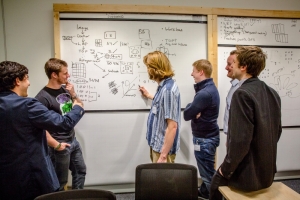 The result? The video search group came up with brand new
algorithms for decompressing jpeg files to make objects recognisable by
sharpening the edges in the image and reducing the computer-generated
artefacts. Glynn Wright, CEO of Aralia, the company involved, said "we now have a clear insight
into how we may advance the state-of-the-art in automated scene analysis. The
range of skills brought to bear by graduates and professors alike forms a
solid basis for our R&D that will keep Aralia busy for many months to come.
Some of the results promise to be of considerable significance to virtually
everyone who uses digital images."
The result? The video search group came up with brand new
algorithms for decompressing jpeg files to make objects recognisable by
sharpening the edges in the image and reducing the computer-generated
artefacts. Glynn Wright, CEO of Aralia, the company involved, said "we now have a clear insight
into how we may advance the state-of-the-art in automated scene analysis. The
range of skills brought to bear by graduates and professors alike forms a
solid basis for our R&D that will keep Aralia busy for many months to come.
Some of the results promise to be of considerable significance to virtually
everyone who uses digital images."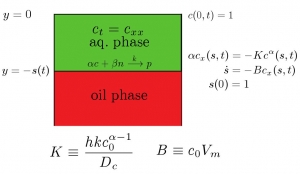 In parallel the cleansing group modelled the movement of hazardous
materials and decontaminants through carpets and concrete. The key new insight
was that cleansing is better if the reaction produces products that are soluble
in the decontaminant rather than the hazardous material. "The week was a
great success" said Anthony Arkell and Hasmitta Stewart of the Government
Decontamination Service. "The range of chemicals and types of surfaces
proved to be an impossible task to prioritise and investigate within a
laboratory but the outcomes from ESGI 100 will allow us to target further
research and development and provide better advice in the interim. It was also
a great pleasure to be involved with such a range of talented and enthusiastic
people". These successes were repeated across the week as mathematicians and industrialists worked side by side on shared interests and goals.
In parallel the cleansing group modelled the movement of hazardous
materials and decontaminants through carpets and concrete. The key new insight
was that cleansing is better if the reaction produces products that are soluble
in the decontaminant rather than the hazardous material. "The week was a
great success" said Anthony Arkell and Hasmitta Stewart of the Government
Decontamination Service. "The range of chemicals and types of surfaces
proved to be an impossible task to prioritise and investigate within a
laboratory but the outcomes from ESGI 100 will allow us to target further
research and development and provide better advice in the interim. It was also
a great pleasure to be involved with such a range of talented and enthusiastic
people". These successes were repeated across the week as mathematicians and industrialists worked side by side on shared interests and goals. 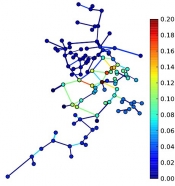 Perhaps Bugs Bunny would not have taken a wrong turn at
Albuquerque if he'd only known some more network analysis? In a paper published in
Perhaps Bugs Bunny would not have taken a wrong turn at
Albuquerque if he'd only known some more network analysis? In a paper published in 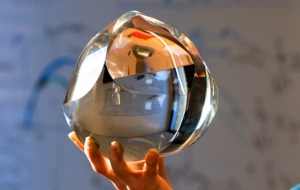 Arguably mathematicians are the scientific all-rounders, applying their
skills to a range of subjects from chemistry and medicine to engineering and
economics. In some cases these skills extend even further. Professor Alain
Goriely, Statutory Professor of Mathematical Modelling in Oxford, has just won
second prize in the Weird and Wonderful section of the 2014
National Science Photography Competition, organised by the Engineering and
Physical Sciences Research Council (EPSRC) for his photograph of a gömböc. A gömböc is a convex
Arguably mathematicians are the scientific all-rounders, applying their
skills to a range of subjects from chemistry and medicine to engineering and
economics. In some cases these skills extend even further. Professor Alain
Goriely, Statutory Professor of Mathematical Modelling in Oxford, has just won
second prize in the Weird and Wonderful section of the 2014
National Science Photography Competition, organised by the Engineering and
Physical Sciences Research Council (EPSRC) for his photograph of a gömböc. A gömböc is a convex