Oxford Mathematics Public Events
Cascading Principles - a major mathematically inspired art exhibition by Conrad Shawcross
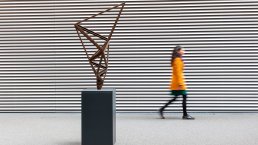
Oxford Mathematics is delighted to be hosting one of the largest exhibitions by the artist Conrad Shawcross in the UK. The exhibition, Cascading Principles: Expansions within Geometry, Philosophy, and Interference, brings together over 40 of Conrad's mathematically inspired works from the past seventeen years. Rather than in a gallery, they are placed in the working environment of the practitioners of the subject that inspired them, namely mathematics.
Conrad Shawcross models scientific thought and reasoning within his practice. Drawn to mathematics, physics, and philosophy from the early stages of his artistic career, Shawcross combines these disciplines in his work. He places a strong emphasis on the nature of matter, and on the relativity of gravity, entropy, and the nature of time itself. Like a scientist working in a laboratory, he conceives each work as an experiment. Modularity is key to his process and many works are built from a single essential unit or building block. If an atom or electron is a basic unit for physicists, his unit is the tetrahedron.
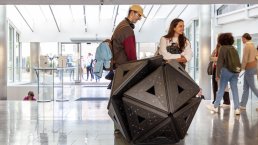
Unlike other shapes, a tetrahedron cannot tessellate with itself. It cannot cover or form a surface through its repetition - one tetrahedron is unable to fit together with others of its kind. Whilst other shapes can sit alongside one another without creating gaps or overlapping, tetrahedrons cannot resolve in this way. Shawcross’ Schisms are a perfect demonstration of this failure to tessellate. They bring twenty tetrahedrons together to form a sphere, which results in a deep crack and ruptures that permeate its surface. This failure of its geometry means that it cannot succeed as a scientific model, but it is this very failure that allows it to succeed as an art work, the cracks full of broad and potent implications.
The show includes all Conrad's manifold geometric and philosophical investigations into this curious, four-surfaced, triangular prism to date. These include the Paradigms, the Lattice Cubes, the Fractures, the Schisms, and The Dappled Light of the Sun. The latter was first shown in the courtyard of the Royal Academy and subsequently travelled all across the world, from east to west, China to America.
The show also contains the four Beacons. Activated like a stained-glass window by the light of the sun, they are composed of two coloured, perforated disks moving in counter rotation to one another, patterning the light through the non-repeating pattern of holes, and conveying a message using semaphoric language. These works are studies for the Ramsgate Beacons commission in Kent, as part of Pioneering Places East Kent.
The exhibition Cascading Principles: Expansions within Geometry, Philosophy, and Interference is curated by Fatoş Üstek, and is organised in collaboration with Oxford Mathematics.
The exhibition is open 9am-5pm, Monday to Friday. Some of the works are in the private part of the building and we shall be arranging regular tours of that area. If you wish to join a tour please email @email.
The exhibition runs until 30 June 2026. You can see and find out more here.
Watch the four public talks centred around the exhibition (featuring Conrad himself).
The exhibition is generously supported by our longstanding partner XTX Markets.
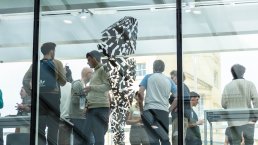
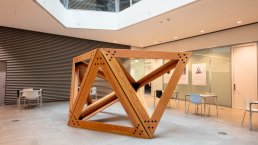
Images clockwise from top left of Schism, Fracture, Paradigm and Axiom
Paul Ouwerkerk - The Oxford Variations
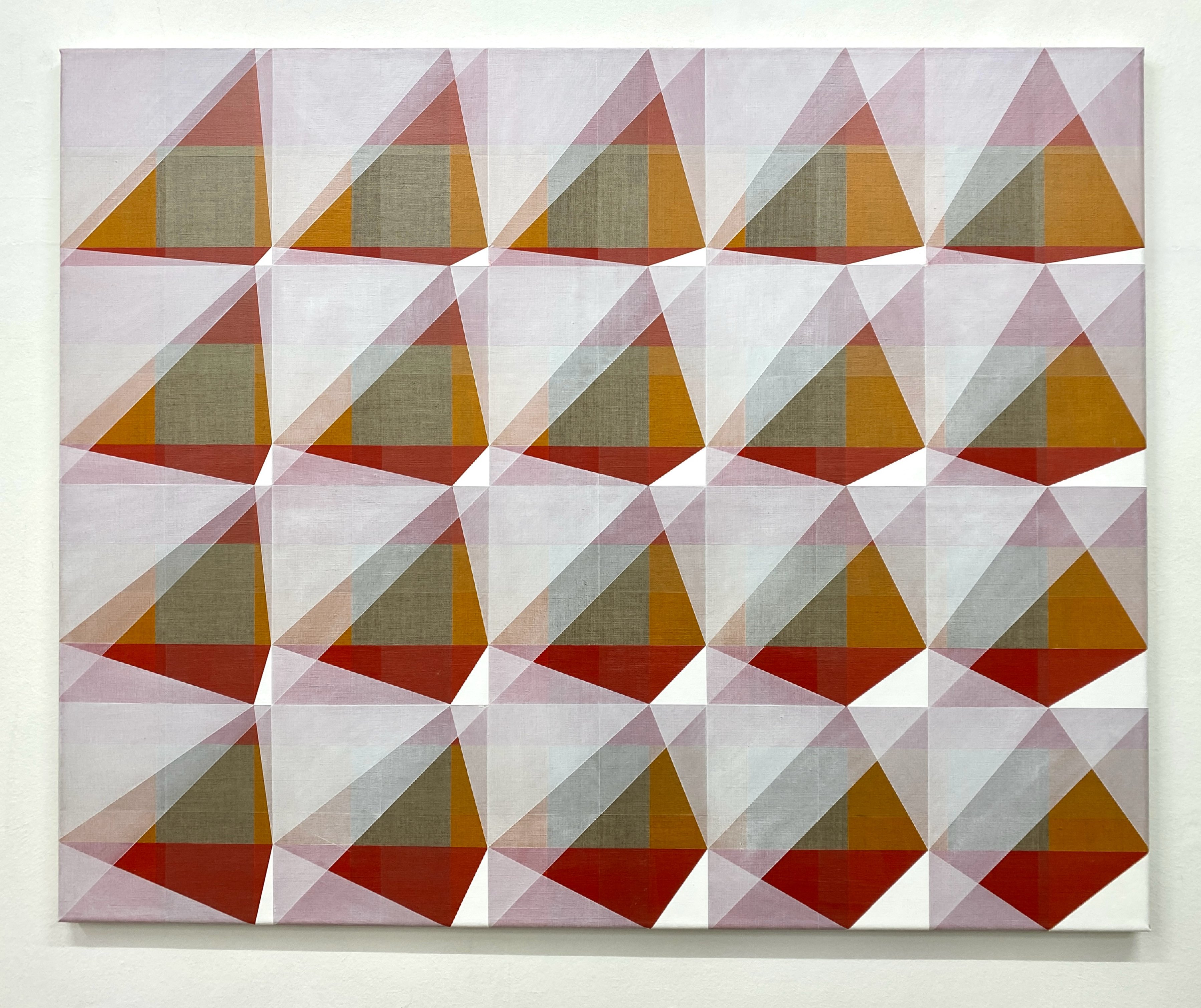
We are delighted to introduce our latest exhibition in the Andrew Wiles Building. Visual artist Paul Ouwerkerk has created 30 new paintings where he plays with the perspective plane in paintings that are generated from self-composed number sequences. The handcrafted canvases are the result of a process in which the artist, after defining a rigid grid as starting point, leaves space for intuition and industrious manual application to elaborate towards the final result.
Visually these paintings can often be interpreted as unfolded polyhedra, dissolving into mathematical landscape perspectives. The rule-based compositions are sometimes derailed purposefully during the painting process, as if to ‘break-the-code’. Painting techniques and materials play a pivotal role in the creation of these works and the materialisation of these abstract illusions.
Paul Ouwerkerk lives and works in Amsterdam. He has a background in art, photography and design. His previous work experience is intermingled with the world of architecture, urbanism and landscape design. Since 2017 he has been painting his abstract ‘Dynamic Geometry’ series.
9 a.m. - 5 p.m. Monday to Friday.