

Introduction
In this case study, I will try to explain the component lattice introduced in my collaborative work, Intrinsic Donaldson–Thomas theory. I. Component lattices of stacks, which involves a blend of Lie theory and stack theory.
Lie theory
Root systems characterise the most perfectly symmetric patterns in euclidean space. Very surprisingly, such patterns correspond to the classification of Lie groups, or more precisely, of reductive groups. For example, the reductive group $\mathrm{SL}_3 (\mathbb{C})$ corresponds to the following root system in $\mathbb{R}^2$:
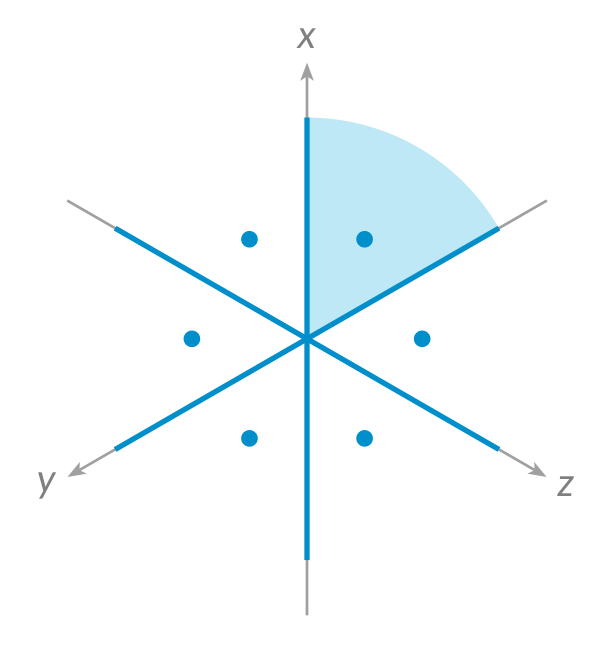
Figure 1 The root system of $\mathrm{SL}_3 (\mathbb{C})$
Here, the root system of $\mathrm{SL}_3 (\mathbb{C})$ sits in the two-dimensional character lattice $\Lambda^T$ of the maximal torus $T$ of $\mathrm{SL}_3 (\mathbb{C})$, and we draw it overlapped with the cocharacter lattice $\Lambda_T$, the dual of $\Lambda^T$. There are $6$ roots indicated by blue dots, the blue lines are hyperplanes perpendicular to the root vectors, and the light blue area is one of the $6$ chambers cut out by the lines. The Weyl group $W$ acts on the lattice by reflections across the hyperplanes, and by acting on a chosen chamber, all the chambers are reached without repetition, so that elements of $W$ are in bijection with the chambers.
For a reductive group $G$, its maximal torus $T$ and Weyl group $W$, we are particularly interested in the quotient sets $$ \Lambda_T / W \quad \text{and} \quad \Lambda^T / W \ , $$ which can be thought of a single chamber in the root hyperplane arrangement, or the light blue area in Figure 1 when $G = \mathrm{SL}_3 (\mathbb{C})$. They occur frequently in representation theory, although they are not usually phrased this way as quotients. For example, we have the following:
- Cohomology: The cohomology of the classifying space $\mathrm{B} G$ is $$ \mathrm{H}^\bullet (\mathrm{B} G; \mathbb{Q}) \simeq \mathbb{Q} [x_1, \dotsc, x_n]^W \ , $$ where $x_1, \dotsc, x_n$ is a set of coordinates on $\Lambda_T$, and the superscript $W$ means taking the invariant part under the Weyl group action. In other words, the cohomology is the space of $W$-invariant polynomial functions on $\Lambda_T$, or equivalently, polynomial functions on the quotient $\Lambda_T / W$.
- Representations: All finite-dimensional representations of $G$ split into direct sums of irreducible representations, and the irreducible representations are in one-to-one correspondence with the quotient set $\Lambda^T / W$, where each representation corresponds to its highest weight.
- Cocharacters: Conjugacy classes of cocharacters of $G$, or homomorphisms $\mathbb{C}^\times \to G$, are in one-to-one correspondence with $\Lambda_T / W$.
Stack theory
Stacks are a very interesting type of geometric objects, with many applications in algebraic and differential geometry, number theory, and physics. Just as manifolds are essential to classical geometry, stacks in a broad sense are essential to the quantum geometry of the real world that we live in.
To explain what a stack is, let us first recall that a groupoid is, by definition, a category where all morphisms are invertible. Here, we think of it slightly differently: for us, a groupoid is a set where each element is equipped with a group, called its automorphism group.
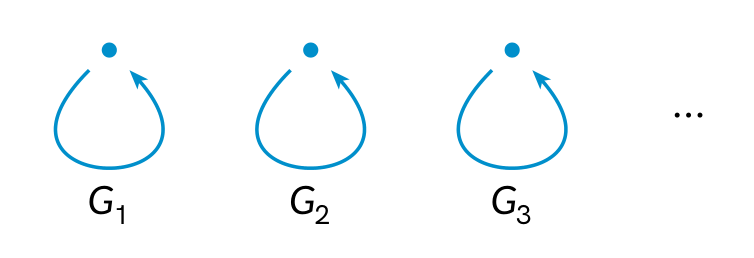
Figure 2 A groupoid
A stack can be roughly defined as a Lie groupoid, that is, a groupoid whose sets of objects and morphisms are complex manifolds. In other words, a stack is like a complex manifold, but each point is equipped with an automorphism group, which is a complex Lie group.
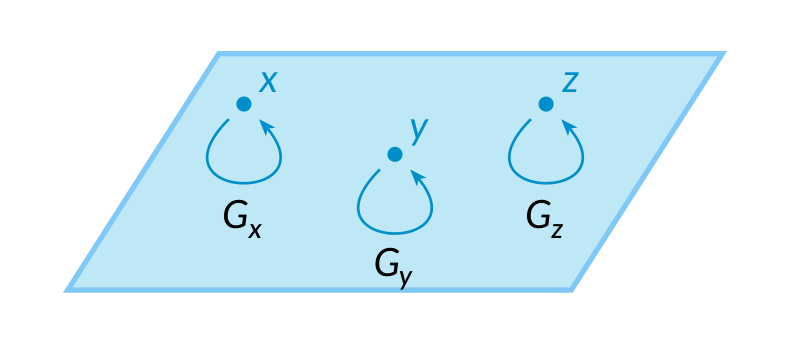
Figure 3 A stack
For example, each complex manifold is itself a stack, where each point has a trivial automorphism group.
As a slightly less trivial example, for a complex Lie group $G$, there is the classifying stack denoted by $* / G$, which has a single point with automorphism group $G$. In this way, complex Lie groups can be seen as special cases of stacks.
The component lattice
As we explained, stacks can be seen as a generalisation of Lie groups. The component lattice of a stack is the corresponding generalisation of root systems.
Intuitively, for a stack $X$, its component lattice $\mathrm{CL} (X)$ is defined by taking the automorphism group $G_x$ of each point $x \in X$, then taking the data $\Lambda_T / W$ for each of these groups $G_x$, then gluing them together according to the topology of $X$.
Figure 4 An example of the component lattice
The precise definition goes as follows. For a complex stack $X$, define its component lattice $\mathrm{CL} (X)$ as the set of connected components $$ \mathrm{CL} (X) = \text{π}_0 \bigl( \, \mathrm{Map} ( {*} / \mathbb{C}^\times, X) \, \bigr) $$ of the space of maps from the classifying stack $ * / \mathbb{C}^\times$ to $X$.
Here, a map $* / G \to X$ is nothing but a point $x \in X$ together with a cocharacter $\mathbb{C}^\times \to G_x$, up to conjugation in $G_x$, and taking the set of connected components is the same as saying that two such maps are equivalent whenever one of them can be continuously deformed to the other. This explains why $\mathrm{CL} (X)$ can be thought as glued from the data $\Lambda_T / W$ at its points.
The component lattice allows us to generalise the notion of Weyl groups to stacks. From the component lattice, we can construct a category of special faces of a stack $X$, which is often a finite category, where automorphism groups of objects can be interpreted as Weyl groups for stacks.
Many results in Lie theory about $\Lambda_T / W$ and $\Lambda^T / W$, such as those mentioned earlier, can also be generalised to stacks. Namely, the cohomology of a stack can be decomposed according to the component lattice, which was studied in the joint work, Cohomology of symmetric stacks. Another joint work in progress shows that the derived category of coherent sheaves on a stack admits a semiorthogonal decomposition according to the component lattice, generalising the description of representations of a Lie group.
Chenjing Bu is a postdoctoral research associate in Oxford Mathematics.