


In the summer of 1828, the Scottish botanist Robert Brown was studying the flowering plant Clarkia pulchella under his microscope [1]. While observing grains of pollen suspended in water, Brown noticed that these microscopic objects were engaged in erratic, jittery, and continuous motion. Brown's discovery of this behaviour, now called Brownian motion, was later developed by many mathematicians and physicists, including seminal contributions by Albert Einstein [2], and it ultimately confirmed the theory that the world is composed of atoms and molecules.
Since then, Brownian dynamics have become ubiquitous in the mathematical modelling of noisy real-world systems. Typically, one considers the interplay between the governing forces of the system and the random fluctuations that occur due to noise. This culminates in the mathematical framework of stochastic differential equations (SDEs), which have found applications in finance, biology, and far beyond.
A general SDE takes the form,
\[ dx(t) = f(x)\,dt + \sigma(x)\,dw(t) \]
where \( x(t) \) is the time-dependent state of the system, \( f \) represents the governing forces, \( \sigma(x) \) is the noise intensity, and \( w(t) \) is the Brownian motion. Whilst this approach gives us a framework with which to study models via mathematical analysis, when monitoring the dynamics of a real-world stochastic system, we often only have access to observed, noisy trajectories, and not to \( f \) or \( \sigma \). As a result, procedures to infer \( f \) and \( \sigma \) from this observed data become extremely important.
An alternative approach that has become quite popular in biophysics [3,4], is to discretise continuous space with a sequence of grid-cells [Fig. 1]. Then the observed trajectory can be coarse-grained and considered to be a sequence of movements between these discrete cells. This coarse-grained process can be thought of as a random walk, where the walker moves between adjacent cells according to some probabilities. We describe random walks of this nature by the so-called master equation,
\[ \frac{dp}{dt} = Lp \]
where \( p = (p_1, \dots, p_n) \) and \( p_i \) is the probability of being in state \( i \) at time \( t \), and \( L_{ij} \) is the transition rate from cell \( j \) to cell \( i \).
We also set diagonal entries to be \( L_{ii} = -\sum_{i} L_{ij} \), which ensures that probabilities always sum to 1.
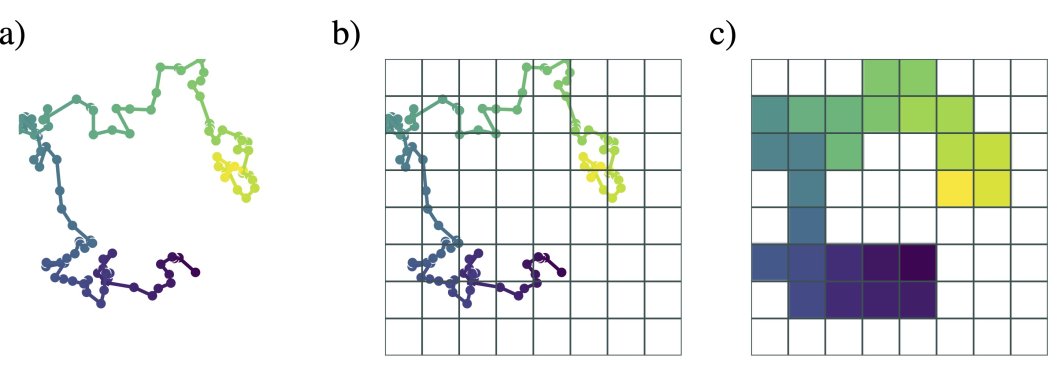
The key motivation for applying this coarse-graining is that inferring this random walk model from data is much easier [5]. We must simply count jumps between cells! Armed with this simple inference approach, we can investigate the properties of the observed system, like its steady-state dynamics and probability fluxes.
However, in order for this to be a valid approximation, we would expect that our two processes converge in the limit, i.e. as the size of the squares shrink to zero, and the number of squares goes to infinity, does our coarse-grained model become equivalent to our SDE? In order to answer this question, it is necessary to derive the transition rates of the master equation directly from the SDE itself.
In our recent paper published in Journal of Statistical Mechanics: Theory and Experiment [6], we set out to do precisely that. In order to derive the transition rates from the functions \( f \) and \( \sigma \), we notice that the master equation is not the discrete analogue of the SDE itself, but instead of the Fokker-Planck (FP) equation,
\[ \partial_t p(x,t) = -\nabla \cdot \left[ f(x)p(x,t) - \nabla \cdot \left( \frac{\sigma^2(x)}{2} p(x,t) \right) \right] \]
which is a partial differential equation (PDE) describing \( p(x,t) \), the probability of the process taking the value \( x \) at time \( t \). Like the master equation, this PDE describes the density dynamics, i.e. how the probability distribution shifts over time. Those in numerical analysis will know that approximating the spatial evolution of a PDE with discrete states is necessary to calculate their solution with a computer. As a result, the problem of coarse-graining our Brownian dynamics becomes a problem in the numerical solution of PDEs.
Despite this, we cannot naively apply any convergent approximation and expect to get a valid master equation. In order for our coarse-grained process to be a valid random walk, we must ensure that the derived transition rates between cells are positive (only when a transition is possible), and that probability is conserved, i.e. at any time \( t \) we need that \( \sum_i p_i(t) = 1 \). Finite volume methods are one family of numerical schemes that conserve these properties, and we derive the appropriate transition rates for the excellent Scharfetter-Gummel discretisation, which gives a valid master equation without additional constraints (e.g. on the step-size). Using this approach, our approximation inherits the many convergence and consistency results that have been proven for this scheme in the numerical analysis of PDEs [7].
Whilst this is a simple and elegant approach for deriving the coarse-grained dynamics of a system under Brownian motion, it is far from complete. The scheme itself is convergent but we show that statistical inference of the random walk model from stochastic trajectories leads to a poor estimate of key biophysical quantities, like the entropy production rate (EPR). This is partly due to the fact that this coarse-graining obscures probability currents and induces memory in the process [8] — something which is not accounted for in a simple memoryless random walk model.
Our work also prompts further analysis of the relationship between discrete and continuous stochastic processes, and how their behaviour aligns in the limit. Of particular interest is the convergence of various decompositions that can be defined for continuous vector fields and for discrete graphs, which we have explored briefly in previous work [9,10]. These approaches promise to draw previously unrealised links between topics in discrete and continuous stochastic processes, numerical analysis, discrete exterior calculus, and graph theory, as well as finding real-world applications to stochastic systems in a variety of scientific domains.
One application is to investigate if a biological system has active dynamics, meaning there is a net probability flux and a non-zero EPR. Using this coarse-graining approach, we have quantified the presence of these irreversible currents in the collective dynamics of schooling fish [6], flickering red-blood cells, and healthy and arrhythmic heartbeats [9]. Others have investigated the dynamics of motile single-celled organisms [3] and human brain dynamics [11], amongst other biological systems.
Ramón Nartallo-Kaluarachchi was a postgraduate student in Oxford Mathematics.
References
- Brown, R. (1828). Brief account of microscopical observations made in the months of June, July and August 1827, on the particles contained in the pollen of plants; and on the general existence of active molecules in organic and inorganic bodies. Philosophical Magazine, 4, 161. https://doi.org/10.1080/14786442808674769
- Einstein, A. (1905). On the movement of small particles suspended in stationary liquids required by the molecular-kinetic theory of heat. Annalen der Physik, 32(8), 549–560. https://doi.org/10.1002/andp.19053220806
- Battle, C. et al. (2016). Broken detailed balance at mesoscopic scales in active biological systems. Science, 352(6285), 604–607. https://doi.org/10.1126/science.aac8167
- Gnesotto, F. S. et al. (2018). Broken detailed balance and non-equilibrium dynamics in living systems: a review. Reports on Progress in Physics, 81, 066601. https://doi.org/10.1088/1361-6633/aab3ed
- Bladt, M. and Sørensen, M. (2005). Statistical inference for discretely observed Markov jump processes. Journal of the Royal Statistical Society Series B, 67(3), 395–410. https://doi.org/10.1111/j.1467-9868.2005.00508.x
- Nartallo-Kaluarachchi, R., Lambiotte, R. and Goriely, A. (2026). Coarse-graining nonequilibrium diffusions with Markov chains. Journal of Statistical Mechanics: Theory and Experiment, 033205. http://dx.doi.org/10.1088/1742-5468/ae4f7d
- Bessemoulin-Chatard, M. (2012). A finite volume scheme for convection–diffusion equations with nonlinear diffusion derived from the Scharfetter–Gummel scheme. Numerische Mathematik, 121, 637–670. https://doi.org/10.1007/s00211-012-0448-x
- Esposito, M. (2012). Stochastic thermodynamics under coarse graining. Physical Review E, 85, 041125. https://doi.org/10.1103/PhysRevE.85.041125
- Nartallo-Kaluarachchi, R. et al. (2024). Decomposing force fields as flows on graphs reconstructed from stochastic trajectories. Proceedings of the Third Learning on Graphs Conference (LoG 2024), PMLR 269. https://doi.org/10.48550/arXiv.2409.07479
- Nartallo-Kaluarachchi, R. (2025). Cycles and potentials: From structure to stochastic dynamics. London Mathematical Society Newsletter, Sept. 2025. View article
- Lynn, C. W. et al. (2021). Broken detailed balance and entropy production in the human brain. Proceedings of the National Academy of Sciences, 118(47), e2109889118. https://doi.org/10.1073/pnas.2109889118