

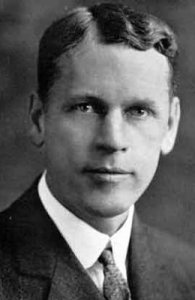
The mathematician Oswald Veblen (1880–1960) is not widely remembered today, except perhaps by those who study geometrical or topological topics that relate to his work. In his day, however, Veblen was a major figure in American mathematics, not just as a researcher and a teacher, but as an organiser. As President of the American Mathematical Society, he oversaw its first major fundraiser during the 1920s. Later on, he advised on the foundation of the Institute for Advanced Study in Princeton and became its first professor. In that post, Veblen was involved in the appointment of the Institute’s other early members, such as Hermann Weyl and Albert Einstein.
There has never been a full biography of Veblen, so a recent project has sought to address that omission, with the result being a special issue of the Bulletin of the American Mathematical Society. Articles in the issue consider Veblen in his various roles: research mathematician, educator, and, as Saunders Mac Lane dubbed him, ‘mathematical statesman’. One article in particular, by Christopher Hollings (Oxford Mathematics), Stephen F. Kennedy (Carleton College, Minnesota), and Erika Luciano (University of Turin), looks at Veblen’s scientific diplomacy [1].
Veblen was a central figure in American and international efforts to aid Jewish mathematicians fleeing 1930s Europe, using his wide knowledge of the American mathematical landscape to secure temporary teaching posts for refugees. In less dangerous times, he used the same skills to try to secure positions for up-and-coming mathematicians. Nowhere is this clearer than in his decades-long correspondence with G. H. Hardy, where they discussed the merits of young scholars and ways in which to help them. Veblen’s knowledge of at least some young British mathematicians would have been gained at first hand when in 1928-9 he swapped places with Hardy and spent some time in Oxford (Hardy was then Savilian Professor of Geometry), where he delivered a course of lectures on ‘Tensors and other differential invariants’ – a topic that was at that time a long way from anything taught in Oxford.
Veblen’s stature on the international stage also saw him heavily involved in the International Congresses of Mathematicians (ICMs). He was a plenary speaker at both the 1928 Bologna Congress and that held in Oslo in 1936. When the ICM was held at Harvard in 1950, Veblen was elected President of the Congress, as one of the elder statesmen of American mathematics. Although Veblen never wrote or spoke publicly about his personal philosophy, it was probably well reflected in the opening address that he gave at the 1950 Congress in which he noted the enrichment of American mathematics through the absorption of so many European scholars over the preceding decades, and stressed the importance of international meetings, even in the face of political difficulties.
[1] Christopher D. Hollings, Stephen F. Kennedy and Erika Luciano, ‘The Informal Diplomacies of Oswald Veblen’, Bulletin of the American Mathematical Society 63(3) (2026), 491–529