

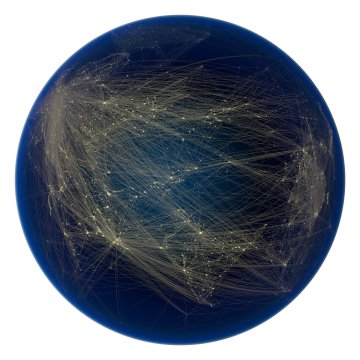
The 1918 Spanish influenza pandemic claimed around fifty million lives worldwide. Interventions were introduced to reduce the spread of the virus, but these were not based on quantitative assessments of the likely effects of different control strategies. One hundred years later, mathematical modelling is routinely used for forecasting and to help plan interventions during outbreaks in populations of humans, animals and plants.
Fri, 19 Jul 2019
12:00
12:00
L6
Mass, Kaehler Manifolds, and Symplectic Geometry
Prof Claude LeBrun
(Stonybrook)
Abstract
In the speaker's previous joint work with Hans-Joachim Hein, a mass formula for asymptotically locally Euclidean (ALE) Kaehler manifolds was proved, assuming only relatively weak fall-off conditions on the metric. However, the case of real dimension four presented technical difficulties that led us to require fall-off conditions in this special dimension that are stronger than the Chrusciel fall-off conditions that sufficed in higher dimensions. This talk will explain how a new proof of the 4-dimensional case, using ideas from symplectic geometry, shows that Chrusciel fall-off suffices to imply all our main results in any dimension. In particular, I will explain why our Penrose-type inequality for the mass of an asymptotically Euclidean Kaehler manifold always still holds, given only this very weak metric fall-off hypothesis.
Case fatality ratio estimates for the 2013 – 2016 West African Ebola epidemic: application of boosted regression trees for imputation
Forna, A
Nouvellet, P
Dorigatti, I
Donnelly, C
Clinical Infectious Diseases
volume 70
issue 12
2476-2483
(22 Jul 2019)
Correction: Influence of Schistosoma mansoni and Hookworm Infection Intensities on Anaemia in Ugandan Villages
Chami, G
Fenwick, A
Bulte, E
Kontoleon, A
Kabatereine, N
Tukahebwa, E
Dunne, D
PLOS Neglected Tropical Diseases
volume 9
issue 12
e0004287
(04 Dec 2015)
Diffusion of treatment in social networks and mass drug administration
Chami, G
Kontoleon, A
Bulte, E
Fenwick, A
Kabatereine, N
Tukahebwa, E
Dunne, D
Nature Communications
volume 8
issue 1
1929
(05 Dec 2017)
Precision global health and comorbidity: a population-based study of 16 357 people in rural Uganda
Chami, G
Kabatereine, N
Tukahebwa, E
Dunne, D
Journal of The Royal Society Interface
volume 15
issue 147
20180248
(31 Oct 2018)
Exploring network theory for mass drug administration
Chami, G
Molyneux, D
Kontoleon, A
Dunne, D
Trends in Parasitology
volume 29
issue 8
370-379
(03 Aug 2013)
Social Network Analysis Predicts Health Behaviours and Self-Reported Health in African Villages
Chami, G
Ahnert, S
Voors, M
Kontoleon, A
PLOS ONE
volume 9
issue 7
e103500
(29 Jul 2014)
Influence of Schistosoma mansoni and Hookworm infection intensities on anaemia in Ugandan villages
Chami, G
Fenwick, A
Bulte, E
Kontoleon, A
Kabatereine, N
Tukahebwa, E
Dunne, D
PLoS Neglected Tropical Diseases
volume 9
issue 10
(29 Oct 2015)
Profiling nonrecipients of mass drug administration for Schistosomiasis and Hookworm infections: A comprehensive analysis of Praziquantel and Albendazole coverage in community-directed treatment in Uganda
Chami, G
Kontoleon, A
Bulte, E
Fenwick, A
Kabatereine, N
Tukahebwa, E
Dunne, D
Clinical Infectious Diseases
volume 62
issue 2
200-207
(25 Sep 2015)