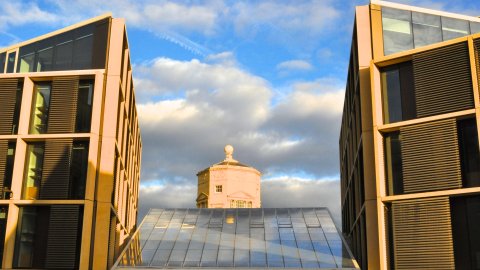
Find out what Oxford has to offer besides world class research in beautiful surroundings.
Fri, 20 Nov 2015
10:00 -
11:00
L4
More accurate optical measurements
Graeme Clark
(Lein)
Abstract
Lein’s confocal systems make accurate and precise measurements in many different applications. In applications where the object under test introduces variability and/or optical aberrations to the optical signal, the accuracy and precision may deteriorate. This technical challenge looks for mathematical solutions to improve the accuracy and precision of measurements made in such circumstances.
The presentation will outline the confocal principle, show “perfect” signals, give details of how we analyse such signals, then move on to less perfect signals and the effects on measurement accuracy and precision.
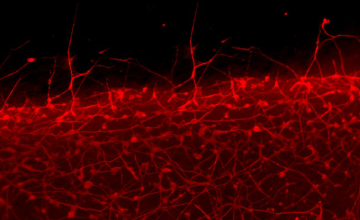
Collaboration may have a claim to being the most overused word in academia (and one or two other places as well), but as the world accumulates more and more data and is able to study mechanisms and organisms at an ever smaller scale, then it is inevitable that more than one expertise is needed to describe the full story.
Tue, 01 Dec 2015
12:00 -
13:00
L4
Quantum systems as spacetime probes
Ivette Fuentes
(University of Vienna)
Abstract
Hawking radiation and particle creation by an expanding Universe
are paradigmatic predictions of quantum field theory in curved spacetime.
Although the theory is a few decades old, it still awaits experimental
demonstration. At first sight, the effects predicted by the theory are too
small to be measured in the laboratory. Therefore, current experimental
efforts have been directed towards siumlating Hawking radiation and
studying quantum particle creation in analogue spacetimes.
In this talk, I will present a proposal to test directly effects of
quantum field theory in the Earth's spacetime using quantum technologies.
Under certain circumstances, real spacetime distortions (such as
gravitational waves) can produce observable effects in the state of
phonons of a Bose-Einstein condensate. The sensitivity of the phononic
field to the underlying spacetime can also be used to measure spacetime
parameters such as the Schwarzschild radius of the Earth.
Fri, 30 Oct 2015
10:00 -
11:00
L4
Elkem furnace challenges: Electromagnetic stirring of silicon; Thermal cracking of electrodes
Aasgeir Valderhaug
(Elkem)
Fri, 27 Nov 2015
16:00 -
17:00
L1
Are Black Holes Real ?
Sergiu Klainerman
(Princeton University, NJ)
Abstract
The talk will consider three well-defined problems which can be interpreted as mathematical tests of the physical reality of black holes: Rigidity, stability and formation of black holes.