


Quantum field theories are full of mathematical riches, so long as one is clever and knows where to look. In this case study, I describe recent work inspired by the physics of four-dimensional superconformal field theory that uncovers an appearance of some of the formal structures coming from Kähler geometry within the theory of vertex operator algebras.
Thu, 18 Jun 2026
16:00 -
17:00
L5
Ambiguity-Averse Deep Hedging
Adam Jones
((Mathematical Institute University of Oxford))
Abstract
The uncertainty in future market dynamics is an important consideration when developing strategies for hedging derivatives, particularly data driven strategies such as deep hedging. Deep market generators can produce higher fidelity training data than classical models, but, like those, typically require frequent recalibration to new market data. The resulting strategies are thus susceptible to underperformance if there is a mismatch (distributional shift) between training data and live data. We present a framework to train a modified deep hedger which displays a form of ambiguity aversion, henceforth termed an Ambiguity-Averse Deep Hedger (AADH). The modeller has full control over exactly which aspects of distributional shifts the AADH is to be robust to, through selection of features relevant to the trading strategy which are used to cluster the training data, allowing for the evaluation of a loss function motivated by the theory of smooth ambiguity aversion.
Thu, 11 Jun 2026
12:00 -
12:30
Lecture Room 4, Mathematical Institute
Randomized Algorithms for Tensor CUR Approximations in Attention Mechanisms
Katherine Pearce
(University of Texas at Austin)
Abstract
Katherine Pearce is going to talk about: 'Randomized Algorithms for Tensor CUR Approximations in Attention Mechanisms'
Attention mechanisms are a central component of transformer models that capture contextual relationships between tokens in large language models. Although many of the underlying computations (e.g., query, key, and value embeddings in multi-head attention) are inherently multi-way, classical transformer models are built on matrix-based formulations. In this talk, we discuss several ways that tensorial structure can be imposed on and exploited in attention mechanisms of transformer models. We describe how tensor-based attention can capture higher-order contextual relationships among tokens. We then explore how randomized algorithms to compute tensor CUR decompositions may be used to accelerate computations in tensor-based attention and reduce storage requirements.
Thu, 04 Jun 2026
12:00 -
12:30
Lecture Room 4, Mathematical Institute
Error estimations for randomized low-rank approximations
Lorenzo Lazzarino
((Mathematical Institute University of Oxford))
Abstract
Lorenzo Lazzarino will talk about: 'Error estimations for randomized low-rank approximations'
Randomized algorithms in numerical linear algebra have proven to be effective in ameliorating issues of scalability when working with large matrices, efficiently producing accurate low-rank approximations. A key remaining challenge, however, is to efficiently assess the approximation accuracy of randomized methods without additional expensive matrix accesses.
In this talk, we discuss a posteriori error estimation strategies for randomized low-rank approximations, with a focus on estimators that can be constructed from the same data used to compute the approximation or without matrix global accesses. These can serve both as certification tools and as algorithmic building blocks, enabling adaptive approximations and informed trade-offs between accuracy and computational cost. As a motivation and a case study, we include a discussion on spectromicroscopy experiments.
Thu, 14 May 2026
12:00 -
12:30
Lecture Room 4, Mathematical Institute
Regularization Methods for Hierarchical Programming
Daniel Cortild
((Mathematical Institute University of Oxford))
Abstract
Daniel Cortild is going to talk about: 'Regularization Methods for Hierarchical Programming'
We consider hierarchical variational inequality problems, or more generally, variational inequalities defined over the set of zeros of a monotone operator. This framework includes convex optimization over equilibrium constraints and equilibrium selection problems. In a real Hilbert space setting, we combine a Tikhonov regularization and a proximal penalization to develop a flexible double-loop method for which we prove asymptotic convergence and provide rate statements in terms of gap functions. Our method is flexible, and effectively accommodates a large class of structured operator splitting formulations for which fixed-point encodings are available.
Joint work with Meggie Marschner, and Mathias Staudigl (University of Mannheim)
Thu, 07 May 2026
12:00 -
12:30
Lecture Room 4, Mathematical Institute
Adaptive preconditioning for linear least-squares problems via iterative CUR
Jung Eun Huh
((Mathematical Institute University of Oxford))
Abstract
Speaker Jung Eun Huh will talk about: 'Adaptive preconditioning for linear least-squares problems via iterative CUR'
Large-scale linear least-squares problems arise in many areas of computational science and data analysis, where efficiency and scalability are crucial. In this talk, we introduce a randomized preconditioning framework for iterative solvers based on low-rank approximations of small sketches of the original problem. The key idea is to iteratively construct low-rank preconditioners that reshape the singular value distribution in a favourable way. By tightly coupling the preconditioning and Krylov solving phases within an iterative CUR decomposition -- a low-rank approximation built from selected of columns and rows of the original matrix -- the proposed algorithm achieves faster and earlier convergence than existing methods. The algorithm performs particularly well on problems that are large in both dimensions, as well as on sparse and ill-conditioned systems.
This is a joint work with Coralia Cartis and Yuji Nakatsukasa.
Thu, 30 Apr 2026
12:00 -
12:30
Lecture Room 4, Mathematical Institute
Structure-preserving finite elements and the convergence of augmented Lagrangian methods
Charles Parker II
(U.S Naval Research Lab)
Abstract
Charles Parker II will be talking about: 'Structure-preserving finite elements and the convergence of augmented Lagrangian methods'
Problems with physical constraints, such as the incompressibility constraint for mass conservation in fluids or Gauss's laws for electric and magnetic fields, result in generalized saddle point systems. So-called structure-preserving finite elements respect the constraints pointwise, resulting in more physically accurate solutions that are typically robust with respect to some problem parameters. However, constructing these finite elements may involve complicated spaces for the Lagrange multiplier variables. Augmented Lagrangian methods (ALMs) provide one process to compute the solution without the need for an explicit basis for the Lagrange multiplier space. In this talk, we present new convergence estimates for a standard ALM method, sometimes called the iterated penalty method, applied to structure-preserving discretizations of linear saddle point systems.
We are making a series of films about maths in different langugaes and need an Arabic speaker. All it requires is translating a few mathematical terms and saying a few things about learning maths in a language other than English.
However, whatever your first language (ex English) we'd like to hear from you. If you want to take part, please email @email
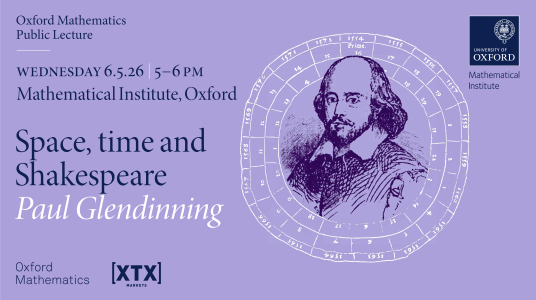 Space, time and Shakespeare - Paul Glendinning
Space, time and Shakespeare - Paul Glendinning
Wednesday 06 May 2026, 5.00-6.00 pm, L1
Shakespeare’s work provides a snapshot of how people made sense of the world around them: how they solved problems (how large is an opposing army?) and how they navigated a complex environment (does the sun rise in the east?).