

BGG sequences with weak regularity and applications
Čap, A
Hu, K
(19 Jan 2023)
A 2-complex containing Sobolev spaces of matrix fields
Gopalakrishnan, J
Hu, K
Schöberl, J
(16 Jul 2025)
Design and analysis of twisted and BGG Stokes-de Rham polytopal complexes
Di Pietro, D
Droniou, J
Hu, K
Leroy, A
(23 Jul 2025)
Seeking SOTA: Time-Series Forecasting Must Adopt Taxonomy-Specific Evaluation to Dispel Illusory Gains
Saqur, R
Bergmeir, C
Horvath, B
Schmidt, D
Rudzicz, F
Lyons, T
(16 Mar 2026)
Some comments on the Butler-Volmer equation for modeling Lithium-ion batteries
Ramos, A
Please, C
(19 Mar 2015)
Mon, 11 May 2026
14:00 -
15:00
Lecture Room 3
Smooth, globally Polyak-Łojasiewicz functions are nonlinear least-squares
Associate Professor Nicolas Boumal
(École Polytechnique Fédérale de Lausanne - EPFL)
Abstract
Associate Professor Nicolas Boumal will talk about: 'Smooth, globally Polyak-Łojasiewicz functions are nonlinear least-squares'
Polyak-Łojasiewicz (PŁ) functions abound in the literature, especially in nonconvex optimization. When they are also smooth, they become surprisingly simple---with an exotic twist. The plan is for us to discover the structure of those functions and of their sets of minimizers via gradient flow and fiber bundles.
Joint work with Christopher Criscitiello and Quentin Rebjock.
Fri, 19 Jun 2026
16:00 -
17:00
Lecture Room 3
Maths & Stats Colloquium
Prof Andrew Saxe
(UCL Gatsby Computational Neuroscience Unit)
Abstract
Professor Andrew Saxe will talk about; 'Demystifying depth: principles of learning in deep neural networks'
Deep neural networks have revolutionized artificial intelligence, yet their inner workings remain poorly understood. This talk presents mathematical analyses of the nonlinear dynamics of learning in several solvable deep network models, offering theoretical insights into the role of depth. These models reveal how learning algorithms, data structure, initialization schemes, and architectural choices interact to produce hidden representations that afford complex generalization behaviours. A recurring theme across these analyses is a neural race: competing pathways within a deep network vie to explain the data, with an implicit bias toward shared representations. These shared representations in turn shape the network’s capacity for systematic generalization, multitasking, and transfer learning. I will show how such principles manifest across diverse architectures—including feedforward and linear attention networks. Together, these results provide analytic foundations for understanding how environmental statistics, network architecture, and learning dynamics jointly structure the emergence of neural representations and behaviour.
Further Information
Bio:
Andrew Saxe is a Professor of Theoretical Neuroscience and Machine Learning at the Gatsby Computational Neuroscience Unit and Sainsbury Wellcome Centre at UCL, and a Visiting Professor at Wits University. His research seeks to unravel the computational principles governing learning in artificial and biological systems. To do so, his work draws on a range of applied mathematics in order to understand modern ‘deep’ artificial neural networks and develop theories for experimental domains in neuroscience and psychology. His work has been recognized by the Robert J. Glushko Dissertation Prize from the Cognitive Science Society, a Schmidt Science Polymath award, and the Blavatnik UK Finalist Award in Life Sciences. He is a CIFAR Fellow in the Learning in Machines & Brains program.
Problems, progress and perspectives in mathematical and computational biology
Wang, Q
Othmer, H
Maini, P
Bulletin of Mathematical Biology
volume 88
issue 5
(06 Apr 2026)
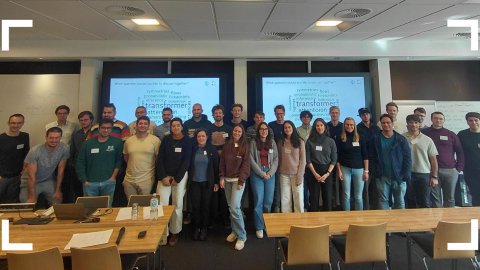
Workshop on the Mathematics of Transformers
Improved measurements of the TeV-PeV extragalactic neutrino spectrum from joint analyses of IceCube tracks and cascades
Abbasi, R
Ackermann, M
Adams, J
Agarwalla, S
Aguilar, J
Ahlers, M
Alameddine, J
Ali, S
Amin, N
Andeen, K
Arguelles, C
Ashida, Y
Athanasiadou, S
Axani, S
Babu, R
Bai, X
Baines-Holmes, J
V., A
Barwick, S
Bash, S
Basu, V
Bay, R
Beatty, J
Tjus, J
Behrens, P
Beise, J
Bellenghi, C
Benkel, B
BenZvi, S
Berley, D
Bernardini, E
Besson, D
Blaufuss, E
Bloom, L
Blot, S
Bodo, I
Bontempo, F
Motzkin, J
Meneguolo, C
Boser, S
Botner, O
Bottcher, J
Braun, J
Brinson, B
Brisson-Tsavoussis, Z
Burley, R
Butterfield, D
Campana, M
Carloni, K
Carpio, J
Chattopadhyay, S
Chau, N
Chen, Z
Chirkin, D
Choi, S
Clark, B
Coleman, A
Coleman, P
Collin, G
Borja, D
Connolly, A
Conrad, J
Corley, R
Cowen, D
De Clercq, C
DeLaunay, J
Delgado, D
Delmeulle, T
Deng, S
Desiati, P
de Vries, K
de Wasseige, G
DeYoung, T
Diaz-Velez, J
DiKerby, S
Dittmer, M
Domi, A
Draper, L
Dueser, L
Durnford, D
Dutta, K
DuVernois, M
Ehrhardt, T
Eidenschink, L
Eimer, A
Eller, P
Ellinger, E
Elsasser, D
Engel, R
Erpenbeck, H
Esmail, W
Eulig, S
Evans, J
Evenson, P
Fan, K
Fang, K
Farrag, K
Fazely, A
Fedynitch, A
Feigl, N
Finley, C
Fischer, L
Fox, D
Franckowiak, A
Fukami, S
Furst, P
Gallagher, J
Ganster, E
Garcia, A
Garcia, M
Garg, G
Genton, E
Gerhardt, L
Ghadimi, A
Glaser, C
Glusenkamp, T
Gonzalez, J
Goswami, S
Granados, A
Grant, D
Gray, S
Griffin, S
Griswold, S
Groth, K
Guevel, D
Gunther, C
Gutjahr, P
Ha, C
Haack, C
Hallgren, A
Halve, L
Halzen, F
Hamacher, L
Minh, M
Handt, M
Hanson, K
Hardin, J
Harnisch, A
Hatch, P
Haungs, A
Haussler, J
Helbing, K
Hellrung, J
Henke, B
Hennig, L
Henningsen, F
Heuermann, L
Hewett, R
Heyer, N
Hickford, S
Hidvegi, A
Hill, C
Hill, G
Hmaid, R
Hoffman, K
Hooper, D
Hori, S
Hoshina, K
Hostert, M
Hou, W
Huber, T
Hultqvist, K
Hymon, K
Ishihara, A
Iwakiri, W
Jacquart, M
Jain, S
Janik, O
Jansson, M
Jeong, M
Jin, M
Kamp, N
Kang, D
Kang, W
Kang, X
Kappes, A
Kardum, L
Karg, T
Karl, M
Karle, A
Katil, A
Kauer, M
Kelley, J
Khanal, M
Zathul, A
Kheirandish, A
Kimku, H
Kiryluk, J
Klein, C
Klein, S
Kobayashi, Y
Kochocki, A
Koirala, R
Kolanoski, H
Kontrimas, T
Kopke, L
Kopper, C
Koskinen, D
Koundal, P
Kowalski, M
Kozynets, T
Krieger, N
Krishnamoorthi, J
Krishnan, T
Kruiswijk, K
Krupczak, E
Kumar, A
Kun, E
Kurahashi, N
Lad, N
Gualda, C
Arnaud, L
Lamoureux, M
Larson, M
Lauber, F
Lazar, J
DeHolton, K
Leszczynska, A
Liao, J
Lin, C
Liu, Y
Liubarska, M
Love, C
Lu, L
Lucarelli, F
Luszczak, W
Lyu, Y
Madsen, J
Magnus, E
Makino, Y
Manao, E
Mancina, S
Mand, A
Maris, I
Marka, S
Marka, Z
Marten, L
Martinez-Soler, I
Maruyama, R
Mauro, J
Mayhew, F
McNally, F
Mead, J
Meagher, K
Mechbal, S
Medina, A
Meier, M
Merckx, Y
Merten, L
Mitchell, J
Molchany, L
Montaruli, T
Moore, R
Morii, Y
Mosbrugger, A
Moulai, M
Mousadi, D
Moyaux, E
Mukherjee, T
Naab, R
Nakos, M
Naumann, U
Necker, J
Neste, L
Neumann, M
Niederhausen, H
Nisa, M
Noda, K
Noell, A
Novikov, A
Pollmann, A
O’Dell, V
Olivas, A
Orsoe, R
Osborn, J
O’Sullivan, E
Palusova, V
Pandya, H
Parenti, A
Park, N
Parrish, V
Paudel, E
Paul, L
de los Heros, C
Pernice, T
Peterson, J
Plum, M
Ponten, A
Poojyam, V
Popovych, Y
Rodriguez, M
Pries, B
Procter-Murphy, R
Przybylski, G
Pyras, L
Raab, C
Rack-Helleis, J
Rad, N
Ravn, M
Rawlins, K
Rechav, Z
Rehman, A
Reistroffer, I
Resconi, E
Reusch, S
Rho, C
Rhode, W
Ricca, L
Riedel, B
Rifaie, A
Roberts, E
Robertson, S
Rongen, M
Rosted, A
Rott, C
Ruhe, T
Ruohan, L
Ryckbosch, D
Saffer, J
Salazar-Gallegos, D
Sampathkumar, P
Sandrock, A
Sanger-Johnson, G
Santander, M
Sarkar, S
Savelberg, J
Scarnera, M
Schaile, P
Schaufel, M
Schieler, H
Schindler, S
Schlickmann, L
Schluter, B
Schluter, F
Schmeisser, N
Schmidt, T
Schroder, F
Schumacher, L
Schwirn, S
Sclafani, S
Seckel, D
Seen, L
Seikh, M
Seunarine, S
Myhr, P
Shah, R
Shefali, S
Shimizu, N
Skrzypek, B
Snihur, R
Soedingrekso, J
Sogaard, A
Soldin, D
Soldin, P
Sommani, G
Spannfellner, C
Spiczak, G
Spiering, C
Stachurska, J
Stamatikos, M
Stanev, T
Stezelberger, T
Sturwald, T
Stuttard, T
Sullivan, G
Taboada, I
Ter-Antonyan, S
Terliuk, A
Thakuri, A
Thiesmeyer, M
Thompson, W
Thwaites, J
Tilav, S
Tollefson, K
Toscano, S
Tosi, D
Trettin, A
Upadhyay, A
Upshaw, K
Vaidyanathan, A
Valtonen-Mattila, N
Valverde, J
Vandenbroucke, J
Van Eeden, T
van Eijndhoven, N
Van Rootselaar, L
van Santen, J
Vara, J
Varsi, F
Venugopal, M
Vereecken, M
Carrasco, S
Verpoest, S
Veske, D
Vijai, A
Villarreal, J
Walck, C
Wang, A
Warrick, E
Weaver, C
Weigel, P
Weindl, A
Weldert, J
Wen, A
Wendt, C
Werthebach, J
Weyrauch, M
Whitehorn, N
Wiebusch, C
Williams, D
Witthaus, L
Wolf, M
Wrede, G
Xu, X
Yanez, J
Yao, Y
Yildizci, E
Yoshida, S
Young, R
Yu, F
Yu, S
Yuan, T
Zegarelli, A
Zhang, S
Zhang, Z
Zhelnin, P
Zilberman, P
Physical Review D
volume 113
issue 6
062002
(15 Mar 2026)