Thu, 17 May 2018

17:00 - 18:00
L1

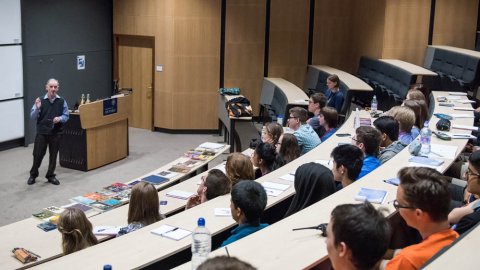
Michael Atiyah - Numbers are Serious but they are also Fun

Michael Atiyah
(University of Edinburgh)
Abstract

Archimedes, who famously jumped out of his bath shouting "Eureka", also invented $\pi$. 

Euler invented $e$ and had fun with his formula $e^{2\pi i} = 1$

The world is full of important numbers waiting to be invented. Why not have a go ?

Michael Atiyah is one of the world's foremost mathematicians and a pivotal figure in twentieth and twenty-first century mathematics. His lecture will be followed by an interview with Sir John Ball, Sedleian Professor of Natural Philosophy here in Oxford where Michael will talk about his lecture, his work and his life as a mathematician.

Please email @email to register.

The Oxford Mathematics Public Lectures are generously supported by XTX Markets.

As part of our series of research articles deliberately focusing on the rigour and intricacies of mathematics, we look at Oxford Mathematician Minyhong Kim's research in to the relationship between number theory and topology. Minhyong Kim is Professor of Number Theory here in Oxford and Fellow of Merton College.

It is probably well-known that number theory is the source of some of the oldest and most accessible questions in mathematics:

A nonparametric significance test for sampled networks
Elliott, A Leicht, E Whitmore, A Reinert, G Reed-Tsochas, F Bioinformatics volume 34 issue 1 64-71 (01 Jul 2017)
Conditional risk measures in a bipartite market structure
Kley, O Klueppelberg, C Reinert, G Scandinavian Actuarial Journal volume 2018 issue 4 328-355 (13 Jul 2017)
Mon, 27 Nov 2017

16:00 - 17:00
L4

Homogenization of the eigenvalues of the Neumann-Poincaré operator

Charles Dapogny
(Universite Grenoble-Alpes)
Abstract

In this presentation, we investigate the spectrum of the Neumann-Poincaré operator associated to a periodic distribution of small inclusions with size ε, and its asymptotic behavior as the parameter ε vanishes. Combining techniques pertaining to the fields of homogenization and potential theory, we prove that the limit spectrum is composed of the `trivial' eigenvalues 0 and 1, and of a subset which stays bounded away from 0 and 1 uniformly with respect to ε. This non trivial part is the reunion of the Bloch spectrum, accounting for the collective resonances between collections of inclusions, and of the boundary layer spectrum, associated to eigenfunctions which spend a not too small part of their energies near the boundary of the macroscopic device. These results shed new light about the homogenization of the voltage potential uε caused by a given source in a medium composed of a periodic distribution of small inclusions with an arbitrary (possibly negative) conductivity a surrounded by a dielectric medium, with unit conductivity.

Subscribe to