

Wed, 25 Oct 2017
16:00 -
17:00
C5
Trees, Lattices and Superrigidity
Elia Fioravanti
(University of Oxford)
Abstract
If $G$ is an irreducible lattice in a semisimple Lie group, every action of $G$ on a tree has a global fixed point. I will give an elementary discussion of Y. Shalom's proof of this result, focussing on the case of $SL_2(\mathbb{R}) \times SL_2(\mathbb{R})$. Emphasis will be placed on the geometric aspects of the proof and on the importance of reduced cohomology, while other representation theoretic/functional analytic tools will be relegated to a couple of black boxes.
Search for High-energy Neutrinos from Binary Neutron Star Merger GW170817 with ANTARES, IceCube, and the Pierre Auger Observatory
Albert, A
Andre, M
Anghinolfi, M
Ardid, M
Aubert, J
Aublin, J
Avgitas, T
Baret, B
Barrios-Marti, J
Basa, S
Belhorma, B
Bertin, V
Biagi, S
Bormuth, R
Bourret, S
Bouwhuis, M
Branzas, H
Bruijn, R
Brunner, J
Busto, J
Capone, A
Caramete, L
Carr, J
Celli, S
El Moursli, R
Chiarusi, T
Circella, M
Coelho, J
Coleiro, A
Coniglione, R
Costantini, H
Coyle, P
Creusot, A
Diaz, A
Deschamps, A
De Bonis, G
Distefano, C
Di Palma, I
Domi, A
Donzaud, C
Dornic, D
Drouhin, D
Eberl, T
El Bojaddaini, I
El Khayati, N
Elsaesser, D
Enzenhofer, A
Ettahiri, A
Fassi, F
Felis, I
Fusco, L
Gay, P
Giordano, V
Glotin, H
Gregoire, T
Ruiz, R
Graf, K
Hallmann, S
van Haren, H
Heijboer, A
Hello, Y
Hernandez-Rey, J
Hoessl, J
Hofestaedt, J
Illuminati, G
James, C
de Jong, M
Jongen, M
Kadler, M
Kalekin, O
Katz, U
Kiessling, D
Kouchner, A
Kreter, M
Kreykenbohm, I
Kulikovskiy, V
Lachaud, C
Lahmann, R
Lefevre, D
Leonora, E
Lotze, M
Loucatos, S
Marcelin, M
Margiotta, A
Marinelli, A
Martinez-Mora, J
Mele, R
Melis, K
Michael, T
Migliozzi, P
Moussa, A
Navas, S
Nezri, E
Organokov, M
Pavalas, G
Pellegrino, C
Perrina, C
Piattelli, P
Popa, V
Pradier, T
Quinn, L
Racca, C
Riccobene, G
Sanchez-Losa, A
Saldana, M
Salvadori, I
Samtleben, D
Sanguineti, M
Sapienza, P
Schussler, F
Sieger, C
Spurio, M
Stolarczyk, T
Taiuti, M
Tayalati, Y
Trovato, A
Turpin, D
Tonnis, C
Vallage, B
Van Elewyck, V
Versari, F
Vivolo, D
Vizzoca, A
Wilms, J
Zornoza, J
Zuniga, J
Aartsen, M
Ackermann, M
Adams, J
Aguilar, J
Ahlers, M
Ahrens, M
Al Samarai, I
Altmann, D
Andeen, K
Anderson, T
Ansseau, I
Anton, G
Arguelles, C
Auffenberg, J
Axani, S
Bagherpour, H
Bai, X
Barron, J
Barwick, S
Baum, V
Bay, R
Beatty, J
Tjus, J
Becker, K
BenZvi, S
Berley, D
Bernardini, E
Besson, D
Binder, G
Bindig, D
Blaufuss, E
Blot, S
Bohm, C
Boerner, M
Bos, F
Bose, D
Boeser, S
Botner, O
Bourbeau, E
Bourbeau, J
Bradascio, F
Braun, J
Brayeur, L
Brenzke, M
Bretz, H
Bron, S
Brostean-Kaiser, J
Burgman, A
Carver, T
Casey, J
Casier, M
Cheung, E
Chirkin, D
Christov, A
Clark, K
Classen, L
Coenders, S
Collin, G
Conrad, J
Cowen, D
Cross, R
Day, M
de Andre, J
De Clercq, C
DeLaunay, J
Dembinski, H
De Ridder, S
Desiati, P
de Vries, K
de Wasseige, G
de With, M
DeYoung, T
Diaz-Velez, J
di Lorenzo, V
Dujmovic, H
Dumm, J
Dunkman, M
Dvorak, E
Eberhardt, B
Ehrhardt, T
Eichmann, B
Eller, P
Evenson, P
Fahey, S
Fazel, A
Felde, J
Filimonov, K
Finley, C
Flis, S
Franckowiak, A
Friedman, E
Fuchs, T
Gaisser, T
Gallagher, J
Gerhardt, L
K
Giang, W
Glauch, T
Glsenkamp, T
Goldschmidt, A
Gonzalez, J
Grant, D
Griffith, Z
Haack, C
Hallgren, A
Halzen, F
Hanson, K
Hebecker, D
Heereman, D
Helbing, K
Hellauer, R
Hickford, S
Hignight, J
Hill, G
Hoffman, K
Hoffmann, R
Hokanson-Fasig, B
Hoshina, K
Huang, F
Huber, M
Hultqvist, K
Huennefeld, M
In, S
Ishihara, A
Jacobi, E
Japaridze, G
Jeong, M
Jero, K
Jones, B
Kalaczynski, P
Kang, W
Kappes, A
Karg, T
Karle, A
Kauer, M
Keivani, A
Kelley, J
Kheirandish, A
Kim, J
Kim, M
Kintscher, T
Kiryluk, J
Kittler, T
Klein, S
Kohnen, G
Koirala, R
Kolanoski, H
Kopke, L
Kopper, C
Kopper, S
Koschinsky, J
Koskinen, D
Kowalski, M
Krings, K
Kroll, M
Kruckl, G
Kunnen, J
Kunwar, S
Kurahashi, N
Kuwabara, T
Kyriacou, A
Labare, M
Lanfranchi, J
Larson, M
Lauber, F
Lesiak-Bzdak, M
Leuermann, M
Liu, Q
Lu, L
Lunemann, J
Luszczak, W
Madsen, J
Maggi, G
Mahn, K
Mancina, S
Maruyama, R
Mase, K
Maunu, R
McNally, F
Meagher, K
Medici, M
Meier, M
Menne, T
Merino, G
Meures, T
Miarecki, S
Micallef, J
Momente, G
Montaruli, T
Moore, R
Moulai, M
Nahnhauer, R
Nakarmi, P
Naumann, U
Neer, G
Niederhausen, H
Nowicki, S
Nygren, D
Pollmann, A
Olivas, A
O'Murchadha, A
Palczewski, T
Pandya, H
Pankova, D
Peiffer, P
Pepper, J
de Los Heros, C
Pieloth, D
Pinat, E
Plum, M
Pranav, D
Price, P
Przybylski, G
Raab, C
Raedel, L
Rameez, M
Rawlins, K
Rea, I
Reimann, R
Relethford, B
Relich, M
Resconi, E
Rhode, W
Richman, M
Robertson, S
Rongen, M
Rott, C
Ruhe, T
Ryckbosch, D
Rysewyk, D
Saelzer, T
Herrera, S
Sandrock, A
Sandroos, J
Santander, M
Sarkar, S
Satalecka, K
Schlunder, P
Schmidt, T
Schneider, A
Schoenen, S
Schoeneberg, S
Schumacher, L
Seckel, D
Seunarine, S
Soedingrekso, J
Soldin, D
Song, M
Spiczak, G
Spiering, C
Stachurska, J
Stamatikos, M
Stanev, T
Stasik, A
Stettner, J
Steuer, A
Stezelberger, T
Stokstad, R
Stossl, A
Strotjohann, N
Stuttard, T
Sullivan, G
Sutherland, M
Taboada, I
Tatar, J
Tenholt, F
Ter-Antonyan, S
Terliuk, A
Tesic, G
Tilav, S
Toale, P
Tobin, M
Toscano, S
Tosi, D
Tselengidou, M
Tung, C
Turcati, A
Turley, C
Ty, B
Unger, E
Usner, M
Vandenbroucke, J
Van Driessche, W
van Eijndhoven, N
Vanheule, S
van Santen, J
Vehring, M
Vogel, E
Vraeghe, M
Walck, C
Wallace, A
Wallraff, M
Wandler, F
Wandkowsky, N
Waza, A
Weaver, C
Weiss, M
Wendt, C
Werthebach, J
Westerhoff, S
Whelan, B
Wiebe, K
Wiebusch, C
Wille, L
Williams, D
Wills, L
Wolf, M
Wood, J
Wood, T
Woolsey, E
Woschnagg, K
Xu, D
Xu, X
Xu, Y
Yanez, J
Yodh, G
Yoshida, S
Yuan, T
Zoll, M
Aab, A
Abreu, P
Aglietta, M
Albuquerque, I
Albury, J
Allekotte, I
Almela, A
Alvarez Castillo, J
Alvarez-Muniz, J
Anastasi, G
Anchordoqui, L
Andrada, B
Andringa, S
Aramo, C
Arsene, N
Asorey, H
Assis, P
Avila, G
Badescu, A
Balaceanu, A
Barbato, F
Barreira Luz, R
Bellido, J
Berat, C
Bertaina, M
Bertou, X
Biermann, P
Biteau, J
Blaess, S
Blanco, A
Blazek, J
Bleve, C
Bohacova, M
Bonifazi, C
Borodai, N
Botti, A
Brack, J
Brancus, I
Bretz, T
Bridgeman, A
Briechle, F
Buchholz, P
Bueno, A
Buitink, S
Buscemi, M
Caballero-Mora, K
Caccianiga, L
Cancio, A
Canfora, F
Caruso, R
Castellina, A
Catalani, F
Cataldi, G
Cazon, L
Chavez, A
Chinellato, J
Chudoba, J
Clay, R
Cobos Cerutti, A
Colalillo, R
Coleman, A
Collica, L
Coluccia, M
Conceicao, R
Consolati, G
Contreras, F
Cooper, M
Coutu, S
Covault, C
Cronin, J
D'Amico, S
Daniel, B
Dasso, S
Daumiller, K
Dawson, B
Day, J
de Almeida, R
de Jong, S
De Mauro, G
de Mello Neto, J
De Mitri, I
de Oliveira, J
de Souza, V
Debatin, J
Deligny, O
Diaz Castro, M
Diogo, F
Dobrigkeit, C
D'Olivo, J
Dorosti, Q
dos Anjos, R
Dova, M
Dundovic, A
Ebr, J
Engel, R
Erdmann, M
Erfani, M
Escobar, C
Espadanal, J
Etchegoyen, A
Falcke, H
Farmer, J
Farrar, G
Fauth, A
Fazzini, N
Feldbusch, F
Fenu, F
Fick, B
Figueira, J
Filipcic, A
Freire, M
Fujii, T
Fuster, A
Gaior, R
Garcia, B
Gate, F
Gemmeke, H
Gherghel-Lascu, A
Ghia, P
Giaccari, U
Giammarchi, M
Giller, M
Glas, D
Glaser, C
Golup, G
Gomez Berisso, M
Gomez Vitale, P
Gonzalez, N
Gorgi, A
Gottowik, M
Grillo, A
Grubb, T
Guarino, F
Guedes, G
Halliday, R
Hampel, M
Hansen, P
Harari, D
Harrison, T
Harvey, V
Haungs, A
Hebbeker, T
Heck, D
Heimann, P
Herve, A
Hojvat, C
Holt, E
Homola, P
Horandel, J
Horvath, P
Hrabovsky, M
Huege, T
Hulsman, J
Insolia, A
Isar, P
Jandt, I
Johnsen, J
Josebachuili, M
Jurysek, J
Kaeaepae, A
Kampert, K
Keilhauer, B
Kemmerich, N
Kemp, J
Kieckhafer, R
Klages, H
Kleifges, M
Kleinfeller, J
Krause, R
Krohm, N
Kuempel, D
Mezek, G
Kunka, N
Awad, A
Lago, B
LaHurd, D
Lang, R
Lauscher, M
Legumina, R
Leigui de Oliveira, M
Letessier-Selvon, A
Lhenry-Yvon, I
Link, K
Lo Presti, D
Lopes, L
Lopez, R
Lopez Casado, A
Lorek, R
Luce, Q
Lucero, A
Malacari, M
Mallamaci, M
Mandat, D
Mantsch, P
Mariazzi, A
Maris, I
Marsella, G
Martello, D
Martinez, H
Martinez Bravo, O
Masias Meza, J
Mathes, H
Mathys, S
Matthews, J
Matthiae, G
Mayotte, E
Mazur, P
Medina, C
Medina-Tanco, G
Melo, D
Menshikov, A
Merenda, K
Michal, S
Micheletti, M
Middendorf, L
Miramonti, L
Mitrica, B
Mockler, D
Mollerach, S
Montanet, F
Morello, C
Morlino, G
Mostafa, M
Mueller, A
Mueller, G
Muller, M
Mueller, S
Mussa, R
Naranjo, I
Nellen, L
Nguyen, P
Niculescu-Oglinzanu, M
Niechciol, M
Niemietz, L
Niggemann, T
Nitz, D
Nosek, D
Novotny, V
Nozka, L
Nunez, L
Oikonomou, F
Olinto, A
Palatka, M
Pallotta, J
Papenbreer, P
Parente, G
Parra, A
Paul, T
Pech, M
Pedreira, F
Pekala, J
Pelayo, R
Pena-Rodriguez, J
Pereira, L
Perlin, M
Perrone, L
Peters, C
Petrera, S
Phuntsok, J
Pierog, T
Pimenta, M
Pirronello, V
Platino, M
Poh, J
Porowski, C
Prado, R
Privitera, P
Prouza, M
Quel, E
Querchfeld, S
Quinn, S
Ramos-Pollan, R
Rautenberg, J
Ravignani, D
Ridky, J
Riehn, F
Risse, M
Ristori, P
Rizi, V
Rodrigues de Carvalho, W
Fernandez, G
Rodriguez Rojo, J
Roncoroni, M
Roth, M
Roulet, E
Rovero, A
Ruehl, P
Saffi, S
Saftoiu, A
Salamida, F
Salazar, H
Saleh, A
Salina, G
Sanchez, F
Sanchez-Lucas, P
Santos, E
Sarazin, F
Sarmento, R
Sarmiento-Cano, C
Sato, R
Schauer, M
Scherini, V
Schieler, H
Schimp, M
Schmidt, D
Scholten, O
Schovanek, P
Schroeder, F
Schroeder, S
Schulz, A
Schumacher, J
Sciutto, S
Segreto, A
Shadkam, A
Shellard, R
Sigl, G
Silli, G
Smida, R
Snow, G
Sommers, P
Sonntag, S
Soriano, J
Squartini, R
Stanca, D
Stanic, S
Stasielak, J
Stassi, P
Stolpovskiy, M
Strafella, F
Streich, A
Suarez, F
Suarez Duran, M
Sudholz, T
Suomijarvi, T
Supanitsky, A
Supik, J
Swain, J
Szadkowski, Z
Taboada, A
Taborda, O
Timmermans, C
Todero Peixoto, C
Tomankova, L
Tome, B
Torralba Elipe, G
Travnicek, P
Trini, M
Tueros, M
Ulrich, R
Unger, M
Urban, M
Valdes Galicia, J
Valino, I
Valore, L
van Aar, G
van Bodegom, P
van den Berg, A
van Vliet, A
Varela, E
Vargas Cardenas, B
Vazquez, R
Veberic, D
Ventura, C
Vergara Quispe, I
Verzi, V
Vicha, J
Villasenor, L
Vorobiov, S
Wahlberg, H
Wainberg, O
Walz, D
Watson, A
Weber, M
Weindl, A
Wiedenski, M
Wiencke, L
Wilczynski, H
Wirtz, M
Wittkowski, D
Wundheiler, B
Yang, L
Yushkov, A
Zas, E
Zavrtanik, D
Zavrtanik, M
Zepeda, A
Zimmermann, B
Ziolkowski, M
Zong, Z
Zuccarello, F
Abbott, B
Abbott, R
Abbott, T
Acernese, F
Ackley, K
Adams, C
Adams, T
Addesso, P
Adhikari, R
Adya, V
Affeldt, C
Afrough, M
Agarwal, B
Agathos, M
Agatsuma, K
Aggarwal, N
Aguiar, O
Aiello, L
Ain, A
Ajith, P
Allen, B
Allen, G
Allocca, A
Altin, P
Amato, A
Ananyeva, A
Anderson, S
Anderson, W
Angelova, S
Antier, S
Appert, S
Arai, K
Araya, M
Areeda, J
Arnaud, N
Arun, K
Ascenzi, S
Ashton, G
Ast, M
Aston, S
Astone, P
Atallah, D
Aufmuth, P
Aulbert, C
AultONeal, K
Austin, C
Avila-Alvarez, A
Babak, S
Bacon, P
Bader, M
Bae, S
Baker, P
Baldaccini, F
Ballardin, G
Ballmer, S
Banagiri, S
Barayoga, J
Barclay, S
Barish, B
Barker, D
Barkett, K
Barone, F
Barr, B
Barsotti, L
Barsuglia, M
Barta, D
Bartlett, J
Bartos, I
Bassiri, R
Basti, A
Batch, J
Bawaj, M
Bayley, J
Bazzan, M
Becsy, B
Beer, C
Bejger, M
Belahcene, I
Bell, A
Berger, B
Bergmann, G
Bero, J
Berry, C
Bersanetti, D
Bertolini, A
Betzwieser, J
Bhagwat, S
Bhandare, R
Bilenko, I
Billingsley, G
Billman, C
Birch, J
Birney, R
Birnholtz, O
Biscans, S
Biscoveanu, S
Bisht, A
Bitossi, M
Biwer, C
Bizouard, M
Blackburn, J
Blackman, J
Blair, C
Blair, D
Blair, R
Bloemen, S
Bock, O
Bode, N
Boer, M
Bogaert, G
Bohe, A
Bondu, F
Bonilla, E
Bonnand, R
Boom, B
Bork, R
Boschi, V
Bose, S
Bossie, K
Bouffanais, Y
Bozzi, A
Bradaschia, C
Brady, P
Branchesi, M
Brau, J
Briant, T
Brillet, A
Brinkmann, M
Brisson, V
Brockill, P
Broida, J
Brooks, A
Brown, D
Brunett, S
Buchanan, C
Buikema, A
Bulik, T
Bulten, H
Buonanno, A
Buskulic, D
Buy, C
Byer, R
Cabero, M
Cadonati, L
Cagnoli, G
Cahillane, C
Bustillo, J
Callister, T
Calloni, E
Camp, J
Canepa, M
Canizares, P
Cannon, K
Cao, H
Cao, J
Capano, C
Capocasa, E
Carbognani, F
Caride, S
Carney, M
Diaz, J
Casentini, C
Caudill, S
Cavaglia, M
Cavalier, F
Cavalieri, R
Cella, G
Cepeda, C
Cerda-Duran, P
Cerretani, G
Cesarini, E
Chamberlin, S
Chan, M
Chao, S
Charlton, P
Chase, E
Chassande-Mottin, E
Chatterjee, D
Cheeseboro, B
Chen, H
Chen, X
Chen, Y
Cheng, H
Chia, H
Chincarini, A
Chiummo, A
Chmiel, T
Cho, H
Cho, M
Chow, J
Christensen, N
Chu, Q
Chua, A
Chua, S
Chung, A
Chung, S
Ciani, G
Ciolfi, R
Cirelli, C
Cirone, A
Clara, F
Clark, J
Clearwater, P
Cleva, F
Cocchieri, C
Coccia, E
Cohadon, P
Cohen, D
Colla, A
Collette, C
Cominsky, L
Jr, C
Conti, L
Cooper, S
Corban, P
Corbitt, T
Cordero-Carrion, I
Corley, K
Cornish, N
Corsi, A
Cortese, S
Costa, C
Coughlin, M
Coughlin, S
Coulon, J
Countryman, S
Couvares, P
Covas, P
Cowan, E
Coward, D
Cowart, M
Coyne, D
Coyne, R
Creighton, J
Creighton, T
Cripe, J
Crowder, S
Cullen, T
Cumming, A
Cunningham, L
Cuoco, E
Dal Canton, T
Dalya, G
Danilishin, S
D'Antonio, S
Danzmann, K
Dasgupta, A
Dattilo, V
Dave, I
Davier, M
Davis, D
Daw, E
Day, B
De, S
DeBra, D
Degallaix, J
De laurentis, M
Deleglise, S
Del Pozzo, W
Demos, N
Denker, T
Dent, T
De Pietri, R
Dergachev, V
De Rosa, R
DeRosa, R
De Rossi, C
DeSalvo, R
de Varona, O
Devenson, J
Dhurandhar, S
Diaz, M
Di Fiore, L
Di Giovanni, M
Di Girolamo, T
Di Lieto, A
Di Pace, S
Di Renzo, F
Doctor, Z
Dolique, V
Donovan, F
Dooley, K
Doravari, S
Dorrington, I
Douglas, R
Alvarez, M
Downes, T
Drago, M
Dreissigacker, C
Driggers, J
Du, Z
Ducrot, M
Dupej, P
Dwyer, S
Edo, T
Edwards, M
Effler, A
Eggenstein, H
Ehrens, P
Eichholz, J
Eikenberry, S
Eisenstein, R
Essick, R
Estevez, D
Etienne, Z
Etzel, T
Evans, M
Evans, T
Factourovich, M
Fafone, V
Fair, H
Fairhurst, S
Fan, X
Farinon, S
Farr, B
Farr, W
Fauchon-Jones, E
Favata, M
Fays, M
Fee, C
Fehrmann, H
Feicht, J
Fejer, M
Fernandez-Galiana, A
Ferrante, I
Ferreira, E
Ferrini, F
Fidecaro, F
Finstad, D
Fiori, I
Fiorucci, D
Fishbach, M
Fisher, R
Fitz-Axen, M
Flaminio, R
Fletcher, M
Fong, H
Font, J
Forsyth, P
Forsyth, S
Fournier, J
Frasca, S
Frasconi, F
Frei, Z
Freise, A
Frey, R
Frey, V
Fries, E
Fritschel, P
Frolov, V
Fulda, P
Fyffe, M
Gabbard, H
Gadre, B
Gaebel, S
Gair, J
Gammaitoni, L
Ganija, M
Gaonkar, S
Garcia-Quiros, C
Garufi, F
Gateley, B
Gaudio, S
Gaur, G
Gayathri, V
Gehrels, N
Gemme, G
Genin, E
Gennai, A
George, D
George, J
Gergely, L
Germain, V
Ghonge, S
Ghosh, A
Ghosh, S
Giaime, J
Giardina, K
Giazotto, A
Gill, K
Glover, L
Goetz, E
Goetz, R
Gomes, S
Goncharov, B
Gonzalez, G
Castro, J
Gopakumar, A
Gorodetsky, M
Gossan, S
Gosselin, M
Gouaty, R
Grado, A
Graef, C
Granata, M
Grant, A
Gras, S
Gray, C
Greco, G
Green, A
Gretarsson, E
Groot, P
Grote, H
Grunewald, S
Gruning, P
Guidi, G
Guo, X
Gupta, A
Gupta, M
Gushwa, K
Gustafson, E
Gustafson, R
Halim, O
Hall, B
Hall, E
Hamilton, E
Hammond, G
Haney, M
Hanke, M
Hanks, J
Hanna, C
Hannam, M
Hannuksela, O
Hanson, J
Hardwick, T
Harms, J
Harry, G
Harry, I
Hart, M
Haster, C
Haughian, K
Healy, J
Heidmann, A
Heintze, M
Heitmann, H
Hello, P
Hemming, G
Hendry, M
Heng, I
Hennig, J
Heptonstall, A
Heurs, M
Hild, S
Hinderer, T
Hoak, D
Hofman, D
Holt, K
Holz, D
Hopkins, P
Horst, C
Hough, J
Houston, E
Howell, E
Hreibi, A
Hu, Y
Huerta, E
Huet, D
Hughey, B
Husa, S
Huttner, S
Huynh-Dinh, T
Indik, N
Inta, R
Intini, G
Isa, H
Isac, J
Isi, M
Iyer, B
Izumi, K
Jacqmin, T
Jani, K
Jaranowski, P
Jawahar, S
Jimenez-Forteza, F
Johnson, W
Jones, D
Jones, R
Jonker, R
Ju, L
Junker, J
Kalaghatgi, C
Kalogera, V
Kamai, B
Kandhasamy, S
Kang, G
Kanner, J
Kapadia, S
Karki, S
Karvinen, K
Kasprzack, M
Katolik, M
Katsavounidis, E
Katzman, W
Kaufer, S
Kawabe, K
Kefelian, F
Keitel, D
Kemball, A
Kennedy, R
Kent, C
Key, J
Khalili, F
Khan, I
Khan, S
Khan, Z
Khazanov, E
Kijbunchoo, N
Kim, C
Kim, K
Kim, W
Kim, Y
Kimbrell, S
King, E
King, P
Kinley-Hanlon, M
Kirchhoff, R
Kissel, J
Kleybolte, L
Klimenko, S
Knowles, T
Koch, P
Koehlenbeck, S
Koley, S
Kondrashov, V
Kontos, A
Korobko, M
Korth, W
Kowalska, I
Kozak, D
Kramer, C
Kringel, V
Krishnan, B
Krolak, A
Kuehn, G
Kumar, P
Kumar, R
Kumar, S
Kuo, L
Kutynia, A
Kwang, S
Lackey, B
Lai, K
Landry, M
Lange, J
Lantz, B
Lanza, R
Lartaux-Vollard, A
Lasky, P
Laxen, M
Lazzarini, A
Lazzaro, C
Leaci, P
Leavey, S
Lee, C
Lee, H
Lee, K
Lehmann, J
Lenon, A
Leonardi, M
Leroy, N
Letendre, N
Levin, Y
Li, T
Linker, S
Littenberg, T
Liu, J
Lo, R
Lockerbie, N
London, L
Lord, J
Lorenzini, M
Loriette, V
Lormand, M
Losurdo, G
Lough, J
Lousto, C
Lovelace, G
Lueck, H
Lumaca, D
Lundgren, A
Lynch, R
Ma, Y
Macas, R
Macfoy, S
Machenschalk, B
MacInnis, M
Macleod, D
Hernandez, I
Magana-Sandoval, F
Zertuche, L
Magee, R
Majorana, E
Maksimovic, I
Man, N
Mandic, V
Mangano, V
Mansell, G
Manske, M
Mantovani, M
Marchesoni, F
Marion, F
Marka, S
Marka, Z
Markakis, C
Markosyan, A
Markowitz, A
Maros, E
Marquina, A
Martelli, F
Martellini, L
Martin, I
Martin, R
Martynov, D
Mason, K
Massera, E
Masserot, A
Massinger, T
Masso-Reid, M
Mastrogiovanni, S
Matas, A
Matichard, F
Matone, L
Mavalvala, N
Mazumder, N
McCarthy, R
McClelland, D
McCormick, S
McCuller, L
McGuire, S
McIntyre, G
McIver, J
McManus, D
McNeill, L
McRae, T
McWilliams, S
Meacher, D
Meadors, G
Mehmet, M
Meidam, J
Mejuto-Villa, E
Melatos, A
Mendell, G
Mercer, R
Merilh, E
Merzougui, M
Meshkov, S
Messenger, C
Messick, C
Metzdorff, R
Meyers, P
Miao, H
Michel, C
Middleton, H
Mikhailov, E
Milano, L
Miller, A
Miller, B
Miller, J
Millhouse, M
Milovich-Goff, M
Minazzoli, O
Minenkov, Y
Ming, J
Mishra, C
Mitra, S
Mitrofanov, V
Mitselmakher, G
Mittleman, R
Moffa, D
Moggi, A
Mogushi, K
Mohan, M
Mohapatra, S
Montani, M
Moore, C
Moraru, D
Moreno, G
Morriss, S
Mours, B
Mow-Lowry, C
Muir, A
Mukherjee, A
Mukherjee, D
Mukherjee, S
Mukund, N
Mullavey, A
Munch, J
Muniz, E
Muratore, M
Murray, P
Napier, K
Nardecchia, I
Naticchioni, L
Nayak, R
Neilson, J
Nelemans, G
Nelson, T
Nery, M
Neunzert, A
Nevin, L
Newport, J
Newton, G
Ng, K
Nguyen, T
Nichols, D
Nielsen, A
Nissanke, S
Nitz, A
Noack, A
Nocera, F
Nolting, D
North, C
Nuttall, L
Oberling, J
O'Dea, G
Ogin, G
Oh, J
Oh, S
Ohme, F
Okada, M
Oliver, M
Oppermann, P
Oram, R
O'Reilly, B
Ormiston, R
Ortega, L
O'Shaughnessy, R
Ossokine, S
Ottaway, D
Overmier, H
Owen, B
Pace, A
Page, J
Page, M
Pai, A
Pai, S
Palamos, J
Palashov, O
Palomba, C
Pal-Singh, A
Pan, H
Pang, B
Pang, P
Pankow, C
Pannarale, F
Pant, B
Paoletti, F
Paoli, A
Papa, M
Parida, A
Parker, W
Pascucci, D
Pasqualetti, A
Passaquieti, R
Passuello, D
Patil, M
Patricelli, B
Pearlstone, B
Pedraza, M
Pedurand, R
Pekowsky, L
Pele, A
Penn, S
Perez, C
Perreca, A
Perri, L
Pfeiffer, H
Phelps, M
Piccinni, O
Pichot, M
Piergiovanni, F
Pierro, V
Pillant, G
Pinard, L
Pinto, I
Pirello, M
Pitkin, M
Poe, M
Poggiani, R
Popolizio, P
Porter, E
Post, A
Powell, J
Prasad, J
Pratt, J
Pratten, G
Predoi, V
Prestegard, T
Prijatelj, M
Principe, M
Privitera, S
Prodi, G
Prokhorov, L
Puncken, O
Punturo, M
Puppo, P
Puerrer, M
Qi, H
Quetschke, V
Quintero, E
Quitzow-James, R
Raab, F
Rabeling, D
Radkins, H
Raffai, P
Raja, S
Rajan, C
Rajbhandari, B
Rakhmanov, M
Ramirez, K
Ramos-Buades, A
Rapagnani, P
Raymond, V
Razzano, M
Read, J
Regimbau, T
Rei, L
Reid, S
Reitze, D
Ren, W
Reyes, S
Ricci, F
Ricker, P
Rieger, S
Riles, K
Rizzo, M
Robertson, N
Robie, R
Robinet, F
Rocchi, A
Rolland, L
Rollins, J
Roma, V
Romano, R
Romel, C
Romie, J
Rosinska, D
Ross, M
Rowan, S
Ruediger, A
Ruggi, P
Rutins, G
Ryan, K
Sachdev, S
Sadecki, T
Sadeghian, L
Sakellariadou, M
Salconi, L
Saleem, M
Salemi, F
Samajdar, A
Sammut, L
Sampson, L
Sanchez, E
Sanchez, L
Sanchis-Gual, N
Sandberg, V
Sanders, J
Sassolas, B
Saulson, P
Sauter, O
Savage, R
Sawadsky, A
Schale, P
Scheel, M
Scheuer, J
Schmidt, J
Schmidt, P
Schnabel, R
Schofield, R
Schoenbeck, A
Schreiber, E
Schuette, D
Schulte, B
Schutz, B
Schwalbe, S
Scott, J
Scott, S
Seidel, E
Sellers, D
Sengupta, A
Sentenac, D
Sequino, V
Sergeev, A
Shaddock, D
Shaffer, T
Shah, A
Shahriar, M
Shaner, M
Shao, L
Shapiro, B
Shawhan, P
Sheperd, A
Shoemaker, D
Siellez, K
Siemens, X
Sieniawska, M
Sigg, D
Silva, A
Singer, L
Singh, A
Singhal, A
Sintes, A
Slagmolen, B
Smith, B
Smith, J
Smith, R
Somala, S
Son, E
Sonnenberg, J
Sorazu, B
Sorrentino, F
Souradeep, T
Spencer, A
Srivastava, A
Staats, K
Staley, A
Steinke, M
Steinlechner, J
Steinlechner, S
Steinmeyer, D
Stevenson, S
Stone, R
Stops, D
Strain, K
Stratta, G
Strigin, S
Strunk, A
Sturani, R
Stuver, A
Summerscales, T
Sun, L
Sunil, S
Suresh, J
Sutton, P
Swinkels, B
Szczepanczyk, M
Tacca, M
Tait, S
Talbot, C
Talukder, D
Tanner, D
Tapai, M
Taracchini, A
Tasson, J
Taylor, J
Taylor, R
Tewari, S
Theeg, T
Thies, F
Thomas, E
Thomas, M
Thomas, P
Thorne, K
Thrane, E
Tiwari, S
Tiwari, V
Tokmakov, K
Toland, K
Tonelli, M
Tornasi, Z
Torres-Forne, A
Torrie, C
Toyra, D
Travasso, F
Traylor, G
Trinastic, J
Tringali, M
Trozzo, L
Tsang, K
Tse, M
Tso, R
Tsukada, L
Tsuna, D
Tuyenbayev, D
Ueno, K
Ugolini, D
Unnikrishnan, C
Urban, A
Usman, S
Vahlbruch, H
Vajente, G
Valdes, G
van Bakel, N
van Beuzekom, M
van den Brand, J
Van Den Broeck, C
Vander-Hyde, D
van der Schaaf, L
van Heijningen, J
van Veggel, A
Vardaro, M
Varma, V
Vass, S
Vasuth, M
Vecchio, A
Vedovato, G
Veitch, J
Veitch, P
Venkateswara, K
Venugopalan, G
Verkindt, D
Vetrano, F
Vicere, A
Viets, A
Vinciguerra, S
Vine, D
Vinet, J
Vitale, S
Vo, T
Vocca, H
Vorvick, C
Vyatchanin, S
Wade, A
Wade, L
Wade, M
Walet, R
Walker, M
Wallace, L
Walsh, S
Wang, G
Wang, H
Wang, J
Wang, W
Wang, Y
Ward, R
Warner, J
Was, M
Watchi, J
Weaver, B
Wei, L
Weinert, M
Weinstein, A
Weiss, R
Wen, L
Wessel, E
Wessels, P
Westerweck, J
Westphal, T
Wette, K
Whelan, J
Whiting, B
Whittle, C
Wilken, D
Williams, R
Williamson, A
Willis, J
Willke, B
Wimmer, M
Winkler, W
Wipf, C
Wittel, H
Woan, G
Woehler, J
Wofford, J
Wong, K
Worden, J
Wright, J
Wu, D
Wysocki, D
Xiao, S
Yamamoto, H
Yancey, C
Yap, M
Yazback, M
Yu, H
Yvert, M
Zadrozny, A
Zanolin, M
Zelenova, T
Zendri, J
Zevin, M
Zhang, L
Zhang, M
Zhang, T
Zhang, Y
Zhao, C
Zhou, M
Zhou, Z
Zhu, S
Zhu, X
Zucker, M
Zweizig, J
Collaboration, A
Collaboration, I
Collaboration, P
Virgo, L
Astrophysical Journal Letters
volume 850
issue 2
(29 Nov 2017)
http://gateway.webofknowledge.com/gateway/Gateway.cgi?GWVersion=2&SrcApp=PARTNER_APP&SrcAuth=LinksAMR&KeyUT=WOS:000417541800010&DestLinkType=FullRecord&DestApp=ALL_WOS&UsrCustomerID=4fd6f7d59a501f9b8bac2be37914c43e
Compound Poisson approximation of subgraph counts in stochastic block
models with multiple edges
Coulson, M
Gaunt, R
Reinert, G
Journal of Applied Probability
http://arxiv.org/abs/1710.06341v1
models with multiple edges
Wed, 18 Oct 2017
11:00 -
12:30
N3.12
Penrose Tilings: a light introduction
Kieran Calvert
Abstract
This talk will hopefully highlight the general framework in which Penrose tilings are proved to be aperiodic and in fact a tiling.
Wed, 11 Oct 2017
11:00 -
12:30
N3.12
Game, Set and Bound!
Adam Keilthy
(Oxford University)
Abstract
In the game 'Set', players compete to pick out groups of three cards sharing common attributes. But how many cards must be dealt before such a group must appear?
This is an example of a "cap set problem", a problem in Ramsey theory: how big can a set of objects get before some form of order appears? We will translate the cap set problem into a problem of geometry over finite fields, discussing the current best upper bounds and running through an elementary proof. We will also (very) briefly discuss one or two implications of the cap set problem over F_3 to other questions in Ramsey theory and computational complexity
Tue, 31 Oct 2017
14:30 -
15:00
L5
Error bounds for monotone schemes for parabolic Hamilton-Jacobi-Bellman equations in bounded domains
Athena Picarelli
(Imperial College)
Abstract
We provide the rate of convergence of general monotone numerical schemes for parabolic Hamilton-Jacobi-Bellman equations in bounded domains with Dirichlet boundary conditions. The so-called "shaking coefficients" technique introduced by Krylov is used. This technique is based on a perturbation of the dynamics followed by a regularization step by convolution. When restricting the equation to a domain, the perturbed problem may not satisfy such a restriction, so that a special treatment near the boundary is necessary.

Oxford Mathematician Dominic Vella has won one of this year's prestigious Philip Leverhulme Prizes. The award recognises the achievement of outstanding researchers whose work has already attracted international recognition and whose future career is exceptionally promising.
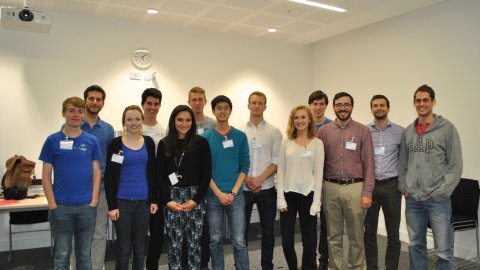
This page has details of the research projects being undertaken by InFoMM Cohort Two.
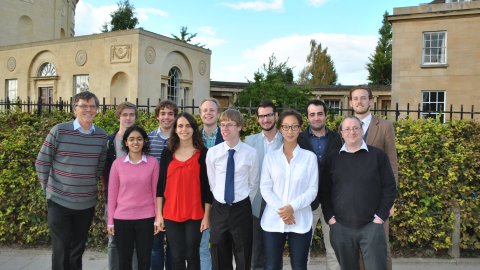
This page has details of the research projects being undertaken by InFoMM Cohort One.