

Mon, 05 Oct 2026

14:00 - 15:00
Lecture Room 3

Learning PDE-based models from data: An analysis-driven perspective on identifiability, consistency, and interpretability

Mr Erion Morina
(University of Graz, Austria)
Abstract

Erion Morina is going to talk about: 'Learning PDE-based models from data: An analysis-driven perspective on identifiability, consistency, and interpretability'


Learning governing equations from data is a central problem in scientific machine learning. Given noisy and incomplete observations of a physical process, the goal is to recover the underlying law. This is often approached by fitting a neural network or a dictionary of candidate terms to the observed dynamics. A good fit, however, does not determine identifiability of the law, its approximability by what is computed, physical consistency, or interpretability as a formula. These depend largely on how the learning problem is posed.

This talk formulates the learning task as a regularized inverse problem in function space and studies how these properties can be established. Over a parameterized class of candidate laws, one minimizes a model residual, a data misfit, and a regularizer, with the class and the regularizer as the design choices. With a sufficiently expressive class and suitable regularization, one obtains a regularization-based notion of identifiability, under which the regularization-minimizing law consistent with the data is unique. As the approximation scale grows and the regularization parameters are chosen accordingly, minimizers of the parameterized problem converge to that law. For classes carrying the structural constraints of the underlying physical model, the learned models are physically consistent and well-posed by construction at every finite approximation scale. For symbolic networks built from rational building blocks, the recovered law is a readable formula. The emphasis of this talk is analytical, and first numerical experiments illustrate the recovery in practice. 

Overall, the results show that identifiability, consistency, and interpretability are not competing objectives, but can be unified in one analysis-driven framework.

Further Information

Bio: 
Erion Morina is a postdoctoral researcher at the University of Graz. He defended his PhD thesis in July 2026 under the supervision of Professor Martin Holler. His research focuses on scientific machine learning and inverse problems, with particular interests in differential equation-based model learning, neural network approximation theory, and parameter identification in medical applications.
Thu, 29 Oct 2026
16:00
L4

TBC

Tim Santens
(University of Cambridge (DPMMS))
Mon, 19 Oct 2026

14:00 - 15:00
Lecture Room 3

The Price of Learning

Dr Ian Osband
(Google DeepMind London)
Abstract

Ian Osband from DeepMind is going to talk about: 'The Price of Learning'

Policy gradient sits at the heart of modern RL, including LLM post-training. Yet on image classification, where the gradient of accuracy is exact, it loses to cross-entropy, even on accuracy. Our explanation is that learning is a sequential resource allocation problem. Data, compute and capacity are scarce, and each update sets where the next one starts. Policy gradient ignores this and spends greedily. This talk presents simple methods that price learning, and shows how they improve robustness, compute efficiency and accuracy.


Further Information

Bio:
Ian Osband leads the Science of Post-Training team at Google DeepMind. Before that he spent two years at OpenAI working on post-training for ChatGPT and reasoning models. He did his PhD at Stanford and studied maths at New College, Oxford.

Mon, 30 Nov 2026

15:30 - 16:30
L3

TBA

Kay Giesecke
(University of Potsdam)
Abstract

TBA

Thu, 15 Oct 2026
17:00
Lecture Room 1

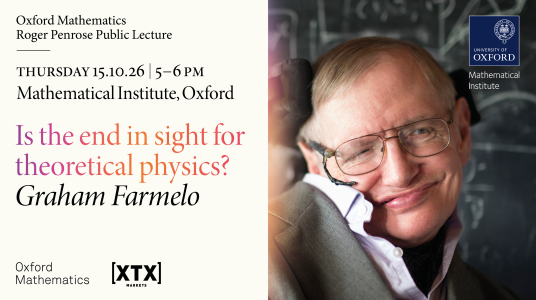
Is the End in Sight for Theoretical Physics? - Graham Farmelo

Graham Farmelo
Further Information

Graham Farmelo's authorised biography of Stephen Hawking will be published in late September. The title of this talk is the same as the one that Hawking chose for his Lucasian Inaugural Lecture in April 1980. Graham will look at the genesis of his presentation, the splash it made and how views on the subject changed in later decades. With the benefit of these reflections, he will hazard a present-day answer to Hawking’s provocative question.

Graham Farmelo is a biographer and science writer. He has written an acclaimed biography of Paul Dirac as well as his biography of Stephen Hawking.

Please email @email to register to attend in person.

The lecture will be broadcast on the Oxford Mathematics YouTube Channel on Thursday 5 November at 5-6 pm and any time after (no need to register for the online version).

The Oxford Mathematics Public Lectures are generously supported by XTX Markets.

Incorporating multiscale mechanics in lithium-ion battery models
Giudici, A Galvis, A Sahu, S Timms, R Please, C Chapman, J Foster, J (20 Aug 2026)
Self-organizing Chimera States in Adaptive Networks
Augustsson, F Cestnik, R Wolfrum, M Bick, C Yanchuk, S Martens, E (20 Aug 2026)
A transform approach to the supercooled Stefan problem
Blore, T Hambly, B Electronic Communications in Probability volume 31 (16 Sep 2026) doi:10.1214/26-ECP814
A likelihood-based framework for simultaneously learning both noise and growth dynamics using biologically-informed neural networks
Crossley, R Baker, R Bulletin of Mathematical Biology
Multilevel lattice-based kernel approximation for elliptic PDEs with random coefficients
Gilbert, A Giles, M Kuo, F Sloan, I Srikumar, A Numerische Mathematik
Subscribe to