Tue, 04 Feb 2020
16:00
C1

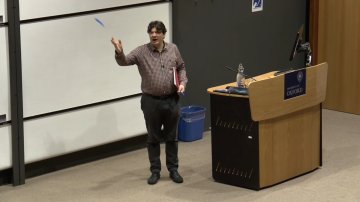
Lipschitz spaces from the semigroup language point of view

Marta de Leon Contreaas
(University of Reading)
Abstract

 Lipschitz (or H\"older) spaces $C^\delta, \, k< \delta <k+1$, $k\in\mathbb{N}_0$, are the set of functions that are more regular than the $\mathcal{C}^k$ functions and less regular than the $\mathcal{C}^{k+1}$ functions. The classical definitions of H\"older classes involve  pointwise conditions for the functions and their derivatives.  This implies that to prove   regularity results for an operator among these spaces  we need its pointwise expression.  In many cases this can be a rather involved formula, see for example the expression of $(-\Delta)^\sigma$  in (Stinga, Torrea, Regularity Theory for the fractional harmonic oscilator, J. Funct. Anal., 2011.)

In  the 60's of last century, Stein and Taibleson, characterized bounded H\"older functions via some integral estimates of the Poisson semigroup, $e^{-y\sqrt{-\Delta}},$ and of  the Gauss semigroup, $e^{\tau{\Delta}}$. These kind of semigroup descriptions allow to obtain regularity results for fractional operators in these spaces in a more direct way.

 In this talk we shall see that we can characterize H\"older spaces adapted to other differential operators $\mathcal{L}$ by means of semigroups and that these characterizations will allow us to prove the boundedness of some fractional operators, such as $\mathcal{L}^{\pm \beta}$, Riesz transforms or Bessel potentials, avoiding the long, tedious and cumbersome computations that are needed when the pointwise expressions are handled.
Tue, 14 Jan 2020
16:00
C3

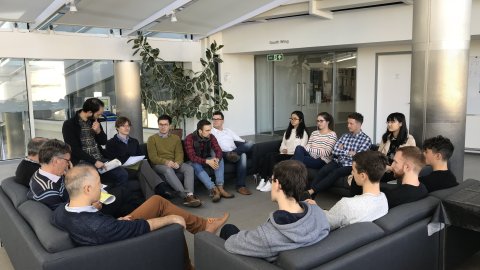
Structure theory for groupoid C*-algebras

Christian Bonicke
(University of Glasgow)
Abstract

C*-algebras constructed from topological groupoids allow us to study many interesting and a priori very different constructions
of C*-algebras in a common framework. Moreover, they are general enough to appear intrinsically in the theory. In particular, it was recently shown
by Xin Li that all C*-algebras falling within the scope of the classification program admit (twisted) groupoid models.
In this talk I will give a gentle introduction to this class of C*-algebras and discuss some of their structural properties, which appear in connection
with the classification program.
 

Wed, 15 Jan 2020

14:00 - 15:00
L3

Curve counting via stable objects in derived categories of Calabi-Yau 4-folds

Yalong Cao
(IPMU Tokyo)
Further Information

In a joint work with Davesh Maulik and Yukinobu Toda, we proposed a conjectural Gopakumar-Vafa type formula for the generating series of stable pair invariants on Calabi-Yau 4-folds. In this talk, I will present the recent joint work with Yukinobu Toda on how to give an interpretation of the above GV type formula in terms of wall-crossing phenomena in the derived category of coherent sheaves. 

Tue, 26 Nov 2019

14:00 - 15:00
L6

Partial Associativity in Latin Squares

Jason Long
(University of Oxford)
Further Information

Latin squares arise from the multiplication tables of groups, but the converse is not true in general. Given a Latin square A, we can define a group operation giving A as its multiplication table only when A satisfies a suitable associativity constraint. This observation leads to a natural question concerning the '1%' version: if A is only partially associative, can we still obtain something resembling a group structure? I will talk about some joint work with Tim Gowers on this question.

Oxford Mathematics London Public Lecture: Timothy Gowers - Productive generalization: one reason we will never run out of interesting mathematical questions

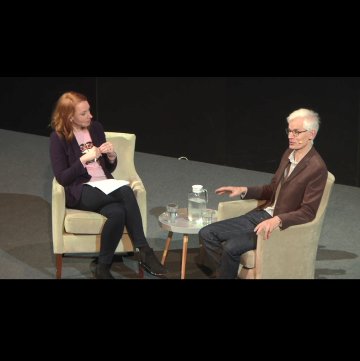
In our Oxford Mathematics London Public Lecture held at the Science Museum, Fields Medallist Tim Gowers uses the principle of generalization to show how mathematics progresses in its relentless pursuit of problems.

After the lecture in a fascinating Q&A with Hannah Fry, Tim discusses how he approaches problems, both mathematical and personal.

Our latest online student lecture is the first in the Quantum Theory course for Second Year Students. Fernando Alday reflects on the breakdown of the deterministic world and describes some of the experiments that defined the new Quantum Reality.

This is the sixth lecture in our series of Oxford Mathematics Student Lectures. The lectures aim to throw a light on the student experience and how we teach. All lectures are followed by tutorials where pairs of students spend an hour with their tutor to go through the lectures and accompanying work sheets.

Mon, 10 Feb 2020
14:15
L4

Morse theory on singular spaces

Graeme Wilkin
(York University)
Abstract

Morse theory has a long history with many spectacular applications in different areas of mathematics. In this talk I will explain an extension of the main theorem of Morse theory that works for a large class of functions on singular spaces. The main example to keep in mind is that of moment maps on varieties, and I will present some applications to the topology of symplectic quotients of singular spaces.
 

Subscribe to