

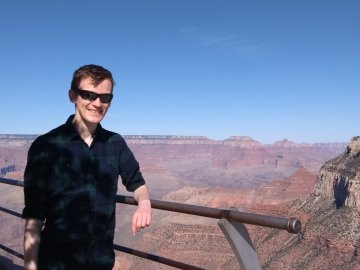
Oxford Mathematician Matthew Butler has been awarded the biennial Lighthill-Thwaites Prize for 2019. The prize is awarded by the Institute of Mathematics and its Applications to researchers who have spent no more than five years in full-time study or work since completing their undergraduate degrees.
Wed, 08 May 2019
11:00
11:00
N3.12
Completing Kronecker-Weber (via completing the rationals)
Jay Swar
(University of Oxford)
Abstract
KW states that every finite abelian extension of the rationals is contained in a cyclotomic extension. In a previous talk, this was reduced to considering cyclic extensions of the local fields Q_p of prime power order l^r. When l\neq p, general theory is sufficient, however for l=p, more specific (although not necessarily more abstruse) descriptions become necessary.
I will focus on the simple structure of Q_p's extensions to obstruct the remaining obstructions to KW (and hopefully provoke some interest in local fields in those less familiar). Time-permitting, I will talk about this theorem in the context of class field theory and/or Hilbert's 12th problem.
Thu, 16 May 2019
11:30
11:30
C4
An Imaginary Ax-Kochen-Ershov principle
Silvain Rideau
(CNRS / Institut de Mathématiques de Jussieu-Paris Rive Gauche)
Abstract
In the spirit of the Ax-Kochen-Ershov principle, one could conjecture that the imaginaries in equicharacteristic zero Henselian fields can be entirely classified in terms of the Haskell-Hrushovski-Macpherson geometric imaginaries, residue field imaginaries and value group imaginaries. However, the situation is more complicated than that. My goal in this talk will be to present what we believe to be an optimal conjecture and give elements of a proof.
Further Information
(work in progress with Martin Hils)
Thu, 16 May 2019
16:00 -
17:00
L6
A quantitative bound in the nonlinear Roth theorem
Sean Prendiville
(Manchester)
Abstract
We discuss a nonlinear variant of Roth’s theorem on the existence of three-term progressions in dense sets of integers, focusing on an effective version of such a result. This is joint work with Sarah Peluse.
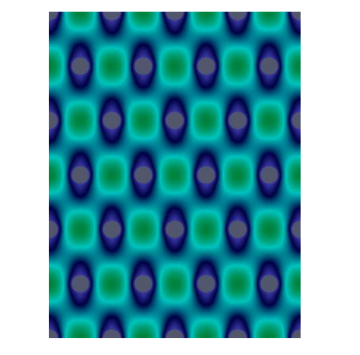
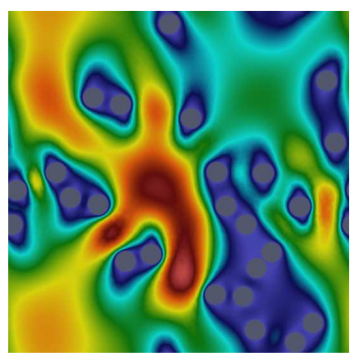
Oxford Mathematician Ian Griffiths talks about his work with colleagues Galina Printsypar and Maria Bruna on modelling the most efficient filters for uses as diverse as blood purification and domestic vacuum cleaners.
Thu, 09 May 2019
16:00 -
17:00
L6
Prime number models, large gaps, prime tuples and the square-root sieve.
Kevin Ford
(Illinois at Urbana-Champaign)
Abstract
We introduce a new probabilistic model for primes, which we believe is a better predictor for large gaps than the models of Cramer and Granville. We also make strong connections between our model, prime k-tuple counts, large gaps and the "square-root sieve". In particular, our model makes a prediction about large prime gaps that may contradict the models of Cramer and Granville, depending on the tightness of a certain sieve estimate. This is joint work with Bill Banks and Terence Tao.
Thu, 30 May 2019
16:00 -
17:00
L6
Fourier expansions at cusps and the Manin constant of elliptic curves
Michalis Neururer
(TU Darmstadt)
Abstract
I will discuss the arithmetic significance of Fourier expansions of modular forms at cusps. I will talk about joint work with F. Brunault, where we determine the number field generated by Fourier coefficients of newforms at a cusp. Then I will discuss joint work with A. Saha and K. Česnavičius where we find denominator bounds for Fourier expansions at cusps and apply these bounds to a conjecture on the Manin constants of elliptic curves.
Tue, 07 May 2019
14:30 -
15:00
L5
Fireshape, a look under the hood
Alberto Paganini
(Oxford)
Abstract
Fireshape is a shape optimization library based on finite elements. In this talk I will describe how Florian Wechsung and I developed Fireshape and will share my reflections on lessons learned through the process.
Thu, 06 Jun 2019
16:00
16:00
C4
Equivariant Topological Quantum Field Theories
Thomas Wasserman
(University of Copenhagen)
Abstract
Topological quantum field theories (TQFTs) are an extensively studied scheme for constructing invariants of manifolds, inspired by physics. In this talk, we will discuss a particular flavour of TQFT, where we equip our manifolds with principal bundles for some finite group. After introducing TQFTs and this particular flavour, I will discuss games one can play with these TQFTs, and a possible strategy for classifying equivariant TQFTs in three dimensions.
Thu, 13 Jun 2019
16:00
16:00
C4
The signature obstruction to finding characteristic classes for manifold bundles
Jan Steinebrunner
(Oxford University)
Abstract
A cohomology class on the diffeomorphism group Diff(M) of a manifold M
can be thought of as a characteristic class for smooth M-bundles.
I will survey a technique for producing examples of such classes,
and then explain how the signature (of 4-manifolds) provides an
obstruction to this technique in dimension 3.
I will define Miller-Morita-Mumford classes and explain how we can
think of them as coming from classes on the cobordism category.
Madsen and Weiss showed that for a surface S of genus g all cohomology
classes
of the mapping class group MCG(S) (of degree < 2(g-2)/3) are MMM-classes.
This technique has been successfully ported to higher even dimensions d= 2n,
but it cannot possibly work in odd dimensions:
a theorem of Ebert says that for d=3 all MMM-classes are trivial.
In the second part of my talk I will sketch a new proof of (a part of)
Ebert's theorem.
I first recall the definition of the signature sign(W) of a 4 manifold W,
and some of its properties, such as additivity with respect to gluing.
Using the signature and an idea from the world of 1-2-3-TQFTs,
I then go on to define a 'central extension' of the three dimensional
cobordism category.
This central extension corresponds to a 2-cocycle on the 3d cobordism
category,
and we will see that the construction implies that the associated MMM-class
has to vanish on all 3-dimensional manifold bundles.