

On p -refined Friedberg–Jacquet integrals and the classical symplectic locus in the GL 2 n eigenvariety
Barrera Salazar, D
Graham, A
Williams, C
Research in Number Theory
volume 11
issue 2
(25 Apr 2025)
Tue, 29 Apr 2025
15:30
15:30
L4
On the birational geometry of algebraically integrable foliations
Paolo Cascini
(Imperial College London)
Abstract
I will review recent progress on extending the Minimal Model Program to algebraically integrable foliations, focusing on applications such as the canonical bundle formula and recent results toward the boundedness of Fano foliations.
Local character expansions and asymptotic cones over finite fields
Ciubotaru, D
Okada, E
Proceedings of the London Mathematical Society
volume 130
issue 5
(01 May 2025)
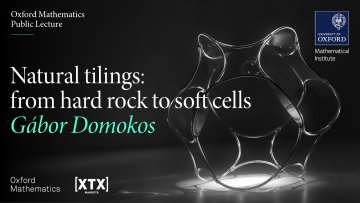
In this Oxford Mathematics Public Lecture Gábor Domokos uses the geometric theory of tilings to describe natural patterns ranging from nanoscale to planetary scale, appearing in physics, biology, and geology and will introduce a new class of shapes called soft cells, which appear in both living and non-living nature.
Thu, 19 Jun 2025
12:00 -
12:30
L4
Optimal random sampling for approximation with non-orthogonal bases
Astrid Herremans
(KU Leuven)
Abstract
Recent developments in optimal random sampling for least squares approximations have led to the identification of a (near-)optimal sampling distribution. This distribution can easily be evaluated given an orthonormal basis for the approximation space. However, many computational problems in science and engineering naturally yield building blocks that enable accurate approximation but do not form an orthonormal basis. In the first part of the talk, we will explore how numerical rounding errors affect the approximation error and the optimal sampling distribution when approximating with non-orthogonal bases. In the second part, we will demonstrate how this distribution can be computed without the need to orthogonalize the basis. This is joint work with Daan Huybrechs and Ben Adcock.
Thu, 12 Jun 2025
12:00 -
12:30
L4
Cubic-quartic regularization models for solving polynomial subproblems in third-order tensor methods
Kate Zhu
(Mathematical Institute (University of Oxford))
Abstract
High-order tensor methods for solving both convex and nonconvex optimization problems have recently generated significant research interest, due in part to the natural way in which higher derivatives can be incorporated into adaptive regularization frameworks, leading to algorithms with optimal global rates of convergence and local rates that are faster than Newton's method. On each iteration, to find the next solution approximation, these methods require the unconstrained local minimization of a (potentially nonconvex) multivariate polynomial of degree higher than two, constructed using third-order (or higher) derivative information, and regularized by an appropriate power of the change in the iterates. Developing efficient techniques for the solution of such subproblems is currently, an ongoing topic of research, and this talk addresses this question for the case of the third-order tensor subproblem. In particular, we propose the CQR algorithmic framework, for minimizing a nonconvex Cubic multivariate polynomial with Quartic Regularisation, by sequentially minimizing a sequence of local quadratic models that also incorporate both simple cubic and quartic terms.
The role of the cubic term is to crudely approximate local tensor information, while the quartic one provides model regularization and controls progress. We provide necessary and sufficient optimality conditions that fully characterise the global minimizers of these cubic-quartic models. We then turn these conditions into secular equations that can be solved using nonlinear eigenvalue techniques. We show, using our optimality characterisations, that a CQR algorithmic variant has the optimal-order evaluation complexity of $O(\epsilon^{-3/2})$ when applied to minimizing our quartically-regularised cubic subproblem, which can be further improved in special cases. We propose practical CQR variants that judiciously use local tensor information to construct the local cubic-quartic models. We test these variants numerically and observe them to be competitive with ARC and other subproblem solvers on typical instances and even superior on ill-conditioned subproblems with special structure.
Thu, 05 Jun 2025
12:00 -
12:30
L4
Reducing acquisition time and radiation damage: data-driven subsampling for spectromicroscopy
Lorenzo Lazzarino
(Mathematical Institute (University of Oxford))
Abstract
Spectro-microscopy is an experimental technique with great potential to science challenges such as the observation of changes over time in energy materials or environmental samples and investigations of the chemical state in biological samples. However, its application is often limited by factors like long acquisition times and radiation damage. We present two measurement strategies that significantly reduce experiment times and applied radiation doses. These strategies involve acquiring only a small subset of all possible measurements and then completing the full data matrix from the sampled measurements. The methods are data-driven, utilizing spectral and spatial importance subsampling distributions to select the most informative measurements. Specifically, we use data-driven leverage scores and adaptive randomized pivoting techniques. We explore raster importance sampling combined with the LoopASD completion algorithm, as well as CUR-based sampling where the CUR approximation also serves as the completion method. Additionally, we propose ideas to make the CUR-based approach adaptive. As a result, capturing as little as 4–6% of the measurements is sufficient to recover the same information as a conventional full scan.
Thu, 08 May 2025
16:00
16:00
Lecture Room 4, Mathematical Institute
Uniform Equidistribution of Quadratic Polynomials via Averages of $\mathrm{SL}_2(\mathbb{R})$ Automorphic Kernels
Lasse Grimmelt
(University of Oxford)
Abstract
In recent joint work with J. Merikoski, we developed a new way to employ $\mathrm{SL}_2(\mathbb{R})$ spectral methods to number-theoretical counting problems, entirely avoiding Kloosterman sums and the Kuznetsov formula. The main result is an asymptotic formula for an automorphic kernel, with error terms controlled by two new kernels. This framework proves particularly effective when averaging over the level and leads to improvements in equidistribution results involving quadratic polynomials. In particular, we show that the largest prime divisor of $n^2 + h$ is infinitely often larger than $n^{1.312}$, recovering earlier results that had relied on the Selberg eigenvalue conjecture. Furthermore, we obtain, for the first time in this setting, strong uniformity in the parameter $h$.
Thu, 29 May 2025
12:00 -
12:30
L4
Low-rank approximation of parameter-dependent matrices via CUR decomposition
Taejun Park
(Mathematical Institute (University of Oxford))
Abstract
Low-rank approximation of parameter-dependent matrices A(t) is an important task in the computational sciences, with applications in areas such as dynamical systems and the compression of series of images. In this talk, we introduce AdaCUR, an efficient randomised algorithm for computing low-rank approximations of parameter-dependent matrices using the CUR decomposition. The key idea of our approach is the ability to reuse column and row indices for nearby parameter values, improving efficiency. The resulting algorithm is rank-adaptive, provides error control, and has complexity that compares favourably with existing methods. This is joint work with Yuji Nakatsukasa.
Thu, 22 May 2025
12:00 -
12:30
L4
Control of multistable structures with shape optimization
Arselane Hadj Slimane
(ENS Paris-Saclay)
Abstract
Shape optimization is a rich field at the intersection of analysis, optimization, and engineering. It seeks to determine the optimal geometry of structures to minimize performance objectives, subject to physical constraints—often modeled by Partial Differential Equations (PDEs). Traditional approaches commonly assume that these constraints admit a unique solution for each candidate shape, implying a single-valued shape-to-solution map. However, many real-world structures exhibit multistability, where multiple stable configurations exist under identical physical conditions.
This research departs from the single-solution paradigm by investigating shape optimization in the presence of multiple solutions to the same PDE constraints. Focusing on a neo-Hookean hyperelastic model, we formulate an optimization problem aimed at controlling the energy jump between distinct solutions. Drawing on bifurcation theory, we develop a theoretical framework that interprets these solutions as continuous branches parameterized by shape variations. Building on this foundation, we implement a numerical optimization strategy and present numerical results that demonstrate the effectiveness of our approach.