

Abnormal morphology biases haematocrit distribution in tumour vasculature and contributes to heterogeneity in tissue oxygenation
Bernabeu Llinares, M
Kory, J
Grogan, J
Markelc, B
Beardo, A
d'Avezac, M
Enjalbert, R
Kaeppler, J
Daly, N
Hetherington, J
Kruger, T
Maini, P
Pitt-Francis, J
Muschel, R
Alarcon, T
Byrne, H
Proceedings of the National Academy of Sciences
volume 117
issue 45
27811-27819
(27 Oct 2020)
doi:10.1073/pnas.2007770117
The spatial Muller's ratchet: Surfing of deleterious mutations during range expansion.
Foutel-Rodier, F
Etheridge, A
Theoretical population biology
volume 135
19-31
(17 Oct 2020)
doi:10.1016/j.tpb.2020.07.002
Multiscale Topology Characterises Dynamic Tumour Vascular Networks
Stolz, B
Kaeppler, J
Markelc, B
Mech, F
Lipsmeier, F
Muschel, R
Byrne, H
Harrington, H
Science Advances
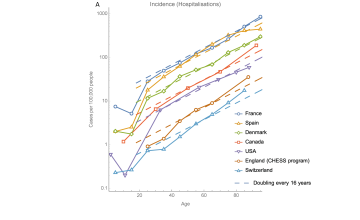
One of the great puzzles of the current COVID-19 crisis is the observation that older people have a much higher risk of becoming seriously ill. While it is usually commonly accepted that the immune system fails progressively with age, the actual mechanism leading to this effect was not fully understood. In a recent work, Sam Palmer from Oxford Mathematics and his colleagues in Cambridge have proposed a simple and elegant solution to this puzzle.
ABC(SMC) 2: simultaneous inference and model checking of chemical reaction networks
Molyneux, G
Abate, A
Computational Methods in Systems Biology
255-279
(29 Sep 2020)
doi:10.1007/978-3-030-60327-4_14
Magmatic channelization by reactive and shear-driven instabilities at mid-ocean ridges: a combined analysis
Rees Jones, D
Zhang, H
Katz, R
Geophysical Journal International
volume 226
issue 1
582-609
(26 Mar 2021)
doi:10.1093/gji/ggab112
Higher-form symmetries of 6d and 5d theories
Bhardwaj, L
Schäfer-Nameki, S
Journal of High Energy Physics
volume 2021
issue 2
(18 Feb 2021)
doi:10.1007/jhep02(2021)159
Measuring the significance of policy outputs with positive unlabeled learning
Zubek, R
Dasgupta, A
Doyle, D
American Political Science Review
volume 115
issue 1
339-346
(19 Oct 2020)
doi:10.1017/S000305542000091X
Thu, 29 Oct 2020
14:00
14:00
Virtual
An algorithm for constructing efficient discretizations for integral equations near corners
Kirill Serkh
(University of Toronto)
Abstract
It has long been known that many elliptic partial differential equations can be reformulated as Fredholm integral equations of the second kind on the boundaries of their domains. The kernels of the resulting integral equations are weakly singular, which has historically made their numerical solution somewhat onerous, requiring the construction of detailed and typically sub-optimal quadrature formulas. Recently, a numerical algorithm for constructing generalized Gaussian quadratures was discovered which, given 2n essentially arbitrary functions, constructs a unique n-point quadrature that integrates them to machine precision, solving the longstanding problem posed by singular kernels.
When the domains have corners, the solutions themselves are also singular. In fact, they are known to be representable, to order n, by a linear combination (expansion) of n known singular functions. In order to solve the integral equation accurately, it is necessary to construct a discretization such that the mapping (in the L^2-sense) from the values at the discretization points to the corresponding n expansion coefficients is well-conditioned. In this talk, we present exactly such an algorithm, which is optimal in the sense that, given n essentially arbitrary functions, it produces n discretization points, and for which the resulting interpolation formulas have condition numbers extremely close to one.
---
A link for this talk will be sent to our mailing list a day or two in advance. If you are not on the list and wish to be sent a link, please send email to @email.
Thu, 15 Oct 2020
14:00
14:00
Virtual
Generalized Gaussian quadrature as a tool for discretizing singular integral equations
Jim Bremer
(UC Davis)
Abstract
One of the standard methods for the solution of elliptic boundary value problems calls for reformulating them as systems of integral equations. The integral operators that arise in this fashion typically have singular kernels, and, in many cases of interest, the solutions of these equations are themselves singular. This makes the accurate discretization of the systems of integral equations arising from elliptic boundary value problems challenging.
Over the last decade, Generalized Gaussian quadrature rules, which are n-point quadrature rules that are exact for a collection of 2n functions, have emerged as one of the most effective tools for discretizing singular integral equations. Among other things, they have been used to accelerate the discretization of singular integral operators on curves, to enable the accurate discretization of singular integral operators on complex surfaces and to greatly reduce the cost of representing the (singular) solutions of integral equations given on planar domains with corners.
We will first briefly outline a standard method for the discretization of integral operators given on curves which is highly amenable to acceleration through generalized Gaussian quadratures. We will then describe a numerical procedure for the construction of Generalized Gaussian quadrature rules.
Much of this is joint work with Zydrunas Gimbutas (NIST Boulder) and Vladimir Rokhlin (Yale University).
A link for this talk will be sent to our mailing list a day or two in advance. If you are not on the list and wish to be sent a link, please send email to @email.