

Mon, 09 Oct 2017
15:45
L6

Topological dimension of the boundaries of some hyperbolic Out(F_n)-graphs

Richard D. Wade
(Oxford)
Abstract

Klarrich showed that the Gromov boundary of the curve complex of a hyperbolic surface is homeomorphic to the space of ending laminations on that surface. Independent results of Bestvina-Reynolds and Hamenstädt give an analogous statement for the free factor graph of a free group, where the space of ending laminations is replaced with a space of equivalence classes of arational trees. I will give an introduction to these objects and describe some joint work with Bestvina and Horbez, where we show that the Gromov boundary of the free factor graph for a free group of rank N has topological dimension at most 2N-2.

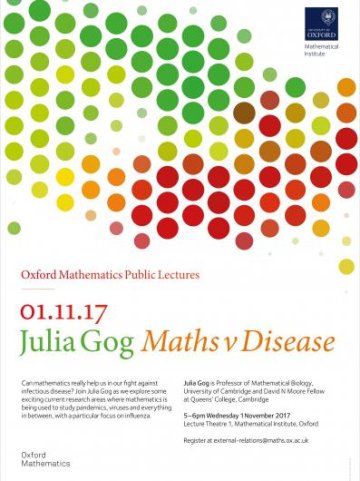
Tue, 28 Nov 2017

18:30 - 19:45

Andrew Wiles - Oxford Mathematics London Public Lecture SOLD OUT

Andrew Wiles
(University of Oxford)
Abstract

Oxford Mathematics Public Lectures - Andrew Wiles, 28th November, 6.30pm, Science Museum, London SW7 2DD

Oxford Mathematics in partnership with the Science Museum is delighted to announce its first Public Lecture in London. World-renowned mathematician Andrew Wiles will be our speaker. Andrew will be talking about his current work and will also be 'in conversation' with mathematician and broadcaster Hannah Fry after the lecture.

This lecture is now sold out, but it will be streamed live and recorded. https://livestream.com/oxuni/wiles
 

Fri, 27 Oct 2017

17:00 - 18:00
L1

Stephen Hawking - Inaugural Roger Penrose Lecture SOLD OUT, WAITING LIST FULL

Stephen Hawking
(University of Cambridge)
Abstract

In recognition of a lifetime's contribution across the mathematical sciences, we are initiating a series of annual Public Lectures in honour of Roger Penrose. The first lecture will be given by his long-time collaborator and friend Stephen Hawking.

Unfortunately the lecture is now sold out and we have a full waiting list. However, we will be podcasting the lecture live (and also via the University of Oxford Facebook page).

Thu, 12 Oct 2017
16:00
L3

Diffusion of particles with short-range interactions

Maria Bruna
(University of Oxford)
Abstract

In this talk we consider a system of interacting Brownian particles. When diffusing particles interact with each other their motions are correlated, and the configuration space is of very high dimension. Often an equation for the one-particle density function (the concentration) is sought by integrating out the positions of all the others. This leads to the classic problem of closure, since the equation for the concentration so derived depends on the two-particle correlation function. We discuss two  common closures, the mean-field (MFA) and the Kirkwood-superposition approximations, as well as an alternative approach, which is entirely systematic, using matched asymptotic expansions (MAE). We compare the resulting (nonlinear) diffusion models with Monte Carlo simulations of the stochastic particle system, and discuss for which types of interactions (short- or long-range) each model works best. 

Thu, 12 Oct 2017
12:00
L4

A new flocking model through body attitude coordination

Sara Merino Aceituno
(Imperial College)
Abstract

We present a new model for multi-agent dynamics where each agent is described by its position and body attitude: agents travel at a constant speed in a given direction and their body can rotate around it adopting different configurations. Agents try to coordinate their body attitudes with the ones of their neighbours. This model is inspired by the Vicsek model. The goal of this talk will be to present this new flocking model, its relevance and the derivation of the macroscopic equations from the particle dynamics.

Global, regional, and national under-5 mortality, adult mortality, age-specific mortality, and life expectancy, 1970-2016: a systematic analysis for the Global Burden of Disease Study 2016
Wang, H Abajobir, A Abate, K Bennett, D Bisanzio, D Deribew, A Gething, P Hay, S Ali, R Rahimi, K Jha, V Lancet volume 390 issue 10100 1084-1150 (16 Sep 2017)
Fri, 20 Oct 2017
14:30
L1

Peter Sarnak - Integer points on affine cubic surfaces

Peter Sarnak
(Princeton University)
Abstract

A cubic polynomial equation in four or more variables tends to have many integer solutions, while one in two variables has a limited number of such solutions. There is a body of work establishing results along these lines. On the other hand very little is known in the critical case of three variables. For special such cubics, which we call Markoff surfaces, a theory can be developed. We will review some of the tools used to deal with these and related problems.

Joint works with Bourgain/Gamburd and with Ghosh
 

Global weak solutions of the Teichmüllerharmonic map flow into general targets
Rupflin, M Topping, P Analysis & PDE volume 12 issue 3 815-842 (01 Jan 2019)
Subscribe to