12:00
12:00
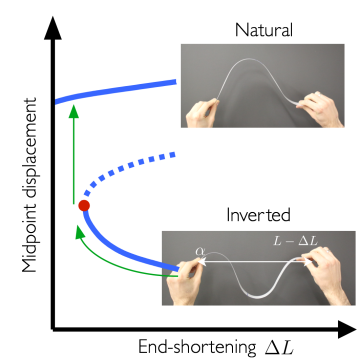
Many elastic structures have two possible equilibrium states. For example umbrellas that become inverted in a sudden gust of wind, nanoelectromechanical switches, origami patterns and even the hopper popper, which jumps after being turned inside-out. These systems typically move from one state to the other via a rapid ‘snap-through’. Snap-through allows plants to gradually store elastic energy, before releasing it suddenly to generate rapid motions, as in the Venus flytrap .
COUPLED BULK-SURFACE PDEs ARISING FROM A MATHEMATICAL MODEL OF RECEPTOR LIGAND DYNAMICS
Kähler groups, residually free groups and subgroups of direct products of surface groups.
Abstract
A Kähler group is a group which can be realised as the fundamental group of a close Kähler manifold. We will prove that for a Kähler group $G$ we have that $G$ is residually free if and only if $G$ is a full subdirect product of a free abelian group and finitely many closed hyperbolic surface groups. We will then address Delzant-Gromov's question of which subgroups of direct products of surface groups are Kähler: We explain how to construct subgroups of direct products of surface groups which have even first Betti number but are not Kähler. All relevant notions will be explained in the talk.
Twisted X-Rays, Orbital Angular Momentum and the Determination of Atomic Structure
Abstract
We find exact solutions of Maxwell's equations that are the precise analog of plane waves, but in the case that the translation group is replaced by the Abelian helical group. These waves display constructive/destructive interference with helical atomic structures, in the same way that plane waves interact with crystals. We show how the resulting far-field pattern can be used for structure determination. We test the method by doing theoretical structure determination on the Pf1 virus from the Protein Data Bank. The underlying mathematical idea is that the structure is the orbit of a group, and this group is a subgroup of the invariance group of the differential equations. Joint work with Dominik Juestel and Gero Friesecke. (Acta Crystallographica A72 and SIAM J. Appl Math).
Ambitwister Strings
Abstract
The talk will review the origins
of ambitwistor strings, and recent progress in extending them to a
wider variety of theories and loop amplitudes.
Geometric scattering for linear quantum fields
Abstract
An essential ingredient of AdS/CFT, dS/CFT and other dualities is a geometric notion of scattering that refers to asymptotics rather than, say, infinite time limits. Though one expects non-perturbative versions to exist in the case of linear quantum fields (and non-linear classical fields), this has been rigorously implemented in Lorentzian settings only relatively recently. The goal of this talk will be to give an overview in different geometrical setups, including asymptotically Minkowski, de Sitter and Anti-de Sitter spacetimes. In particular I will discuss recent results on classical scattering and particle interpretations, compare them with the setup of conformal scattering and explain how they can be used to construct "in-out" Feynman propagators (based on joint works with Christian Gérard and András Vasy).
Polylogarithmic Polygon Origami
Abstract
Amplitudes in planar N=4 SYM are dual to light-like polygonal Wilson-loop expectation values. In many cases their perturbative expansion can be expressed in terms of multiple polylogarithms which also obey certain single-valuedness conditions or branch cut restrictions. The rigidity of this function space, together with a few other conditions, allows one to construct the six-point amplitude -- or hexagonal Wilson loop -- through at least five loops, and the seven-point amplitude through 3.5 loops. Then one can "fold" the polygonal Wilson loops into multiple degenerate configurations, expressing the limiting behavior in terms of simpler function spaces, and learning in the process about how amplitudes factorize.
Automorphic gluing in geometric Langlands via sheaves of categories with Hochschild cochains action
Abstract
I will define the notion of "sheaf of categories with a local action of Hochschild cochains" over a stack. (This notion is analogous to D-modules, in the same way as the notion of "sheaf of categories" is analogous to quasi-coherent sheaves.) I will prove that both categories appearing in geometric Langlands carry this structure over the stack of de Rham {\check{G}}-local systems. Using this, I will explain how to glue D-mod(Bun_G) out of *tempered* D-modules associated to smaller Levi subgroups of G.
Topologically Ordered Matter and Why You Should be Interested
Abstract
In two dimensional topological phases of matter, processes depend on gross topology rather than detailed geometry. Thinking in 2+1 dimensions, the space-time histories of particles can be interpreted as knots or links, and the amplitude for certain processes becomes a topological invariant of that link. While sounding rather exotic, we believe that such phases of matter not only exist, but have actually been observed (or could be soon observed) in experiments. These phases of matter could provide a uniquely practical route to building a quantum computer. Experimental systems of relevance include Fractional Quantum Hall Effects, Exotic superconductors such as Strontium Ruthenate, Superfluid Helium, Semiconductor-Superconductor-Spin-Orbit systems including Quantum Wires. The physics of these systems, and how they might be used for quantum computation will be discussed.