

Tue, 20 Jan 2026

14:00 - 15:00
L4

Counting cycles in planar graphs

Ryan Martin
(Iowa State University)
Abstract

Basic Turán theory asks how many edges a graph can have, given certain restrictions such as not having a large clique. A more generalized Turán question asks how many copies of a fixed subgraph $H$ the graph can have, given certain restrictions. There has been a great deal of recent interest in the case where the restriction is planarity. In this talk, we will discuss some of the general results in the field, primarily the asymptotic value of ${\bf N}_{\mathcal P}(n,H)$, which denotes the maximum number of copies of $H$ in an $n$-vertex planar graph. In particular, we will focus on the case where $H$ is a cycle.

It was determined that ${\bf N}_{\mathcal P}(n,C_{2m})=(n/m)^m+o(n^m)$ for small values of $m$ by Cox and Martin and resolved for all $m$ by Lv, Győri, He, Salia, Tompkins, and Zhu.

The case of $H=C_{2m+1}$ is more difficult and it is conjectured that ${\bf N}_{\mathcal P}(n,C_{2m+1})=2m(n/m)^m+o(n^m)$. 

We will discuss recent progress on this problem, including verification of the conjecture in the case where $m=3$ and $m=4$ and a lemma which reduces the solution of this problem for any $m$ to a so-called "maximum likelihood" problem. The maximum likelihood problem is, in and of itself, an interesting question in random graph theory.

Editorial
Paseau, A Journal for the Philosophy of Mathematics volume 2 7-7 (30 Dec 2025)
Profiling vaccine attitudes and subsequent uptake in 1·1 million people in England: a nationwide cohort study
Whitaker, M Elliott, J Gerard-Ursin, I Cooke, G Donnelly, C Ward, H Elliott, P Chadeau-Hyam, M The Lancet (12 Jan 2026)
Combining the conjectures of Schanuel and Zilber-Pink
Pila, J Rendiconti Lincei. Matematica e Applicazioni
Coffee and equations
Information about the admissions test for Mathematics or joint honours.
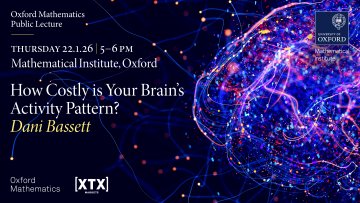
Banner for event. Abstract brain image and details.
Neural systems in general - and the human brain in particular - are organised as networks of interconnected components. Across a range of spatial scales from single cells to macroscopic areas, biological neural networks are neither perfectly ordered nor perfectly random.
Thu, 12 Mar 2026
12:45
L6

An obstruction to realizing anomalous symmetries in 1+1d lattice models

Rajath Radhakrishnan
Abstract
Realizing quantum field theories on lattice models is important for several reasons, ranging from enabling non-perturbative studies of field theories to quantum simulations. However, it is well known that not all quantum field theories can be realized on a lattice (for example, Nielsen-Ninomiya theorem).
 
In this talk, I will consider a very special aspect of this problem. Given a symmetry described by a group G with a specific choice of ’t Hooft anomaly, can it be realized in a quantum spin system, i.e., a lattice model whose Hilbert space is a tensor product of finite-dimensional Hilbert spaces associated with each site? I will describe an explicit constraint which shows that certain anomalous symmetries cannot be realized in such lattice models. 
 
Further Information

Please submit papers to discuss and topic suggestions here: https://sites.google.com/view/math-phys-oxford/journal-club

Thu, 05 Mar 2026
12:45
L6

"Filtering" CFTs at large N

Marta Bucca
Abstract
The map between large-N conformal field theories and semiclassical gravity has been one of the defining achievements of holography. However, the large N holographic dictionary remains incomplete. One of its most notable criticisms, is the failure to address the factorization problem, where the appearance of Euclidean wormholes in the gravitational path integral, lacks a clear interpretation on the large N CFT side. A related challenge is the possibility of erratic N dependence in CFT observables, behaviour with no evident semiclassical gravitational counterpart. In arXiv:2512.13807, a solution is proposed in the form of a large N filter that removes the erratic N dependence of CFT quantities and provides a boundary explanation of  wormhole contributions.
In this talk, I will briefly review the factorization problem and illustrate the proposed large N filter resolution. Time permitting, I will also outline some of the Lorentzian spacetime structures that can emerge when working within the framework of such a large N filter, such as the appearance of baby universes and black holes interiors.
Further Information

Please submit papers to discuss and topic suggestions here: https://sites.google.com/view/math-phys-oxford/journal-club

Subscribe to