

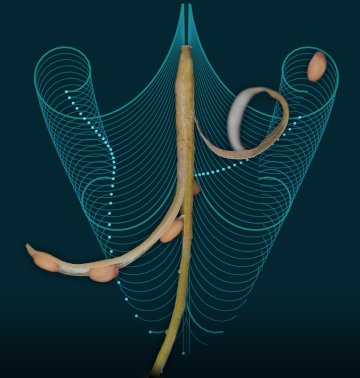
Plants use many strategies to disperse their seeds, but among the most fascinating are exploding seed pods. Scientists had assumed that the energy to power these explosions was generated through the seed pods deforming as they dried out, but in the case of ‘popping cress’ (Cardamine hirsuta) this turns out not to be so. These seed pods don’t wait to dry before they explode.
Wed, 01 Jun 2016
16:00 -
17:00
C1
Finding CAT(-1) structures on groups
Sam Brown
(UCL London)
Abstract
I will describe a method to find negatively curved structures on some groups, by manipulating metrics on piecewise hyperbolic complexes. As an example, I will prove that hyperbolic limit groups are CAT(-1).
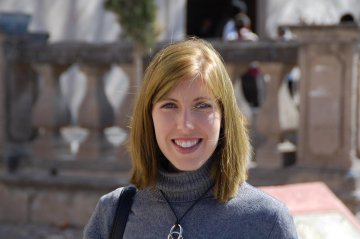
Oxford Mathematician Heather Harrington has been awarded a Royal Society University Research Fellowship. The fellowships recognise outstanding scientists in the UK who are in the early stages of their research career and have the potential to become leaders in their field.
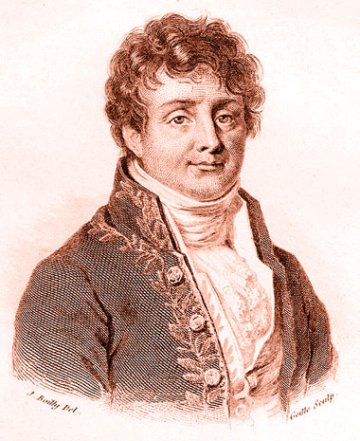
The Fourier transform is that rarest of things: a mathematical method from over 200 years ago which not only remains an active area of research in its own right, but is also an invaluable tool in nearly every branch of mathematics. Though originally developed by Fourier in 1807 to help solve certain partial differential equations, the transform is a living example of a remarkable feature of mathematics, that a tool created in one sub-discipline can break through these artificial classifications and become vital in another.

Professor Nigel Hitchin FRS, Savilian Professor of Geometry in the Mathematical Institute, University of Oxford has won the prestigious Shaw Prize in Mathematical Sciences for, in the words of the Prize Foundation "his far-reaching contributions to geometry, representation theory and theoretical physics. The fundamental and elegant concepts and techniques that he has introduced have had wide
Thu, 02 Jun 2016
11:00
11:00
C5
Horizontal curves of hyperbolic metrics
Rupflin, M
Topping, P
Calculus of Variations and Partial Differential Equations
volume 57
issue 4
106
(15 Aug 2018)
Fri, 10 Feb 2017
16:00 -
17:00
L1
Self-organized dynamics: from emergence of consensus to social hydrodynamics
Eitan Tadmor
(University of Maryland and ETH-ITS)
Abstract
Self-organization is observed in systems driven by the “social engagement” of agents with their local neighbors. Prototypical models are found in opinion dynamics, flocking, self-organization of biological organisms, and rendezvous in mobile networks.
We discuss the emergent behavior of such systems. Two natural questions arise in this context. The underlying issue of the first question is how different rules of engagement influence the formation of clusters, and in particular, the emergence of 'consensus'. Different paradigms of emergence yield different patterns, depending on the propagation of connectivity of the underlying graphs of communication. The second question involves different descriptions of self-organized dynamics when the number of agents tends to infinity. It lends itself to “social hydrodynamics”, driven by the corresponding tendency to move towards the local means.
We discuss the global regularity of social hydrodynamics for sub-critical initial configurations.
Interacting particle Markov chain Monte Carlo
Doucet, A
Rainforth, T
Naesseth, C
Lindsten, F
Paige, B
Wood, F
van de Meent, J
ICML 2016: 33rd International Conference on Machine Learning
(11 Jun 2016)
Controller Synthesis for Probabilistic Safety Specifications using Observers**This work is supported in part by the European Commission IAPP project AMBI 324432, and by the John Fell Oxford University Press(OUP) Research Fund.
Lesser, K
Abate, A
IFAC-PapersOnLine
volume 48
issue 27
329-334
(2015)