

A Bass-Serre theoretic proof of a theorem of Romanovskii and Burns
Andrew, N
Communications in Algebra
volume 51
issue 5
2004-2013
(08 Dec 2022)
Identifying psychiatric diagnosis from missing mood data through the use of log-signature features
Wu, Y
Goodwin, G
Lyons, T
Saunders, K
PLoS ONE
volume 17
issue 11
(17 Nov 2022)
Fri, 10 Feb 2023
16:00
16:00
L1
Departmental Colloquium
Dani Smith Bassett
(University of Pennsylvania)
Abstract
What is curiosity? Is it an emotion? A behavior? A cognitive process? Curiosity seems to be an abstract concept—like love, perhaps, or justice—far from the realm of those bits of nature that mathematics can possibly address. However, contrary to intuition, it turns out that the leading theories of curiosity are surprisingly amenable to formalization in the mathematics of network science. In this talk, I will unpack some of those theories, and show how they can be formalized in the mathematics of networks. Then, I will describe relevant data from human behavior and linguistic corpora, and ask which theories that data supports. Throughout, I will make a case for the position that individual and collective curiosity are both network building processes, providing a connective counterpoint to the common acquisitional account of curiosity in humans.
Further Information
Title: “Mathematical models of curiosity”
Prof. Bassett is the J. Peter Skirkanich Professor at the University of Pennsylvania, with appointments in the Departments of Bioengineering, Electrical & Systems Engineering, Physics & Astronomy, Neurology, and Psychiatry. They are also an external professor of the Santa Fe Institute. Bassett is most well-known for blending neural and systems engineering to identify fundamental mechanisms of cognition and disease in human brain networks.
Cosmic inflation and genetic algorithms
Abel, S
Constantin, A
Harvey, T
Lukas, A
Progress of Physics
volume 71
issue 1
(29 Oct 2022)
Tue, 13 Dec 2022
17:00
17:00
Lecture Theatre 1, Mathematical Institute, Radcliffe Observatory Quarter, Woodstock Road, OX2 6GG
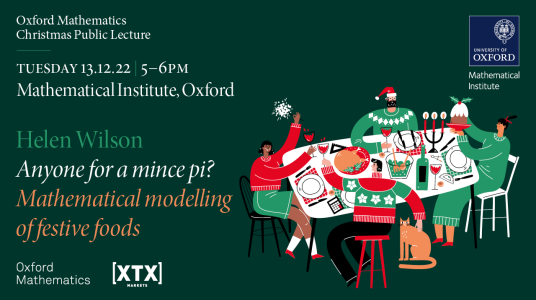
Anyone for a mince pi? Mathematical modelling of festive foods - Helen Wilson
Helen Wilson
(University College London)
Further Information
Oxford Mathematics Christmas Public Lecture
In this talk we'll look at a variety of delicious delights through a lens of fluid dynamics and mathematical modelling. From perfect roast potatoes to sweet sauces, mathematics gets everywhere!
Helen Wilson is Head of the Department of Mathematics at UCL. She is best known for her work on the chocolate fountain (which will feature in this lecture) but does do serious mathematical modelling as well.
Please email @email to register. The lecture will be followed by mince pies and drinks for all.
This lecture will be available on our Oxford Mathematics YouTube Channel at 5pm on 20th December.
The Oxford Mathematics Public Lectures are generously supported by XTX Markets.
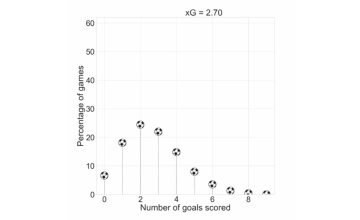
In 2010 Paul the Octopus 'correctly' predicted results in the 2010 World Cup. However, these days the experts are the analysts who trawl through the reams of data about players and teams. And where there is data, there is mathematics. And, particularly, mathematical models. Joshua Bull is a mathematical modeller. He was also the winner of the 2020 Fantasy Football competition from over eight million entrants. So when it came to the Oxford Mathematics 2022 World Cup predictor, Josh fitted the bill perfectly.
Lead–lag detection and network clustering for multivariate time series with an application to the US equity market
Bennett, S
Cucuringu, M
Reinert, G
Machine Learning
volume 111
issue 12
4497-4538
(01 Nov 2022)
Fri, 02 Dec 2022
16:00 -
17:00
L1
Strong cosmic censorship versus Λ
Mihalis Dafermos
(Cambridge)
Abstract
The strong cosmic censorship conjecture is a fundamental open problem in classical general relativity, first put forth by Roger Penrose in the early 70s. This is essentially the question of whether general relativity is a deterministic theory. Perhaps the most exciting arena where the validity of the conjecture is challenged is the interior of rotating black holes, and there has been a lot of work in the past 50 years in identifying mechanisms ensuring that at least some formulation of the conjecture be true. It turns out that when a nonzero cosmological constant Λ is added to the Einstein equations, these underlying mechanisms change in an unexpected way, and the validity of the conjecture depends on a detailed understanding of subtle aspects of black hole scattering theory, surprisingly involving, in the case of negative Λ, some number theory. Does strong cosmic censorship survive the challenge of non-zero Λ? This talk will try to address this Question!
Mon, 23 Jan 2023
14:00 -
15:00
L6
Deep low-rank transport maps for Bayesian inverse problems
Sergey Dolgov
(University of Bath)
Abstract
Characterising intractable high-dimensional random variables is one of the fundamental challenges in stochastic computation. We develop a deep transport map that is suitable for sampling concentrated distributions defined by an unnormalised density function. We approximate the target distribution as the push-forward of a reference distribution under a composition of order-preserving transformations, in which each transformation is formed by a tensor train decomposition. The use of composition of maps moving along a sequence of bridging densities alleviates the difficulty of directly approximating concentrated density functions. We propose two bridging strategies suitable for wide use: tempering the target density with a sequence of increasing powers, and smoothing of an indicator function with a sequence of sigmoids of increasing scales. The latter strategy opens the door to efficient computation of rare event probabilities in Bayesian inference problems.
Numerical experiments on problems constrained by differential equations show little to no increase in the computational complexity with the event probability going to zero, and allow to compute hitherto unattainable estimates of rare event probabilities for complex, high-dimensional posterior densities.
Fully-funded postgraduate scholarships for students on our MSc and DPhil courses.