

16:00
Serre weight conjectures and modularity lifting for GSp4
Abstract
Given a Galois representation attached to a regular algebraic cuspidal automorphic representation, the Hodge--Tate weight of the Galois representation is matched with the weight of the automorphic representation. Serre weight conjectures are mod p analogue of such a correspondence, relating ramification at p of a mod p Galois representation and Serre weights of mod p algebraic automorphic forms. In this talk, I will discuss how to understand Serre weight conjectures and modularity lifting as a relationship between representation theory of finite groups of Lie type (e.g. GSp4(Fp)) and the geometry of p-adic local Galois representations. Then I will explain the proof idea in the case of GSp4. This is based on a joint work with Daniel Le and Bao V. Le Hung.
Compactness tools related to PDEs governing compressible flows.
Abstract
The Oxford SIAM Student Chapter are excited to announce their very first joint event with G-Research. Join them for an introductory talk about the company (a great talk to attend if you are keen on internships), followed by an interactive game with the chance to win £100 Amazon vouchers.
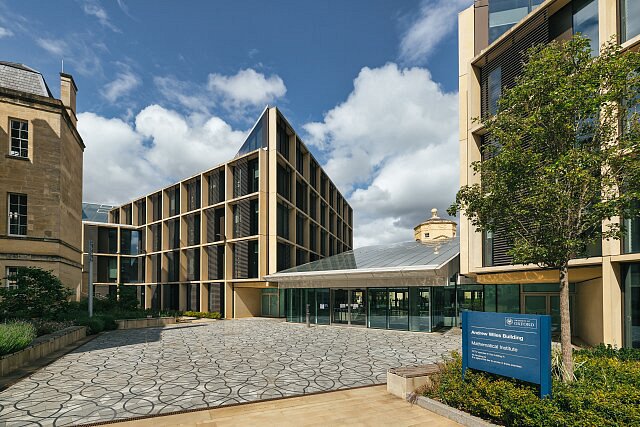
Mathematical Institute, C6, Tuesday 17 February (W5), 3:30 pm. Tea, coffee (decaf available) and biscuits will be provided in the Common Room afterwards.
State time geometry: causal performance profiles and optimal data transport in parallel execution
Abstract
Dr Peter Braam is going to talk about; 'State time geometry: causal performance profiles and optimal data transport in parallel execution'
The increasing complexity of parallel architectures and heterogeneous microarchitectures makes predicting and optimising program performance notoriously difficult. For Optimal Data Transport, we present a discrete variant of the Wasserstein–Fisher–Rao metric that quantifies the true cost of data layout transformations and movement across memory hierarchies. For Causal Performance Profiles, we introduce the Lyons–Gregg Signature, which combines the ideas of Terry Lyons' rough path signatures with hardware performance counters (eBPF) to capture cross-correlated, causal bottlenecks in execution streams. Both arose from State Time Geometry (STG), a model for stateful program execution on computing infrastructure, first modelled as a dynamical system governing state-values over the space of memory addresses. The address space generalises to geometric objects defining infrastructure and leads to the metric. The state transitions of parallel executions become a Grothendieck quantum field theory over the infrastructure and carry the statistical model for the Lyons-Gregg Signature. The central theme is that an intuitive faithful model is not doomed by complexity but forms a geometric domain in which both theoretical and engineering perspectives are simplified.
(In a companion lecture in the Computing Laboratory at 11:00 on Nov 13, we will discuss STG's underlying categorical and geometric structure and its relationship to programming languages and formal methods)
MATH+ is hiring two new Junior Research Group Leaders:
One position is in Statistical Learning: they are looking for a candidate to establish and lead a research group developing novel mathematical and statistical methodologies for modern data analysis. Details on requirements and how to apply.
The Prime Decomposition Theorem for 3-Manifolds
Abstract
A 3-manifold is a space which locally looks like R^3. A major theme in 3-manifold Topology is to understand and classify 3-manifolds. Given two compact 3-manifolds M_1,M_2 we can form another 3-manifold by taking what’s called the “connect sum” of M_1 and M_2. Under this operation, 3-manifolds can be decomposed uniquely into prime pieces just like the integers can be decomposed uniquely as a product of primes. We will discuss this prime decomposition theorem for 3-manifolds while also giving a wide variety of examples.
16:00
A FBSDE construction of the sine-Gordon EQFT
Abstract
I will present a construction and characterization of the (massive) sine-Gordon EQFT up to 6π in the full space. The construction relies on a systematic study of the renormalization flow equation and a forward backward stochastic differential equation (FBSDE) which give good control of the EQFT and allows to derive various additional properties.
This is based on joint work with Massimiliano Gubinelli.