

Elements of the group K1 associated to abelian schemes
Rossler, D
Maillot, V
Oberwolfach Reports
volume 5
issue 3
2013-2014
(09 Aug 2008)
Book review: Recension de 'Lectures grothendieckiennes', édité par Frédéric Jaëck
Rossler, D
Gazette des Mathematiciens
issue 175
70-79
(09 Nov 2022)
Lecture lautmanienne deLa Cl´e des songes d’A. Grothendieck
Rossler, D
Albert Lautman philosophe. Des mathématiques à la Résistance
(02 Jul 2025)
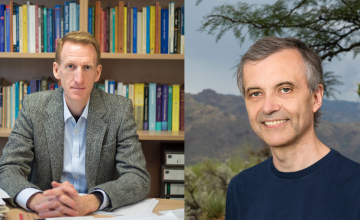
Oxford Mathematicians Ben Green and Alex Scott have been awarded European Research Council (ERC) Advanced Grants. The grants are one of the most prestigious and competitive research awards in the world, providing long-term funding to well-established, leading scientists and scholars who wish to pursue groundbreaking, high-risk projects.

Today sees the pilot launch of Oxford Unbounded, our free online mentoring programme to help students achieve top grades at Maths GCSE/National 5s. Teachers at selected schools across the UK, with a high proportion of students from backgrounds underrepresented at Oxford, have been invited to nominate students in Year 10 (or equivalent).
The nestedness of higher-order networks
LaRock, T
Zhang, Y
Young, J
Eikmeier, N
Lambiotte, R
Landry, N
(18 May 2026)
Thu, 08 Oct 2026
14:00 -
15:00
Lecture Room 3
Bridging high-order numerics and machine learning for kinetic plasma simulation
Lorenzo Pareschi
(Heriot-Watt University)
Abstract
Reliable uncertainty quantification is a central challenge in kinetic plasma simulation, where high dimensionality, multiple physical scales, and sensitivity to uncertain inputs make repeated high-fidelity computations prohibitively expensive. This is particularly relevant in fusion-oriented applications, for which accurate predictions require sophisticated numerical solvers but direct sampling is often out of reach.
In this talk, I will present a multifidelity framework for the Vlasov–Poisson–Landau system designed to combine, rather than replace, high-order numerical simulation with machine learning. At the high-fidelity level, asymptotic-preserving and structure-aware solvers provide accurate kinetic descriptions across different regimes. These are coupled with reduced plasma models and tensor neural surrogates constructed through a micro–macro decomposition, so that the dominant physical structure is treated analytically and numerically, while learning is used only for the lower-complexity kinetic correction. The resulting hierarchy produces inexpensive low-fidelity samples that remain strongly correlated with the high-fidelity kinetic solution. When used as control variates, these models yield substantial variance reduction and computational savings while retaining the high-order solver as the reference description.
Beyond the specific plasma application, the main message is that classical numerical analysis and machine learning need not be competing approaches. High-order solvers can provide structure, reliability, and asymptotic consistency, while learned models provide efficient approximations that can be exploited within rigorous multifidelity estimators. This interaction offers a general route toward trustworthy machine learning for computational science.
Thu, 25 Jun 2026
12:00 -
13:00
C1
Global Well-Posedness for Prandtl-Type Boundary Layer Models
Anita Yang
(The Chinese University of Hong Kong)
Abstract
In this talk, we study some Prandtl-type boundary layer models, including the two-dimensional MHD boundary layer equations and the Prandtl–Shercliff model. For small perturbations of a tangential background magnetic field, we establish the global-in-time existence and uniqueness of solutions to the MHD boundary layer equations in Sobolev spaces. The proof relies on a novel combination of the well-known cancellation mechanism and the concept of linearly good unknowns. We also investigate the Prandtl–Shercliff model. In the two-dimensional case, we establish global-in-time well-posedness in Sobolev spaces without imposing any structural assumptions on the initial data. Moreover, we show that solutions exhibit a global analytic regularization effect in all variables, up to the boundary and for all times. The proofs rely crucially on the intrinsic nonlocal diffusion induced by the Shercliff boundary layer.
Tuesday saw the pilot launch of Oxford Unbounded, our free online mentoring programme to help students achieve top grades at Maths GCSE/National 5s. Teachers at selected schools across the UK, with a high proportion of students from backgrounds underrepresented at Oxford, have been invited to nominate students in Year 10 (or equivalent).
Ben Green and Alex Scott have been awarded European Research Council (ERC) Advanced Grants. The grants are one of the most prestigious and competitive research awards in the world, providing long-term funding to well-established, leading scientists and scholars who wish to pursue groundbreaking, high-risk projects that push the frontiers of knowledge.