

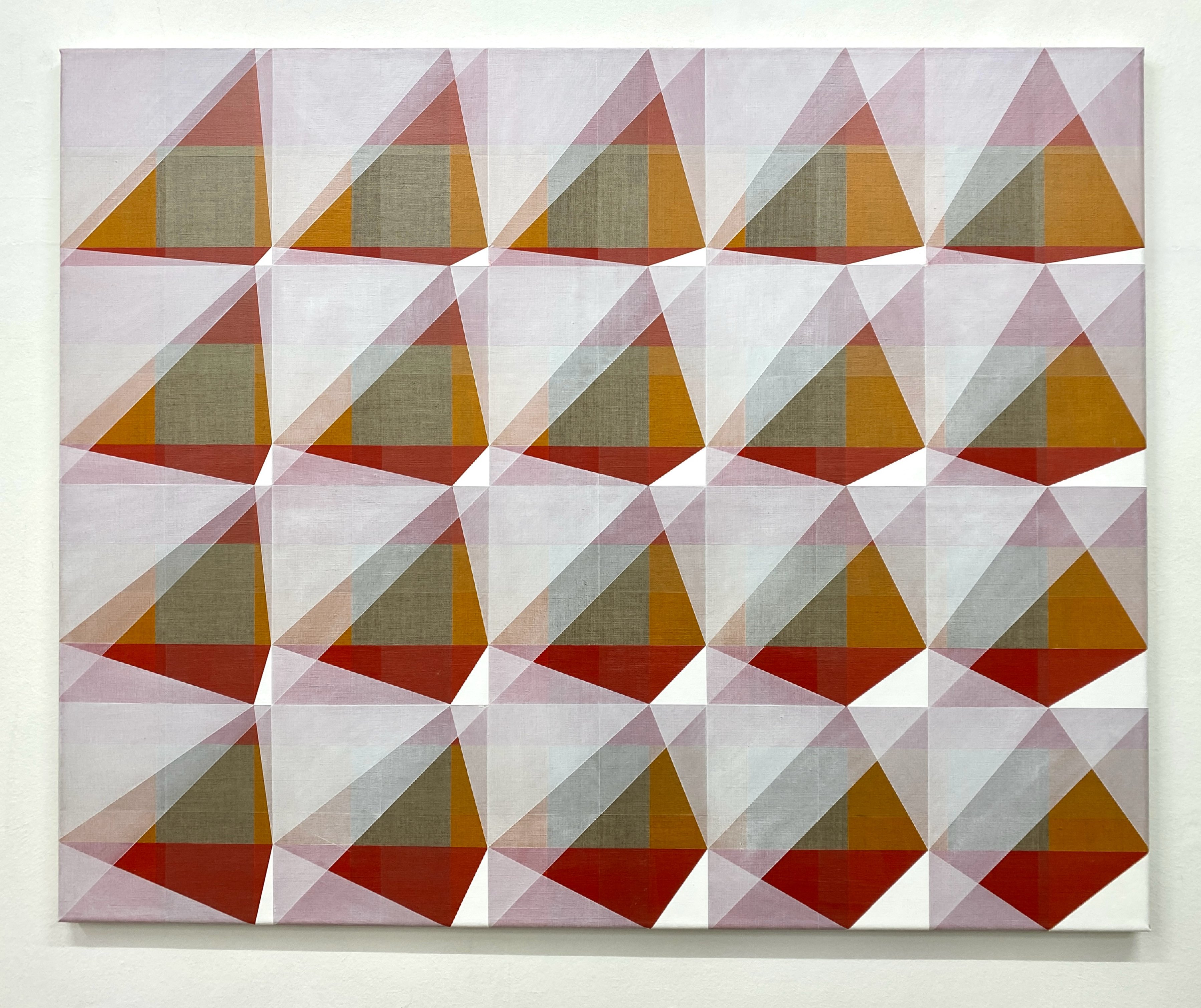
We are delighted to introduce our latest exhibition in the Andrew Wiles Building, featuring 30 mathematically-inspired paintings by Dutch visual artist Paul Ouwerkerk.
The exhibition launch will be on Friday 5th June at 5 p.m. in the South Mezzanine and all are welcome. Please email Dyrol (@email) if you wish to attend.
17:00
Some Ternary Versions of Stability
Abstract
Stability is the prototypical model theoretic dividing line. One interpretation is that a binary relation is stable if it is "close to unary": if the question $(x,y)\in E$ can be answered, at least most of the time, by knowing enough information about $x$, and separately enough information about $y$.
One natural question is asking how this can generalize to ternary (and higher-arity) relations. The connection to hypergraph regularity suggests an approach to identifying ternary stable-like properties, and also that there should be several versions, since a ternary relation could be almost unary, or almost binary, or a combination of these properties.
In this talk, I'll survey some of what we know about several of these "stable-like" ternary notions.
14:00
A proof of the Kim-Vu sandwich conjecture
Abstract
Paul Ouwerkerk - The Oxford Variations
We are delighted to introduce our latest exhibition in the Andrew Wiles Building. Visual artist Paul Ouwerkerk has created 30 new paintings where he plays with the perspective plane in paintings that are generated from self-composed number sequences. The handcrafted canvases are the result of a process in which the artist, after defining a rigid grid as starting point, leaves space for intuition and industrious manual application to elaborate towards the final result.
Visually these paintings can often be interpreted as unfolded polyhedra, dissolving into mathematical landscape perspectives. The rule-based compositions are sometimes derailed purposefully during the painting process, as if to ‘break-the-code’. Painting techniques and materials play a pivotal role in the creation of these works and the materialisation of these abstract illusions.
Paul Ouwerkerk lives and works in Amsterdam. He has a background in art, photography and design. His previous work experience is intermingled with the world of architecture, urbanism and landscape design. Since 2017 he has been painting his abstract ‘Dynamic Geometry’ series.
9 a.m. - 5 p.m. Monday to Friday.

16:00
Lindelöf hypothesis and zero density estimates
Abstract
The Lindelöf hypothesis is known to be weaker than the Riemann hypothesis and one way to assess the difference in their strength is to consider what can be said about the zeroes of the zeta function under the assumption of the Lindelöf hypothesis. Viewing this question in the context of zero density estimates, we prove that $N(\sigma,T) \leq T^{\frac{4(5-6\sigma)}{3(3-2\sigma)} + o(1)}$. This improves the currently known estimate conditional on the Lindelöf hypothesis, $N(\sigma,T) \leq T^{2(1-\sigma)+o(1)}$ based on the mean value theorem, for $\sigma$ near $3/4$.