

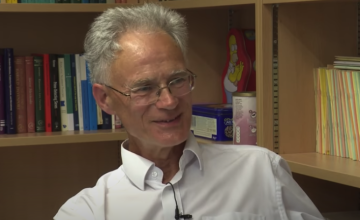
Singer and activist (she doesn't like the title) Peggy Seeger was born in America but now resides in downtown Iffley from where, at the age of 87, she still performs songs about a range of issues from women's experiences to ecological matters. An interesting life.
14:00
The stability and resilience of ecological systems
Note: we would recommend to join the meeting using the Zoom client for best user experience.
Dr. Sonia Kéfi is a Research Director at the the Evolution Sciences Institute (ISEM) in Montpellier, France (https://biodicee.edu.umontpellier.fr/who-we-are/sonia-kefi/).
She is also an external professor at the Santa Fe Institute and she was the recipient of the 2020 Erdos-Renyi Prize from the Network Science Society. Her research aims at understanding how ecosystems persist and change under pressure from changing climate and land use. In her works, she combines mathematical modeling and data analysis to investigate the role of ecological interactions in stabilizing and destabilizing ecosystems, as well as to develop indicators of resilience that could warn us of approaching ecosystem shifts.
Abstract
Understanding the stability of ecological communities is a matter of increasing importance in the context of global environmental change. Yet it has proved to be a challenging task. Different metrics are used to assess the stability of ecological systems, and the choice of one metric over another may result in conflicting conclusions. While the need to consider this multitude of stability metrics has been clearly stated in the ecological literature for decades, little is known about how different stability metrics relate to each other. I’ll present results of dynamical simulations of ecological communities investigating the correlations between frequently used stability metrics, and I will discuss how these results may contribute to make progress in the quantification of stability in theory and in practice.
Zoom Link: https://zoom.us/j/93174968155?pwd=TUJ3WVl1UGNMV0FxQTJQMFY0cjJNdz09
Meeting ID: 931 7496 8155
Passcode: 502784
11:00
Decarbonization of large financial markets
Abstract
We build a model of a financial market where a large number of firms determine their dynamic emission strategies under climate transition risk in the presence of both environmentally concerned and neutral investors. The firms aim to achieve a trade-off between financial and environmental performance, while interacting through the stochastic discount factor, determined in equilibrium by the investors' allocations. We formalize the problem in the setting of mean-field games and prove the existence and uniqueness of a Nash equilibrium for firms. We then present a convergent numerical algorithm for computing this equilibrium and illustrate the impact of climate transition risk and the presence of environmentally concerned investors on the market decarbonization dynamics and share prices. We show that uncertainty about future climate risks and policies leads to higher overall emissions and higher spreads between share prices of green and brown companies. This effect is partially reversed in the presence of environmentally concerned investors, whose impact on the cost of capital spurs companies to reduce emissions. However, if future climate policies are uncertain, even a large fraction of environmentally concerned investors is unable to bring down the emission curve: clear and predictable climate policies are an essential ingredient to allow green investors to decarbonize the economy.
Joint work with Pierre Lavigne