

Cross Modal Retrieval with Querybank Normalisation
Bogolin, S
Croitoru, I
Jin, H
Liu, Y
Albanie, S
volume 00
5184-5195
(24 Jun 2022)
doi:10.1109/cvpr52688.2022.00513
Two Decades of Quantum Information in Singapore
Singh, K
Chuan, K
Ekert, A
Theng, C
Hogan, J
Tan, E
50 Years of Science in Singapore
361-387
(16 Feb 2017)
doi:10.1142/9789813140905_0021
Thu, 02 Nov 2023
14:00
14:00
Lecture Room 3
Recent Developments in the Numerical Solution of PDE-Constrained Optimization Problems
John Pearson
(Edinburgh University)
Abstract
Optimization problems subject to PDE constraints constitute a mathematical tool that can be applied to a wide range of scientific processes, including fluid flow control, medical imaging, option pricing, biological and chemical processes, and electromagnetic inverse problems, to name a few. These problems involve minimizing some function arising from a particular physical objective, while at the same time obeying a system of PDEs which describe the process. It is necessary to obtain accurate solutions to such problems within a reasonable CPU time, in particular for time-dependent problems, for which the “all-at-once” solution can lead to extremely large linear systems.
In this talk we consider iterative methods, in particular Krylov subspace methods, to solve such systems, accelerated by fast and robust preconditioning strategies. In particular, we will survey several new developments, including block preconditioners for fluid flow control problems, a circulant preconditioning framework for solving certain optimization problems constrained by fractional differential equations, and multiple saddle-point preconditioners for block tridiagonal linear systems. We will illustrate the benefit of using these new approaches through a range of numerical experiments.
This talk is based on work with Santolo Leveque (Scuola Normale Superiore, Pisa), Spyros Pougkakiotis (Yale University), Jacek Gondzio (University of Edinburgh), and Andreas Potschka (TU Clausthal).
Minimal entropy conditions for scalar conservation laws with general convex fluxes
Cao, G
Chen, G
Quarterly of Applied Mathematics
volume 81
issue 3
567-598
(24 Apr 2023)
doi:10.1090/qam/1669
Flashes and rainbows in tournaments
Girão, A
Illingworth, F
Michel, L
Savery, M
Scott, A
(22 May 2023)
doi:10.48550/arxiv.2305.13422
Diffusions on a space of interval partitions: the two-parameter model
Forman, N
Rizzolo, D
Shi, Q
Winkel, M
ELECTRONIC JOURNAL OF PROBABILITY
volume 28
1-46
(01 Jan 2023)
doi:10.1214/23-EJP946
Stein’s density method for multivariate continuous distributions
Mijoule, G
Raič, M
Reinert, G
Swan, Y
Electronic Journal of Probability
volume 28
issue none
(01 Jan 2023)
doi:10.1214/22-ejp883
Bias in the arrival of variation can dominate over natural selection in Richard Dawkins’ biomorphs
Martin, N
Camargo, C
Louis, A
doi:10.1101/2023.05.24.542053
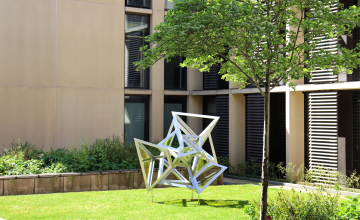
There's much debate about inspiring a greater appreciation for mathematics. Art has a key role.
Plosion 1 (Yellow) is the 40th and final piece in the mathematically inspired exhibition that is Conrad Shawcross' Cascading Principles: Expansions within Geometry, Philosophy, and Interference.