

ON INCORPORATING INDUCTIVE BIASES INTO VAES
Miao, N
Mathieu, E
Siddharth, N
Teh, Y
Rainforth, T
Iclr 2022 10th International Conference on Learning Representations
(01 Jan 2022)
ROBUST PRUNING AT INITIALIZATION
Hayou, S
Ton, J
Doucet, A
Teh, Y
Iclr 2021 9th International Conference on Learning Representations
(01 Jan 2021)
Mathematical modelling of ocular epithelial transport: a review
Dvoriashyna, M
Foss, A
Gaffney, E
Repetto, R
Modeling and Artificial Intelligence in Ophthalmology
volume 5
issue 1
1-17
(31 Oct 2023)
doi:10.35119/maio.v5i1.130
An Approach for Multi-Stage Calculations Incorporating Unsteadiness
Giles, M
v001t01a092-v001t01a092
(01 Jun 1992)
doi:10.1115/92-gt-282
Policy gradient methods find the Nash equilibrium in N-player general-sum linear-quadratic games
Hambly, B
Xu, R
Yang, H
Journal of Machine Learning Research
volume 24
issue 139
1−56
(01 Apr 2023)
A structure-preserving divide-and-conquer method for pseudosymmetric matrices
Benner, P
Nakatsukasa, Y
Penke, C
SIAM Journal on Matrix Analysis and Applications
volume 44
issue 3
1245-1270
(30 Aug 2023)
doi:10.1137/22M1484985
Fri, 09 Jun 2023
12:30 -
13:30
C1
The Harish-Chandra local character expansion and canonical dimensions for p-adic reductive groups
Mick Gielen
(University of Oxford)
Abstract
A complex irreducible admissible representation of a reductive p-adic group is typically infinite-dimensional. To quantify the "size" of such representations, we introduce the concept of canonical dimension. To do so we have to discuss the Moy-Prasad filtrations. These are natural filtrations of the parahoric subgroups. Next, we relate the canonical dimension to the Harish-Chandra local character expansion, which expresses the distribution character of an irreducible representation in terms of nilpotent orbital integrals. Using this, we consider the wavefront set of a representation. This is an invariant the naturally arises from the local character expansion. We conclude by explaining why the canonical dimension might be considered a weaker but more computable alternative to the wavefront set.
Balancing connected colourings of graphs
Illingworth, F
Powierski, E
Scott, A
Tamitegama, Y
Electronic Journal of Combinatorics
volume 30
issue 1
(24 Mar 2023)
doi:10.37236/11256
Torsion homology growth of polynomially growing free-by-cyclic groups
Andrew, N
Hughes, S
Kudlinska, M
Rocky Mountain Journal of Mathematics
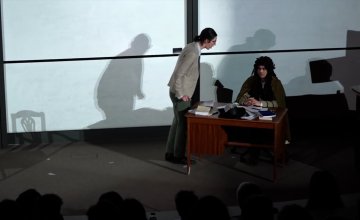
Fermat's Last Tango, written in 2000 by Joanne Sydney Lessner and Joshua Rosenblum, tells the story, in words and music, of a 300 hundred-year-old mathematical mystery and the man who spent seven years trying to solve it.
This version was performed in early March 2023 by Oxford Mathematics students and fellow students from across the University. The venue was a lecture theatre in the Andrew Wiles Building, home to Oxford Mathematics and named after the mathematician who is the subject of the story.