

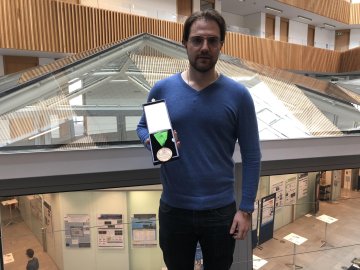
Oxford Mathematician Kristian Kiradjiev has won the Gold Award in the Mathematical Sciences category at this year’s STEM for Britain at the House of Commons on 13th March. This prestigious competition provides an opportunity for researchers to communicate their research to parliamentarians.
Genetic and spatial characterization of the red fox (Vulpes vulpes) population in the area stretching between the Eastern and Dinaric Alps and its relationship with rabies and canine distemper dynamics
Zecchin, B
De Nardi, M
Nouvellet, P
Vernesi, C
Babbucci, M
Crestanello, B
Bagó, Z
Bedeković, T
Hostnik, P
Milani, A
Donnelly, C
Bargelloni, L
Lorenzetto, M
Citterio, C
Obber, F
De Benedictis, P
Cattoli, G
PloS One
volume 14
issue 3
(12 Mar 2019)
The Asymptotic Evolution of the General Stochastic Epidemic
Reinert, G
The Annals of Applied Probability
volume 5
issue 4
1061-1086
(01 Nov 1995)
Couplings for normal approximations with
Stein’s method
Reinert, G
193-207
(05 May 1998)
Stein’s method
Poisson Process Approximation for Sequence Repeats, and Sequencing by Hybridization
Arratia, R
Martin, D
Reinert, G
Waterman, M
Journal of Computational Biology
volume 3
issue 3
425-463
(Jan 1996)
Compound Poisson and Poisson Process Approximations for Occurrences of Multiple Words in Markov Chains
Reinert, G
Schbath, S
Journal of Computational Biology
volume 5
issue 2
223-253
(Jan 1998)
A subset of CCL25-induced gut-homing T cells affects intestinal immunity to infection and cancer
Fu, H
Jangani, M
Parmar, A
Wang, G
Coe, D
Spear, S
Sandrock, I
Capasso, M
Coles, M
Cornish, G
Helmby, H
Marelli-Berg, F
Frontiers in Immunology
volume 10
(25 Feb 2019)
Thu, 23 May 2019
16:00
16:00
C4
Quantum Invariants - The Jones Polynomial as a bridge between algebra and topology
Cristina Palmer-Anghel
(Oxford University)
Abstract
The world of quantum invariants began in 1983 with the discovery of the Jones polynomial. Later on, Reshetikhin and Turaev developed an algebraic machinery that provides knot invariants. This algebraic construction leads to a sequence of quantum generalisations of this invariant, called coloured Jones polynomials. The original Jones polynomial can be defined by so called skein relations. However, unlike other classical invariants for knots like the Alexander polynomial, its relation to the topology of the complement is still a mysterious and deep question. On the topological side, R. Lawrence defined a sequence of braid group representations on the homology of coverings of configuration spaces. Then, based on her work, Bigelow gave a topological model for the Jones polynomial, as a graded intersection pairing between certain homology classes. We aim to create a bridge between these theories, which interplays between representation theory and low dimensional topology. We describe the Bigelow-Lawrence model, emphasising the construction of the homology classes. Then, we show that the sequence of coloured Jones polynomials can be seen through the same formalism, as topological intersection pairings of homology classes in coverings of the configuration space in the punctured disc.
Mon, 24 Jun 2019
17:00 -
18:00
L1
John Bush - Walking on water: from biolocomotion to quantum foundations
John Bush
(MIT)
Further Information
In this lecture John Bush will present seemingly disparate research topics which are in fact united by a common theme and underlaid by a common mathematical framework.
First there is the ingenuity of the natural world where living creatures use surface tension to support themselves on the water surface and propel
themselves along it. Then there is a system discovered by Yves Couder only fifteen years ago, in which a small droplet bounces along the surface of a vibrating liquid bath, guided or 'piloted’ by its own wave field. Its ability to reproduce many features previously thought to be exclusive to quantum systems has launched the field of hydrodynamic quantum analogs, and motivated a critical revisitation of the philosophical foundations of quantum mechanics.
John Bush is a Professor of Applied Mathematics in the Department of Mathematics at MIT specialising in fluid dynamics.
5.00pm-6.00pm, Mathematical Institute, Oxford
Please email @email to register
Watch live:
https://facebook.com/OxfordMathematics
https://livestream.com/oxuni/bush
Oxford Mathematics Public Lectures are generously supported by XTX Markets.
Mon, 18 Mar 2019
15:45
15:45
C4
Algebraic cobordism categories and Grothendieck-Witt-theory
Fabian Hebestreit
(University of Bonn)
Abstract
I will explain how Lurie‘s approach to L-theory via Poincaré categories can be extended to yield cobordism categories of Poincaré objects à la Ranicki. These categories can be delooped by an iterated Q-construction and the resulting spectrum is a derived version of Grothendieck-Witt-theory. Its homotopy type can be described in terms of K- and L-theory as conjectured by Hesselholt-Madsen. Furthermore, it has a clean universal property analogous to that of K-theory, localisation sequences in much greater generality than classical Grothendieck-Witt theory, gives a cycle description of Weiss-Williams‘ LA-theory and allows for maps from the geometric cobordism category, refining and unifying various known invariants.
All original material is joint work with B.Calmès, E.Dotto, Y.Harpaz, M.Land, K.Moi, D.Nardin, T.Nikolaus and W.Steimle.