

Season 11 Episode 6
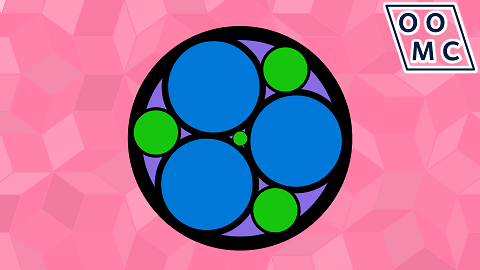
In this episode of the Oxford Online Maths Club, James and Georgina put circles inside circles.
Further Reading
Descartes’ Theorem
The Wikipedia page for the Apollonian gasket includes a sketch of a proof of Descartes' theorem using Heron’s formula, and also has a formula using complex numbers for the location of the centre of the fourth circle in terms of the locations and curvatures of the other three.
The Brilliant website has a different proof of Descartes' theorem using (among other things!) the cosine rule.
The Desmos file that you saw on screen is available here. It uses complex numbers and Möbius transformations.
More circles
At one point we had a stack of circles between two parallel lines, and we could have filled in smaller tangent circles, Apollonian-style. There's a related idea behind something called Ford circles, which are circles in the \(y\geq 0\) half of the \((x,y)\)-plane, with each circle tangent to the \(x\)-axis at some rational number \(\frac{p}{q}\) in lowest terms, and with radius \(\frac{1}{2q^2}\). These circles form some of the Apollonian-style pattern; you can draw Ford circles by iteratively taking any two tangent circles and drawing in the circle that’s tangent to both of them and the \(x\)-axis.
See this Wikipedia page for a diagram. They feature in a Numberphile video Funny Fractions and Ford Circles.
Inversion
We had a previous episode on a related topic Season 5 Episode 6 | Inversion with Rebekah. This is all about the sort of transformation that I mentioned in passing in this week’s episode; inversion. It’s some really beautiful mathematics, and it’s occasionally useful for hard Olympiad-style geometry problems!
Links from the further reading for that episode include
- See Wikipedia for the Pappus chain, a series of tangent circles bounded between two other circles. This pattern appears in some art nouveau works e.g. this decorative panel by Alphonse Mucha.
- This gif of Steiner’s Porism (given one circle inside another, find infinitely many chains that are tangent to both).
- For a related modern result, see this excellent article by Kristian Kiradjiev. (Kristian was an Oxford DPhil student when he wrote this article!)

Threaded Theorems
Georgina recommends Vi Hart’s videos for more maths that you can doodle, for example Doodling in Math Class: Infinity Elephants. Vi Hart’s channel is on Vimeo here.
Georgina’s free mathematical embroidery patterns can be found at Threaded Theorems.
If you want to get in touch with us about any of the mathematics in the video or the further reading, feel free to email us on oomc [at] maths.ox.ac.uk.