Oxford Unbounded
Building on our successful support for Y12 students (UNIQ summer schools, It All Adds Up, MAT livestream) and Y13 students (Opportunity Oxford, Bridging the Gap), we are excited to announce a new outreach initiative to support Y10/11 students.
Oxford Unbounded is a free online mentoring programme to help students achieve top grades at Maths GCSE/National 5s. Teachers at selected schools across the UK, with a high proportion of students from backgrounds underrepresented at Oxford, will be invited to nominate students in Year 10 (or equivalent).
Oxford mentors will tutor groups of 4–5 students on a weekly basis during the summer between Y10 and Y11 (or equivalent) and then continue to provide support during Y11. Students will also be invited to a 3-day revision residential at the Mathematical Institute and Lincoln College, Oxford during the April before their exams.
Please contact outreach@maths.ox.ac.uk with any enquires.
Applications for Oxford Unbounded 2026-27
Applications are now closed for the 26-27 pilot programme. Thank you to all of the teachers who applied! If you wish to hear about when applications will open for the full programme in 2027, you can sign up to our outreach mailing list.
FAQs
How much does it cost?
The programme, including the residential, is entirely free for schools and students and is funded by a generous donation to the University of Oxford to expand our outreach work in STEM subjects.
Who is eligible?
Selected schools from across the UK will be contacted to nominate students on track to achieve a grade 7 (or equivalent) at GCSE Maths. We particularly welcome nominations for students from backgrounds which are underrepresented at Oxford.
Why is the programme called "Unbounded"?
In mathematics, an unbounded function (sequence or process) is one that has no limit and continues forever. Through the programme we hope to encourage students to see that this idea also applies to their potential as mathematicians!
Where will the residential be held?
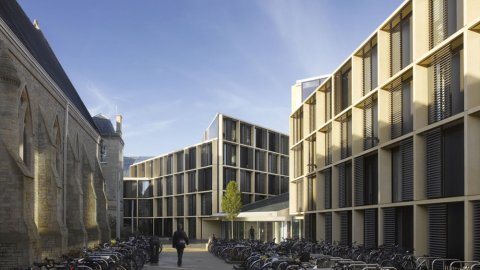
The residential will be hosted by the Mathematical Institute and Lincoln College. The students will be able to experience life as an Oxford undergraduate as they stay in en-suite college accommodation. Revision activities during the day will mostly be held at the Maths Institute. All aspects of the residential, including travel and accommodation, are free for participants.
Thank you to Lincoln College for their support of Oxford Unbounded!

Who are the mentors?
Mentors will mostly be current undergraduate and graduate students at the Mathematical Institute. Some mentors may be from other departments such as Statistics or Computer Science. All mentors will receive mentoring and safeguarding training, and will be DBS checked. Members of outreach staff will be the Designated Safeguarding Lead and Deputy Designated Safeguarding Lead for the programme.
What is the format of the mentoring sessions?
Students will take part in online mentoring sessions with information shared on a dedicated Canvas course. Each session will focus on a different Maths GCSE topic or exam skill. Before the session, students will be asked about their confidence with the topic and will be given some pre-reading or videos and some questions to engage with.
What topics are covered during the programme?
The initial block of mentoring sessions will each cover a standalone topic on the curriculum, taking into account the differences between exam boards. These are topics that frequently arise in the hardest questions near the end of exam papers, such as functions, quadratic equations, geometric transformations, probability, and circles. At the same time, we hope to expose students to more subtle problem-solving skills such as how to approach a non-standard question, how to sanity-check solutions, and the logic of proof.
The second block of mentoring sessions will then merge topics together and tackle problems where it is less clear what to do or what process to use, preparing students to "expect the unexpected". This will also involve shorter sessions on study skills, calculator tips, and exam technique.
What support is available for students who are already on track to achieve top grades?
Many of our other outreach programmes focus on super-curricular maths to stretch students beyond the school curriculum. You can find out more here or sign up to our outreach mailing list to hear about other programmes/events.
Try a question!
Solve the equation \(x(2x-4)=x-2\) for \(x\).
(A) \(\frac{1}{2}\) only,
(B) \(\frac{1}{2}\) or \(2\),
(C) \(1\) only,
(D) \(0\) or \(2\).
We want students to think about how they would answer questions, not just what the answer is. Maybe your first step was to draw a sketch like the one below? Maybe you jumped straight in with the algebra? Being aware of your toolkit is an important part of being a mathematician.

The correct answer is (B), so well done if you picked (B)! What was your method for this question? Did you have to change your method along the way?
Throughout the programme, we'll be using diagnostic questions to spot and address any misconceptions, and we want to help students learn to spot issues too. If a student picks (A), then perhaps they've correctly taken out a factor of \((x-2)\) on the left-hand side, but then divided by this factor without considering the case where it is zero. If a student picks (C), then maybe they have tried to cancel something from each side (perhaps incorrectly, to get something like \( (2x-4) = -2\)). If a student picks (D), then perhaps they're finding the roots of the left-hand side without considering the right-hand side.
Either way, there's plenty for the mentors to talk to students about! On Oxford Unbounded, trying the question is just the start of the conversation...