

Quantum computers achieve a remarkable exponential speedup in integer factorisation (potentially making widely deployed cryptographic schemes vulnerable). Beyond that, however, compelling large-scale applications remain comparatively scarce, and if a fully error-corrected quantum computer were available today, it is not fully clear what 'killer app' it would be used for.
One active research direction is the computation of relative free energies, a key quantity in drug discovery used to rank candidate molecules by their binding affinity to target proteins. In conventional (classical) techniques, free energies can be estimated via molecular dynamics simulations. Atomic nuclei are propagated using Newton’s equations, generating trajectories through configuration space. By sampling configurations over long time scales, one can approximate thermodynamic average quantities such as free energy.
However, accurate force calculations require accounting for electronic structure effects. Electrons obey quantum mechanics, and their behaviour is computationally demanding to simulate on classical hardware. In current workflows, electronic structure calculations with both classical and quantum computational methods are coupled to classical molecular dynamics via a feedback loop or alternating steps, which can be computationally expensive. This motivates the question: can both nuclear dynamics and electronic structure be simulated simultaneously on a quantum computer?
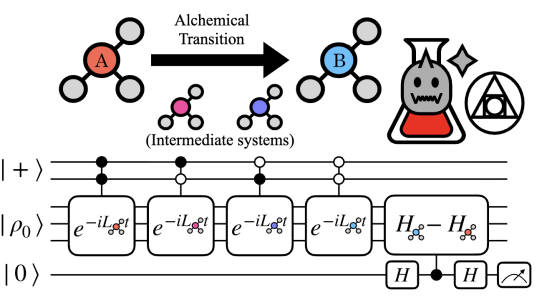
In collaboration with Quantum Motion (a London-based quantum hardware company), Boehringer Ingelheim (a major German pharmaceutical company), and the University of Toronto, we developed an approach that performs both tasks within a unified quantum algorithm. Our algorithm operates on two sets of registers. Classical kinetic and Coulombic forces for nuclei are computed in the nuclear register. Quantum mechanical forces from the electronic ground state are calculated in the electronic register, and 'kicked' back up the nuclear register. Together, these combined forces are then used to generate the probability distribution of the molecular configurations via a continuous time evolution without hybrid loops or iterative methods that alternate between classical and quantum steps.
To compute free energy differences, we adopt alchemical methods, defining a thermodynamic path between two systems and integrating potential energy differences along this path. This means we gradually 'morph' one system into the other using a continuous control parameter, even if the intermediate states are not physically realisable, echoing the ancient transmutative art of alchemy. By exploiting superposition, the quantum computer prepares configurations corresponding to multiple intermediate systems simultaneously. Measurements on this superposed state yield free energy estimates, enabling a fully quantum implementation of relative free energy calculations.
Looking forward, it would be interesting to identify concrete scenarios where the alchemical quantum algorithm offers a practical advantage over classical methods for free energy estimation. This requires obtaining fine-grained resource estimates on systems representative of practical applications to determine constant-level overheads beyond the current analysis of asymptotic and theoretical runtime speedups.
Po-Wei Huang is a postgraduate student in Oxford Mathematics.