

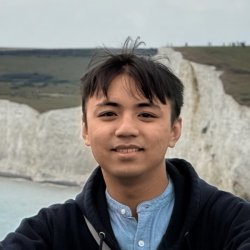
Po-Wei Huang

University of Oxford
Andrew Wiles Building
Radcliffe Observatory Quarter
Woodstock Road
Oxford
OX2 6GG
Full list on Google Scholar or my personal website
Quantum enhanced rare event discovery and sampling
Naixu Guo, Po-Wei Huang, Qisheng Wang, Jayne Thompson, Patrick Rebentrost, Mile Gu, and Chengran Yang
arXiv: 2606.06316 [quant-ph] (2026).
Low-depth amplitude estimation via statistical eigengap estimation
Po-Wei Huang and Bálint Koczor
arXiv: 2603.05475 [quant-ph] (2026).
QKAN: Quantum Kolmogorov-Arnold Networks with applications in machine learning and multivariate state preparation
Petr Ivashkov, Po-Wei Huang, Kelvin Koor, Lirandë Pira, and Patrick Rebentrost
npj Quantum Information 12, 73 (2026).
Accelerating inference for multilayer neural networks with quantum computers
Arthur G. Rattew, Po-Wei Huang, Naixu Guo, Lirandë Pira, and Patrick Rebentrost
In The Fourteenth International Conference on Learning Representations (2026).
— Accepted at QTML 2025 as a contributed talk. —
Fullqubit alchemist: Quantum algorithm for alchemical free energy calculation
Po-Wei Huang, Gregory Boyd, Gian-Luca R. Anselmetti, Matthias Degroote, Nikolaj Moll, Raffaele Santagati, Michael Streif, Daniel Marti-Dafcik, Hamza Jnane, Sophia Simon, Nathan Wiebe, Thomas R. Bromley, and Bálint Koczor
arXiv: 2508.16719 [quant-ph] (2025).
— To appear in npj Quantum Information. —
— Accepted at QCTiP 2026 as a contributed talk. —
C7.4 Intro to Quantum Information Tutor HT26
B8.5 Graph Theory TA MT25
B7.3 Further Quantum Theory TA HT25
B8.4 Information Theory TA MT24
I am a DPhil student in the Quantum Information, Computation and Cryptography Group, advised by Prof. Bálint Koczor, Prof. Simon Benjamin, and Prof. Artur Ekert, as well as a graduate researcher at Quantum Motion. I go by George in daily life.
- EPSRC Quantum Technologies DTP CASE Conversion Studentship with Quantum Motion
- Alan Tayler Scholarship in Mathematics, St. Catherine's College
- Government Scholarship to Study Abroad, Ministry of Education, Taiwan
My research interests include investigating early and fully fault-tolerant quantum algorithms that can be used to better exploit the power of quantum computation, as well as exploring applications in fields such as chemistry, machine learning, and optimisation, where quantum computers may potentially provide advantages over their classical counterparts.