

Season 12 Episode 5
In this episode, we'll explore a few famous fractals and learn about easy ways to invent your own.
Further Reading
Fractal definitions
Dictionary definitions often mention self-similarity (emphasis mine)
Merriam-Webster “any of various extremely irregular curves or shapes for which any suitably chosen part is similar in shape to a given larger or smaller part when magnified or reduced to the same size”
OED “A mathematically conceived curve such that any small part of it, enlarged, has the same statistical character as the original.”
Wolfram MathWorld hedges slightly “A fractal is an object or quantity that displays self-similarity, in a somewhat technical sense, on all scales. The object need not exhibit exactly the same structure at all scales, but the same "type" of structures must appear on all scales.”
Wiktionary has a clue for us “A mathematical set that has a non-integer and constant Hausdorff dimension, corresponding to a geometric figure or object that is self-similar at arbitrarily small scales and thus has infinite complexity.”
Here's a video on this sort of thing; Fractals are typically not self-similar | 3Blue1Brown | YouTube.
Wilson Bentley photos
The Natural History Museum has scans of those photographs of snowflakes available online. You can read about Wilson Bentley in this article from the Smithsonian.
L-systems
Wikipedia for more on L-systems including the pictures and animations we saw in the episode. I was using https://www.trinket.io/turtle to draw mine. Note that Trinket is shutting down in early August 2026.
Cantor set
For the Cantor set, you start with the interval from 0 to 1. For the next step, you remove the middle third $1/3<x<2/3$. Then for each step after that,you remove the middle third from each remaining piece. People usually draw a stack of images to show the middle being progressively removed, but that's not the Cantor set. The Cantor set is the set of points that will remain after any number steps (most of what is drawn on screen to illustrate the Cantor set is not actually part of the Cantor set!).
It’s perhaps not immediately obvious that the set contains any points at all. To see what’s going on, we can write numbers in ternary... what’s ternary, you ask? Well, it’s like binary except you use powers of 3 instead of powers of 2. Also, I’m looking at numbers between 0 and 1, which I’ll write like 0.21 to mean "2/3 + 1/9", using a ternary point... the place value of numbers after the point depends on decreasing powers of 3, just like how we use decreasing powers of 10 in decimal.
When we make the Cantor set, the numbers that are first removed are those with 1 as the first digit in their ternary expansion. And then in the next step, the numbers that are removed are those with 1 as the second digit of their ternary expansion. And so on! The surviving points are the ones which have a ternary expansion that consists of only the digits 0 or 2.
Previous episodes
- Circles in Circles | Season 11 Episode 6 Georgina was on this episode to show us diagrams with lots of circles that get smaller and smaller.
- Tower of Hanoi | Season 12 Episode 0 Ayliean was on this episode, where (spoilers) we saw a Sierpinski-gasket-shaped graph.
Pythagoras tree
The Pythagoras tree starts with just one square, but then in each step you add two squares for each square drawn in the previous step. The new squares branch out from the previous one, inspired by a little diagram showing the squares on the sides of a right-angled triangle. After a few iterations, these branches curl around and overlap previous squares, and it gets more complicated and intricate from there.
The area of this shape (using equal-sized squares in each step, and counting overlapping regions once only) was unknown until a couple of years ago, when user penteract on GitHub calculated it using finite automata. Surprisingly, the area is rational, and the fraction in lowest terms is
$$\frac{12823413011547414368862997525616691741041579688920794331363953564934456759066858494476606822552437442098640979}{877512406035620068631903180662851572553488753575243048137500508983979170248733422547196905684808937723408093}$$
times the area of the initial square. What a result!
Cat fractal
The "cat fractal" that got mentioned in this episode is a fractal that I invented a couple of years ago while I was trying to understand that calculation for the area of the Pythagoras tree. It uses overlapping triangles.
You start with an isosceles right-angled triangle with corners at (0,0) and (1,0) and (0,1). Next we’ll add two triangles. These are copies of the original triangle, reflected in a vertical axis, scaled by a factor of 2, with one positioned so that its right-angle is at the midpoint of the hypotenuse of the original triangle and the other positioned so that its right-angle is at the lower acute angle of the original triangle.
That (rather convoluted!) process is something we can repeat, adding two new triangles for each of the triangles drawn in the previous step.
This picture, drawn by Tommy the turtle, shows 2 levels, then 3 levels, then 8 levels of the cat fractal.
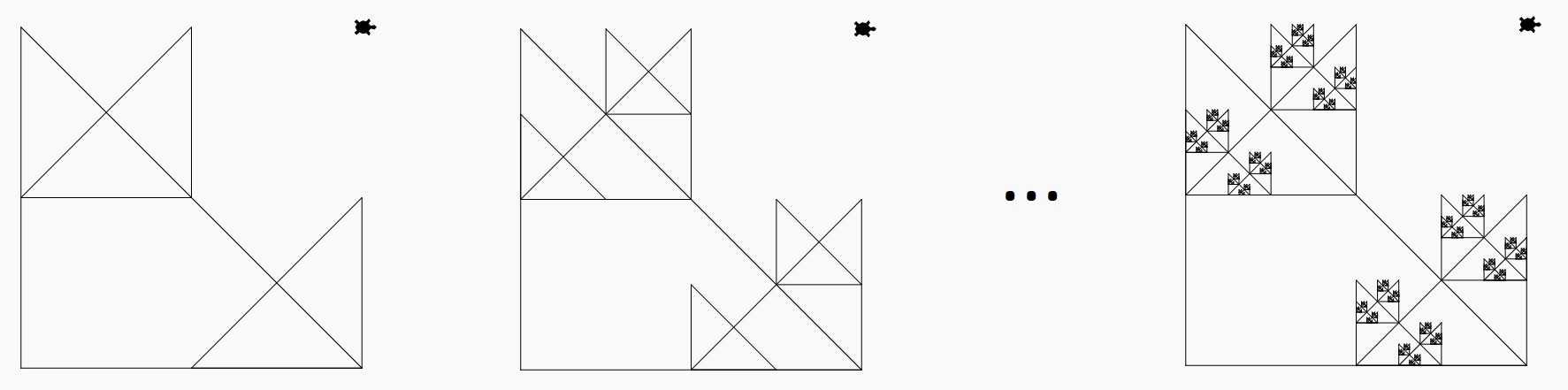
I think that the diagram on the left looks a bit like a cat facing left, hence the name.
The intended challenge is to find the total area inside at least one triangle. I’ll leave that as an exercise!
Droste effect
I said cereal on the livestream, because I thought I’d seen the Droste effect on a cereal box. That appears to be a false memory! The effect is named after a brand of cocoa that used the effect a hundred years ago.
If you want to get in touch with us about any of the mathematics in the video or the further reading, feel free to email us on oomc [at] maths.ox.ac.uk.