


Differentiation Solutions
Part of the Oxford Maths Admissions Test Livestream 2026
These are the solutions for the Differentiation worksheet
Revision Questions
- The derivative of $x^a$ is $ax^{a-1}$ so the derivative of this expression is $17x^{16}+17x^{-18}$.
- Remember that $\sqrt{x}=x^{1/2}$ and $\sqrt[3]{x}=x^{1/3}$, so the derivative of this expression is $x^{-1/2}+x^{-2/3}$, which we could write as $\displaystyle\frac{1}{\sqrt{x}}+\frac{1}{x^{2/3}}$ if we wanted to.
- We can split this into two terms, because $\displaystyle \frac{x+3}{x^2} = \frac{1}{x}+\frac{3}{x^2}$.
Now we can differentiate term-by-term to get $\displaystyle -\frac{1}{x^2}-\frac{6}{x^3}$, which we could write as $-\dfrac{x+6}{x^3}$ if we wanted to. - Differentiate term-by-term to get \[ 0 + 1+ \frac{2x}{2}+\frac{3x^2}{3!}+\frac{4x^3}{4!}+\frac{5x^4}{5!}.\] That simplifies a little bit to give \[ 1+x+\frac{x^2}{2!}+\frac{x^3}{3!}+\frac{x^4}{4!}.\] So it looks like this function is close to being its own derivative. For the purposes of TMUA, there is no such function! At some point in A-level or equivalent, I hope that you will get to see the function $e^x$, which is such a function.
- First we find the derivative $\frac{\mathrm{d}y}{\mathrm{d}x}=3x^2-1$. At $x=1$ this is 2. So our tangent will have gradient 2. It goes through the point $(1,0)$ so the tangent is $y=2(x-1)$. We could write that as $y=2x-2$ if we wanted to.
- This looks absolutely impossible, until you recognise the curve. It's one of the forms of the equation of a circle; if we complete the square for $x$ and complete the square for $y$ we get $(x+1)^2+(y-3)^2=25$. So this curve is a circle with centre $(-1,3)$ and radius 5. Quick sanity check; this goes through the point $(3,0)$ because the displacement $(4,-3)$ has magnitude 5. The line through the centre and the point has gradient $-3/4$, so the tangent will have gradient $4/3$, because for a circle the tangent is at right-angles to the radius. Our tangent goes through the point $(3,0)$, so the tangent is $y=\frac{4}{3}(x-3)$. We could write that as $y=\frac{4}{3}x-4$ if we wanted to.
- First find the derivative at $x=3$, which is $6$ for this parabola. That's the gradient of the tangent, and the normal is at right-angles to the tangent, so it has gradient $\displaystyle -\frac{1}{6}$. We have $\displaystyle y=-\frac{x}{6}+c$ and we want the normal to go through the point $(3,9)$. So we want $\displaystyle c=\frac{19}{2}$.
- Points on this curve satisfy $y=\sqrt{1-x^2}$, which means that they also satisfy $x^2+y^2=1$, and that means that they lie on the unit circle centred on the origin (note that points on our curve have $y\geq 0$, so it's just the upper semicircle). The normal to the curve is therefore just the radius extended out to a line. That will go through the origin, so it has equation $y=mx$ for some $m$. We're asked about the line that goes through the point $(p,\sqrt{1-p^2})$. We've now realised that the line will also go through the origin, so it has gradient $\dfrac{\sqrt{1-p^2}}{p}$. The normal is $y=\dfrac{\sqrt{1-p^2}}{p}x$.
- We could complete the square for this question, writing $\mathrm{f}(x)=(x^2-2)^2-1$. The minimum value will come when $(x^2-2)$ is as close to zero as possible, and that happens when $x^2-2=0$. In that case, the minimum value is $-1$.
Note that if the function had been $x^4+4x^2+3$ then we would have completed the square for $(x^2+2)^2-1$ and our conclusion would be slightly different; the closest that $(x^2+2)$ gets to zero is $2$, when $x=0$.
We could instead have differentiated; $\mathrm{f}'(x)=4x^3-8x$ which is zero when $x=0$ or when $x^2=2$. Checking all the cases helps to avoid the subtlety mentioned in the previous paragraph. Each method has its advantages and disadvantages. - The turning points must have $\displaystyle\frac{\mathrm{d}y}{\mathrm{d}x}=0$ so we must have $4x^3-6x^2+2x=0$. That happens when $x=0$ or when $2x^2-3x+1=0$ which happens when $(2x-1)(x-1)=0$, which is either $x=1$ or $x=\frac{1}{2}$.
Now find the second derivative to check whether these are minima or maxima. We have \[\frac{\mathrm{d}^2y}{\mathrm{d}x^2}=12x^2-12x+2,\] which is positive for $x=0$, negative for $x=\frac{1}{2}$, and positive for $x=1$. So we have a (local) minimum, then a (local) maximum, then a (local) minimum.
The function is decreasing for $x<0$, then increasing for $0< x<\frac{1}{2}$, then decreasing for $\frac{1}{2}< x<1$ then increasing for $x>1$. - The derivative is $\mathrm{f}'(x)=4x^3-12x^2+12x-4$ and this is zero at $x=1$, so we have a stationary point.
To decide whether it's a local maximum or minimum, we could calculate the second derivative $\mathrm{f}''(x)=12x^2-24x+12$, but this turns out to be zero at $x=1$, which is inconclusive. Instead, let's go back to the derivative and try to work out if it changes sign at $x=1$.
We know one factor of that polynomial, so we could factorise $\mathrm{f}'(x)$. If we try that, we find $\mathrm{f}'(x)=4(x-1)^3$. So the sign changes from negative for $x<1$ to positive for $x>1$ and we have a local minimum.
In fact, if we go back to $\mathrm{f}(x)$ and factorise, it turns out that $\mathrm{f}(x)=(x-1)^4$. The graph $y=\mathrm{f}(x)$ is just a translation of the $y=x^4$ graph by one unit in the positive $x$-direction.
TMUA Questions
TMUA 2021 Paper 1 Question 11
- My strategy for this question starts by multiplying out. I know that I'm not going to like what I get! But I can see that I'll get terms that I can differentiate individually.
- I have \[\mathrm{f}(x)=x^{15/7}-x^{8/7}+x^{1/7},\] with derivative \[\mathrm{f}'(x)=\frac{15}{7}x^{8/7}-\frac{8}{7}x^{1/7}+\frac{1}{7}x^{-6/7}\]
- How am I going to work out whether the derivative is positive or negative? I think I'll look for turning points, where the derivative is zero, and investigate the sign between those points.
- Writing $\mathrm{f}'(x)=0$ doesn't get me very far, until I realise that I can factor out a power of $x$ and get something that looks like a quadratic. The key thing to notice is that the exponents $\dfrac{8}{7}$, $\dfrac{1}{7}$, and $-\dfrac{6}{7}$ still have a common difference of $-1$, so if we factor out the correct power, then the exponents will be 2, 1, and 0 again.
- Looking at the last term, which I want to turn into the constant term of the quadratic, I see that I should factor out a power of $x^{-6/7}$.
- Actually, that's a bit of a lie. In fact, I looked at the highest power of $x$ and decided to factor out $x^{-6/7}$ from $x^{8/7}$ so that I'd be left with $x^{14/7}$. Then after I'd done that, I realised that I could have just looked at the constant term.
- Let's also factor out the $\dfrac{1}{7}$ while we're here.
- I get \[\mathrm{f}'(x) = \frac{x^{-6/7}}{7}\left(15x^2-8x+1\right)\]
- This is zero when $15x^2-8x+1=0$, which is when $(5x-1)(3x-1)=0$, so $x=\frac{1}{3}$ or $x=\frac{1}{5}$. A quick sketch of the quadratic is enough for me to convince myself that the gradient is negative in between, so I should take the difference, which is $\frac{2}{15}$.
- The answer is A.
Extension
- If I were using this as the start of an interview question, then next I might tell you that at those turning points the value of the function is $0.665\dots$ and $0.667\dots$ respectively, and I might ask you to sketch the curve $y=\mathrm{f}(x)$.
- Prove that if $\mathrm{f}(x)$ is of the form $x^kq(x)$ for some $k$ and some quadratic $q$, then so is $\mathrm{f}'(x)$.
- If you know the product rule (if $\mathrm{f}(x)=\mathrm{g}(x)\mathrm{h}(x)$ then $\mathrm{f}'(x)=\mathrm{g}'(x)\mathrm{h}(x)+\mathrm{g}(x)\mathrm{h}'(x)$), consider re-doing the algebra above using that rule. Be careful if you're using the product rule for TMUA; questions never require it, and it's not always faster.
TMUA 2021 Paper 1 Question 12
- The first function is $x^4-p^2x^2$ and I'm told that a fact about the minimum value, so I want to find an expression for the minimum value in terms of $p$ and see whether setting that equal to $-9$ tells me anything about $p$.
- I get $4x^3-2p^2x$ for the derivative, and that's zero when $x=0$ or when $2x^2-p^2=0$.
I drew a little sketch while I was thinking about the possibilities for the minimum
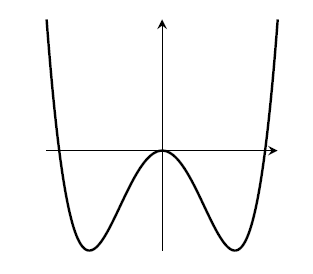
- The function has a local maximum when $x=0$, and the minimum value is attained when $2x^2-p^2=0$. I could solve that for $\displaystyle x=\pm\frac{p}{\sqrt{2}}$.
- The value at the turning points is $\frac{1}{4}p^4-\frac{1}{2}p^4=-9$. This rearranges nicely for $p=\pm \sqrt{6}$.
- I've got two possible values for $p$. I hope that doesn't matter.
- The second function is a quadratic, with derivative $2x-p$, so this time the minimum occurs at $\frac{p}{2}$, with value $\frac{1}{4}p^2-\frac{1}{2}p^2+6$, which is $\dfrac{9}{2}$.
- Alternatively, I could complete the square for the quadratic, writing \[x^2-px+6 = \left(x-\frac{p}{2}\right)^2+6-\frac{p^2}{4}.\] This makes it nice and clear that the minimum value depends on $p^2$ only, and doesn't depend on the sign of $p$.
- The answer is E.
Extension
- You can do this question without differentiating, because you can complete the square for the first function. Give that a go, and explain using this form why there is a local maximum at $x=0$ and why there are local minima at $x=\pm\frac{p}{\sqrt{2}}$.
- Sketch both functions. Show both cases for the second function.
TMUA 2021 Paper 2 Question 6
I started by thinking about whether $P$ implies $Q$. I drew a picture like this
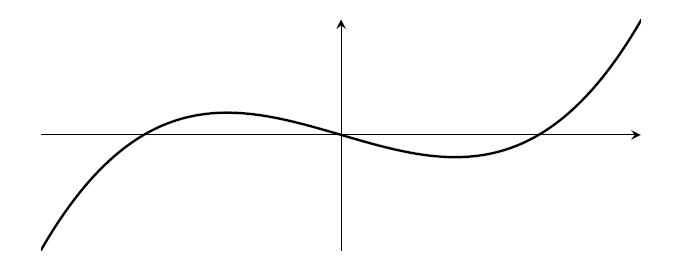
which has exactly three values of $x$ where $\mathrm{f}(x)=0$ and has two values of $x$ where $\mathrm{f}'(x)=0$.- In between two of the roots, whenever I draw a smooth curve that leaves the $x$-axis and comes back, I always have a point where the curve turns around. A turning point! One between the first and second roots, and then one between the second and third roots.
- At this stage, I was convinced that $P$ was sufficient for $Q$. We'll come back!
- Thinking about "the other way around", I want to know whether having a couple of turning points means that you have three roots. My intuition here is "no", loosely because I know that you can translate a graph, which won't change the number of turning points but will probably change the number of roots.
- To illustrate this, I sketched a cubic with two turning points and exactly one root.
- This reminded me that you can have turning points that are nowhere near the roots. What if the previous polynomial did something like that?
Going back to my first sketch, I added some wiggles
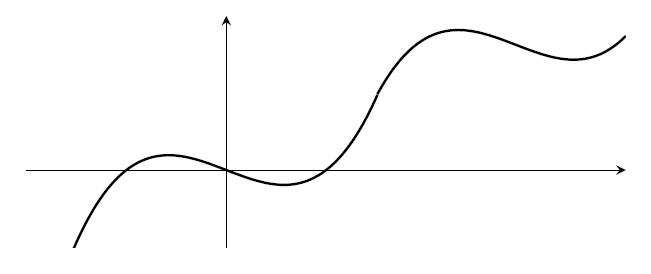
- This polynomial could have way more than "exactly two" turning points!
- I no longer think that $P$ is necessary or sufficient for $Q$.
- The answer is D.
Extension
- The answer to this question is disappointing; statements $P$ and $Q$ appear to have nothing to do with each other. Can you salvage this by changing the phrasing of one or both of the statements slightly?
- Check your understanding with these two statements about a quadratic polynomial $\mathrm{f}(x)$. $A$: $\mathrm{f}(x)=0$ for exactly two real values of $x$. $B$: $\mathrm{f}'(x)=0$ for exactly one real value of $x$. Is $A$ necessary for $B$, sufficient for $B$, both, or neither?
- (Hard) Find a polynomial that satisfies $P$ but not $Q$.
TMUA 2021 Paper 2 Question 8
I started sketching some curves with $p(a)=p(b)$. It seems that I get to choose what that value is, and what $a$ and $b$ are, but it doesn't seem to matter very much; I always have at least one point in between where the gradient is zero.
Just a note; if all your sketches look like this
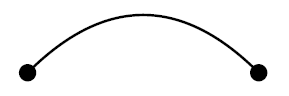
then you're going to be fine for this question, but you can be a bit more inventive! Ideally you'd have a sketch in your collection that looks more like this
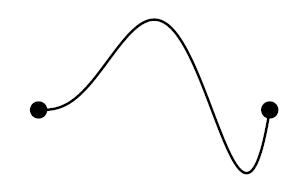
with multiple turning points, and/or with some values larger than $p(a)$, and/or with some values smaller than $p(a)$ and/or with zero derivative at one of the endpoints. None of this matters for this question, but officially we don't know that yet!- All my graphs have a maximum value somewhere in between $a$ and $b$, with zero derivative there. So I think that the condition $\mathrm{p}(a) = \mathrm{p}(b)$ is sufficient for $(\ast)$.
- The other way around, we would have "If there exists a number $c$ with $a< c< b$ such that $\mathrm{p}'(c)=0$ then $\mathrm{p}(a)=\mathrm{p}(b)$".
- I can't really see how this could be true in general. The fact $\mathrm{p}'(c)=0$ is so weak, and doesn't seem to involve $a$ or $b$ at all. How could you possibly know the values of $\mathrm{p}(a)$ and $\mathrm{p}(b)$?
- More precisely, take that first sketch and nudge $b$ left a bit. Now $\mathrm{p}(a)\neq \mathrm{p}(b)$ but there's still a point with zero derivative (the same point as before!).
- So I think that the condition $\mathrm{p}(a)=\mathrm{p}(b)$ is not necessary for $(\ast)$.
- The answer is C.
Extension
- If I were using this as the start of an interview question, then next I might confirm (because we haven't really proved it above) that for any polynomial $\mathrm{p}(x)$ and any real numbers $a$ and $b$ with $a< b$, if $\mathrm{p}(a)=\mathrm{p}(b)$ then there exists a number $c$ with $a< c< b$ such that $\mathrm{p}'(c)=0$. This is called Rolle's theorem. The next task I might give you is as follows; suppose that $\mathrm{p}(a)\neq \mathrm{p}(b)$. Is there always a number $c$ such that $\mathrm{p}'(c)$ is equal to the gradient of the line through $(a,\mathrm{p}(a))$ and $(b,\mathrm{p}(b))$? Can you prove it?
- Next, I might ask you to consider the graph of a polynomial with exactly two turning points. Can you prove that there is a point on such a graph where the second derivative is zero?
TMUA 2022 Paper 1 Question 15
I had to draw a diagram for this just to work out where the rectangle was. It's important that the sides are parallel to the axes
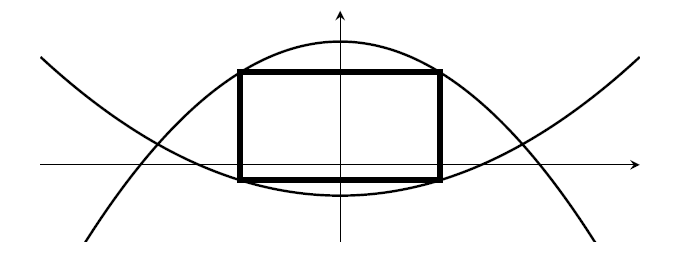
- To draw this, I started by choosing a value for the $x$-coordinate of the right-hand side of the rectangle. Let's call that $a$. I could call it $x$, but that gets confusing quickly.
- The rest of the rectangle followed without further choices from me; the curves have reflectional symmetry in the $y$-axis, which makes things easier. The opposite side must be at $x=-a$. Then the height of the rectangle is given by the difference between the values of $p(a)$ and $q(a)$.
- At some point, I think I've assumed that the corners of the rectangle lie on one curve or the other. Based on my diagram, I might say that if the corners don't lie on the curve, then we can make the rectangle larger by moving the edges outwards until the corners reach the curves.
- The area is \[ \left(2 a\right) \times \left(\left(8-2a^2\right) - (a^2-2)\right)\] which is \[2a(10-3a^2).\]
- It's time to find the maximum of this function of $a$. I'll multiply out the bracket to get $20a-6a^3$, and then differentiate with respect to $a$.
- That gives $20 - 18 a^2$, which is equal to zero when $a$ is $\displaystyle \sqrt{\frac{20}{18}}=\sqrt{\frac{10}{9}}=\frac{\sqrt{10}}{3}$.
- The value of the function at that point is \[\left(2 \frac{\sqrt{10}}{3}\right)\times \left(10 - 3 \frac{10}{9}\right) = \frac{40\sqrt{10}}{9}.\]
- The answer is H.
Extension
- If I were using this as the start of an interview question, then next I might ask you whether it's possible to draw a square in that region enclosed by the curves $p$ and $q$, with all four corners of the square on a curve. Try to decide whether this is possible without detailed calculation... and then with detailed calculation.
TMUA 2022 Paper 2 Question 17
- I always read these line-by-line, while trying to remember what we're trying to prove.
- Here we're trying to prove that if \[27b\!\left(b + \dfrac{4a^3}{27}\right) < 0\qquad(\ast)\] then the equation $x^3 + ax^2 + b = 0$ has three distinct real roots. Quick sanity check; do I think that an equation like that could have three distinct real roots? Yes, it's a cubic, I know that those sometimes (but not always) have three distinct real roots.
- I could believe that there's some complicated inequality involving the coefficients that tells us whether the equation has three distinct real roots (but notice that in this question the student is only asked to check that the condition $(\ast)$ is sufficient, not that it is necessary).
- Step I seems fine to me. I don't particularly want to check that they've evaluated the cubic correctly for the $y$-coordinate of the stationary points, so I'll take that on trust for now.
- Step II seems uncontroversial. I like the way this starts "If $(\ast)$..." because the student is supposed to be proving a statement that starts like that.
- Then the next step says "If the cubic has three distinct roots,..." and alarm bells go off. Don't assume the thing that you're trying to prove, student! Step III is irrelevant.
- The last line starts "Hence", but I don't think this follows. In step II things were going well and we'd shown that the turning points would have opposite signs. That hasn't gone anywhere.
- I think that step III is backwards.
- More precisely, if the student had proved the converse (the other way around), then everything would fit together neatly.
- The answer is E.
Extension
- Explain to yourself why the converse of step III is true, fixing the student's proof.
- Show that $(\ast)$ is necessary for the equation $x^3+ax^2+b=0$ to have three distinct real roots (this is the converse of the overall statement that the student was trying to prove).
- Sketch the region(s) of the $(a,b)$-plane where $(\ast)$ holds.