


Fluency
Part of the Oxford Maths Admissions Test Livestream 2026
Solutions are available here.
General Advice
These questions get you to use techniques without prompting. Do you know what you know?
- Revise your A-level or equivalent.
- You could use flashcards to revise topics, like the ones at www.maths.ox.ac.uk/r/tmua for the TMUA content specification.
- Any questions you can find that are based on mathematics you have learned can be helpful, no matter where you find them. The first set of eight worksheets had lots of tricky questions based on the mathematics on the TMUA content specification.
- The idea is that if we spend less time thinking about the routine steps, we'll have more time and energy to think about more complicated steps in a question.
Warm-up
A sketch of the curve \[ (x^{8}+4yx^{6}+6y^{2}x^{4}+4y^{3}x^{2}+y^{4})^{2}=1 \] is shown below in which of these options?
(a) 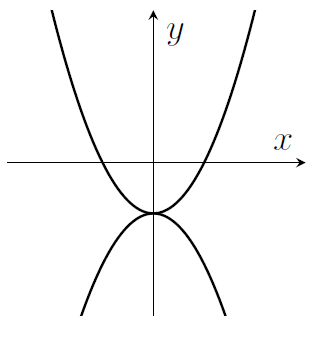
(b) 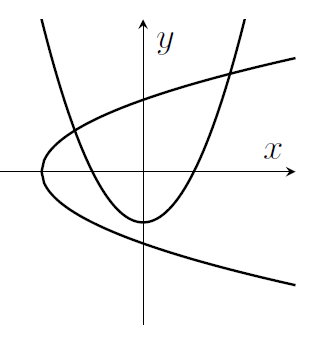
(c) 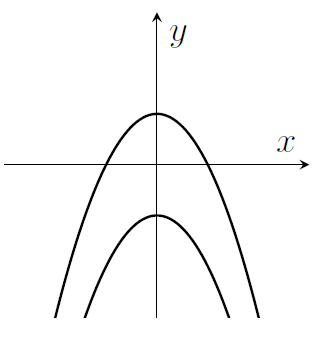
(d) 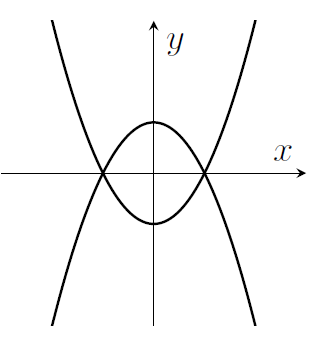
(e) 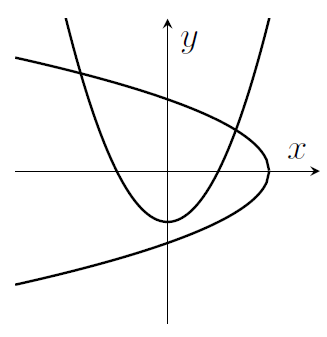
Questions
TMUA 2021 Paper 2 Question 15
A circle has equation \[ x^2+ax+y^2+by+c=0 \] where $a$, $b$, and $c$ are non-zero real constants.
Which one of the following is a necessary and sufficient condition for the circle to be tangent to the $y$-axis?
(A) $a^2=4c$
(B) $b^2=4c$
(C) $\displaystyle \frac{a}{2}=\sqrt{\frac{a^2+b^2}{4}-c}$
(D) $\displaystyle \frac{b}{2}=\sqrt{\frac{a^2+b^2}{4}-c}$
(E) $\displaystyle -\frac{a}{2}=\sqrt{\frac{a^2+b^2}{4}-c}$
(F) $\displaystyle -\frac{b}{2}=\sqrt{\frac{a^2+b^2}{4}-c}$
TMUA 2020 Paper 2 Question 7
Consider the following conditions on a parallelogram $PQRS$, labelled anticlockwise:
I length of $PQ$ $=$ length of $QR$
II The diagonal $PR$ intersects the diagonal $QS$ at right angles.
III $\angle PQR = \angle QRS$
Which of these conditions is/are individually sufficient for the parallelogram $PQRS$ to be a square?
| Condition I is sufficient | Condition II is sufficient | Condition III is sufficient | |
| A | yes | yes | yes |
| B | yes | yes | no |
| C | yes | no | yes |
| D | yes | no | no |
| E | no | yes | yes |
| F | no | yes | no |
| G | no | no | yes |
| H | no | no | no |
TMUA 2022 Paper 2 Question 1
Determine the number of stationary points on the curve with equation \[ y=3x^4+4x^3+6x^2-5 \]
(A) 0
(B) 1
(C) 2
(D) 3
(E) 4
MAT 2010 Q1F
The graph $y=f(x)$ of a function is drawn below for $0\leq x\leq 1$.
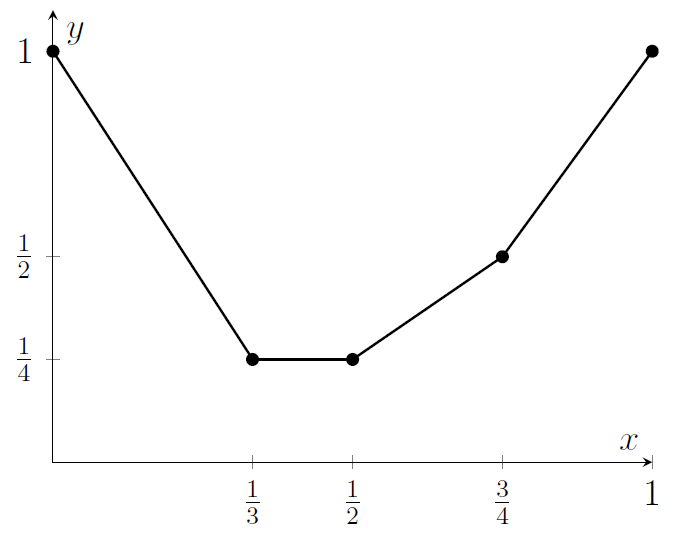
The trapezium rule is then used to estimate \[ \int_0^1 f(x)\,\mathrm{d}x \] by dividing $0\leq x \leq 1$ into $n$ equal intervals. The estimate calculated will equal the actual integral when
(a) $n$ is a multiple of 4,
(b) $n$ is a multiple of 6,
(c) $n$ is a multiple of 8,
(d) $n$ is a multiple of 12.
MAT 2020 Q1I
In the range $-90^\circ\lt x\lt 90^\circ$, how many values of $x$ are there for which the sum to infinity \[ \frac{1}{\tan x}+\frac{1}{\tan^2 x}+\frac{1}{\tan^3 x}+\dots \] equals $\tan x$?
(a) 0
(b) 1
(c) 2
(d) 3
(e) 4.
Part of an Interview
Adapted from an interview question used by James Munro for Maths interviews at Oxford. Reproduced here with permission.
Let $a$ and $b$ and $c$ be real numbers, with $a \neq 0$.
Find conditions on $a$, $b$, and $c$ such that $f(x)=ax^5+bx^3+cx$ is a strictly increasing function.
There are various different cases that you should find.
The interview might need a discussion about what it means for a function to be strictly increasing. For TMUA the definition of "strictly increasing" is that $f'(x)\gt 0$ for all $x$, but an alternative (and non-equivalent) definition is that $f(x)\lt f(y)$ whenever $x\lt y$.
The interview might explore what happens if we instead look at functions for which $f'(x)\geq 0$, or functions for which $f(x)\leq f(y)$ whenever $x \lt y$.
Depending on how the interview is going, we might change the exponents from $(5,3,1)$ to some other strictly-decreasing sequence of three numbers and see what happens.