Oxford University Club Cricket Club (OUCCC) is a friendly and inclusive cricket club for Oxford University staff, graduate students, and alumni, and we’d love to welcome new players this season. We play relaxed 40-over fixtures almost every Sunday from April to September, take a break in July for our popular mini T20 World Cup, and run weekly outdoor nets from February onwards (weather permitting). Players of all abilities are very welcome.

Calving laws and where to find them
Benn, D Wheel, I Åström, J Christoffersen, P Cook, S Luckman, A Nick, F Hulton, N Hewitt, I Bassis, J The Journal of Glaciology 1-35 (06 Feb 2026)
Thu, 05 Mar 2026
11:00
C1

Cancelled

Abstract
This talk has been cancelled.
Probing neutrino emission at GeV energies from compact binary mergers with the IceCube Neutrino Observatory
Abbasi, R Ackermann, M Adams, J Agarwalla, S Aguilar, J Ahlers, M Alameddine, J Amin, N Andeen, K Argüelles, C Ashida, Y Athanasiadou, S Axani, S Babu, R Bai, X Baines-Holmes, J V., A Barwick, S Bash, S Basu, V Bay, R Beatty, J Tjus, J Behrens, P Beise, J Bellenghi, C Benkel, B BenZvi, S Berley, D Bernardini, E Besson, D Blaufuss, E Bloom, L Blot, S Bodo, I Bontempo, F Motzkin, J Meneguolo, C Böser, S Botner, O Böttcher, J Braun, J Brinson, B Brisson-Tsavoussis, Z Burley, R Butterfield, D Campana, M Carloni, K Carpio, J Chattopadhyay, S Chau, N Chen, Z Chirkin, D Choi, S Clark, B Coleman, A Coleman, P Collin, G Connolly, A Conrad, J Corley, R Cowen, D De Clercq, C DeLaunay, J Delgado, D Delmeulle, T Deng, S Desiati, P de Vries, K de Wasseige, G DeYoung, T Díaz-Vélez, J DiKerby, S Dittmer, M Domi, A Draper, L Dueser, L Durnford, D Dutta, K DuVernois, M Ehrhardt, T Eidenschink, L Eimer, A Eller, P Ellinger, E Elsässer, D Engel, R Erpenbeck, H Esmail, W Eulig, S Evans, J Evenson, P Fan, K Fang, K Farrag, K Fazely, A Fedynitch, A Feigl, N Finley, C Fischer, L Fox, D Franckowiak, A Fukami, S Fürst, P Gallagher, J Ganster, E Garcia, A Garcia, M Garg, G Genton, E Gerhardt, L Ghadimi, A Glaser, C Glüsenkamp, T Gonzalez, J Goswami, S Granados, A Grant, D Gray, S Griffin, S Griswold, S Groth, K Guevel, D Günther, C Gutjahr, P Ha, C Haack, C Hallgren, A Halve, L Halzen, F Hamacher, L Minh, M Handt, M Hanson, K Hardin, J Harnisch, A Hatch, P Haungs, A Häußler, J Helbing, K Hellrung, J Hennig, L Heuermann, L Hewett, R Heyer, N Hickford, S Hidvegi, A Hill, C Hill, G Hmaid, R Hoffman, K Hooper, D Hori, S Hoshina, K Hostert, M Hou, W Huber, T Hultqvist, K Hymon, K Ishihara, A Iwakiri, W Jacquart, M Jain, S Janik, O Jeong, M Jin, M Kamp, N Kang, D Kang, W Kang, X Kappes, A Kardum, L Karg, T Karl, M Karle, A Katil, A Kauer, M Kelley, J Khanal, M Zathul, A Kheirandish, A Kimku, H Kiryluk, J Klein, C Klein, S Kobayashi, Y Kochocki, A Koirala, R Kolanoski, H Kontrimas, T Köpke, L Kopper, C Koskinen, D Koundal, P Kowalski, M Kozynets, T Krieger, N Krishnamoorthi, J Krishnan, T Kruiswijk, K Krupczak, E Kumar, A Kun, E Kurahashi, N Lad, N Gualda, C Arnaud, L Lamoureux, M Larson, M Lauber, F Lazar, J DeHolton, K Leszczyńska, A Liao, J Liu, Y Liubarska, M Love, C Lu, L Lucarelli, F Luszczak, W Lyu, Y Madsen, J Magnus, E Mahn, K Makino, Y Manao, E Mancina, S Mand, A Mariş, I Marka, S Marka, Z Marten, L Martinez-Soler, I Maruyama, R Mayhew, F McNally, F Mead, J Meagher, K Mechbal, S Medina, A Meier, M Merckx, Y Merten, L Mitchell, J Molchany, L Montaruli, T Moore, R Morii, Y Mosbrugger, A Moulai, M Mousadi, D Mukherjee, T Naab, R Nakos, M Naumann, U Necker, J Neste, L Neumann, M Niederhausen, H Nisa, M Noda, K Noell, A Novikov, A Pollmann, A O’Dell, V Olivas, A Orsoe, R Osborn, J O’Sullivan, E Palusova, V Pandya, H Parenti, A Park, N Parrish, V Paudel, E Paul, L de los Heros, C Pernice, T Peterson, J Plum, M Pontén, A Poojyam, V Popovych, Y Rodriguez, M Pries, B Procter-Murphy, R Przybylski, G Pyras, L Raab, C Rack-Helleis, J Rad, N Ravn, M Rawlins, K Rechav, Z Rehman, A Reistroffer, I Resconi, E Reusch, S Rho, C Rhode, W Riedel, B Rifaie, A Roberts, E Robertson, S Rongen, M Rosted, A Rott, C Ruhe, T Ruohan, L Saffer, J Salazar-Gallegos, D Sampathkumar, P Sandrock, A Sanger-Johnson, G Santander, M Sarkar, S Savelberg, J Schaile, P Schaufel, M Schieler, H Schindler, S Schlickmann, L Schlüter, B Schlüter, F Schmeisser, N Schmidt, T Schröder, F Schumacher, L Schwirn, S Sclafani, S Seckel, D Seen, L Seikh, M Seunarine, S Myhr, P Shah, R Shefali, S Shimizu, N Skrzypek, B Snihur, R Soedingrekso, J Søgaard, A Soldin, D Soldin, P Sommani, G Spannfellner, C Spiczak, G Spiering, C Stachurska, J Stamatikos, M Stanev, T Stezelberger, T Stürwald, T Stuttard, T Sullivan, G Taboada, I Ter-Antonyan, S Terliuk, A Thakuri, A Thiesmeyer, M Thompson, W Thwaites, J Tilav, S Tollefson, K Toscano, S Tosi, D Trettin, A Upadhyay, A Upshaw, K Vaidyanathan, A Valtonen-Mattila, N Valverde, J Vandenbroucke, J Van Eeden, T van Eijndhoven, N Van Rootselaar, L van Santen, J Vara, J Varsi, F Venugopal, M Vereecken, M Carrasco, S Verpoest, S Veske, D Vijai, A Villarreal, J Walck, C Wang, A Warrick, E Weaver, C Weigel, P Weindl, A Weldert, J Wen, A Wendt, C Werthebach, J Weyrauch, M Whitehorn, N Wiebusch, C Williams, D Witthaus, L Wolf, M Wrede, G Xu, X Yañez, J Yao, Y Yildizci, E Yoshida, S Young, R Yu, F Yu, S Yuan, T Zegarelli, A Zhang, S Zhang, Z Zhelnin, P Zilberman, P Physical Review D volume 113 issue 4 042003 (15 Feb 2026)
Wed, 04 Mar 2026
12:45
TCC VC

Krylov complexity and the universal operator growth hypothesis

Om Gupta
Abstract

A central goal in the study of quantum chaos is being able to make universal statements about the dynamics of generic Hamiltonian systems. Under time evolution, an initially local operator progressively explores the Hilbert space of a system becoming increasingly non-local in the process. We will see that this idea lends itself to a natural notion of operator complexity measured (in the Hilbert space of operators) by the overlap of a time-evolving operator with a basis naturally adapted to time evolution and stratified by the growth in the operator's support. The information contained in this so-called Krylov basis is encoded in a sequence called the Lanczos coefficients which quantify the rate at which an operator is "pushed" along the Krylov basis to successively more complex elements. The universal operator growth hypothesis is then the conjecture that the Lanczos coefficients grow asymptotically linearly in any quantum chaotic system. In this talk, I will present an overview of these ideas and see how they manifest in the example of the well-studied SYK model. This talk is primarily based on 1812.08657.

Accelerating Inference for Multilayer Neural Networks with Quantum Computers
Rattew, A Huang, P Guo, N Pira, L Rebentrost, P The Fourteenth International Conference on Learning Representations
Visual description of the concept
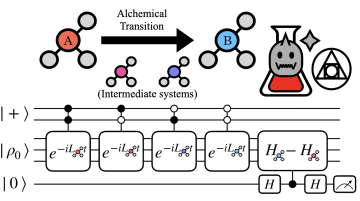
Quantum computers achieve a remarkable exponential speedup in integer factorisation (potentially making widely deployed cryptographic schemes vulnerable). Beyond that large-scale applications remain comparatively scarce, and if a fully error-corrected quantum computer were available it is not clear what 'killer app' it would be used for.
Mon, 15 Jun 2026

15:30 - 16:30
L3

TBA

Emilio Ferrucci
(SISSA)
Abstract

TBA

Mon, 27 Apr 2026

15:30 - 16:30
L3

Fractional Black-Scholes model and Girsanov transform for sub-diffusions

Prof. Zhen-Qing Chen
(University of Washington)
Abstract

We propose a novel Black-Scholes model under which the stock price processes are modeled by stochastic differential equations driven  by sub-diffusions. The new framework can capture the less financial activity phenomenon during the bear markets while having the classical Black-Scholes model as its special case. The sub-diffusive spot market is arbitrage-free but is in general incomplete. We investigate the pricing for European-style contingent claims under this new model. For this, we study the Girsanov transform for sub-diffusions and use it to find risk-neutral probability measures for the new Black-Scholes model. Finally, we derive the explicit formula for the price of European call options and show that it can be determined by a partial differential equation (PDE) involving a fractional derivative in time, which we coin a time-fractional Black-Scholes PDE.

Subscribe to