

Out-of-plane buckling in two-dimensional glass drawing
O'Kiely, D
Breward, C
Griffiths, I
Howell, P
Lange, U
Journal of Fluid Mechanics
volume 869
587-609
(29 Apr 2019)
doi:10.1017/jfm.2019.221
Fri, 08 Mar 2019
10:00 -
11:00
L3
Mechano-electrophysiological coupling in axonal membrane: theory, controversy and neuromodulation
Antoine Jerusalem
(Department of Engineering Science)
Wed, 20 Feb 2019
17:00 -
18:00
C1
Virtual fibring of manifolds and groups
Dawid Kielak
Abstract
I will discuss Agol's proof of the Virtually Fibred Conjecture of
Thurston, focusing on the role played by the `RFRS' property. I will
then show how one can modify parts of Agol's proof by replacing some
topological considerations with a group theoretic statement about
virtual fibring of RFRS groups.
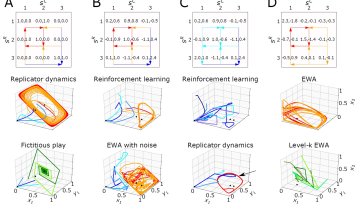
The concept of equilibrium is one of the most central ideas in economics. It is one of the core assumptions in the vast majority of economic models, including models used by policymakers on issues ranging from monetary policy to climate change, trade policy and the minimum wage. But is it a good assumption?
Fri, 10 May 2019
10:00 -
11:00
L3
Developing the Next Generation of Image Reconstruction in Atom Probe Tomography
Charlie Fletcher and Dan Haley
(Department of Materials Science)
Abstract
Atom Probe Tomography is a powerful 3D mass spectrometry technique. By pulsing the sample apex with an electric field, surface atoms are ionised and collected by a detector. A 3D image of estimated initial ion positions is constructed via an image reconstruction protocol. Current protocols assume ion trajectories follow a stereographic projection. However, this method assumes a hemispherical sample apex that fails to account for varying material ionisation rates and introduces severe distortions into atomic distributions for complex material systems.
We aim to develop continuum models and use this to derive a time-dependent mapping describing how ion initial positions on the sample surface correspond to final impact positions on the detector. When correctly calibrated with experiment, such a mapping could be used for performing reconstruction.
Currently we track the sample surface using a level set method, while the electric field is solved via BEM or a FEM-BEM coupling. These field calculations must remain accurate close to the boundary. Calibrating unknown evaporation parameters with experiment requires an ensemble of models per experiment. Therefore, we are also looking to maximise model efficiency via BEM compression methods i.e. fast multipole BEM. Efficiently constructing and reliably interpolating the non-bijective trajectory mapping, while accounting for ion trajectory overlap and instabilities (at sample surface corners), also presents intriguing problems.
This project is in collaboration with Cameca, the leading manufacturer of commercial atom probe instruments. If successful in minimising distortions such a technique could become valuable within the semiconductor industry.
Age-structure as key to delayed logistic proliferation of scratch assays
Ponce Bobadilla, A
Carraro, T
Byrne, H
Maini, P
Alarcon, T
Bulletin of Mathematical Biology
volume 81
issue 7
2706-2724
(14 Feb 2019)
doi:10.1101/540526
Measuring rank robustness in scored protein interaction networks
Bozhilova, L
Whitmore, A
Wray, J
Reinert, G
Deane, C
BMC Bioinformatics
(29 Aug 2019)
doi:10.1101/502302
Supersonic plasma turbulence in the laboratory
White, T
Oliver, M
Mabey, P
Bott, A
Schekochihin, A
Gregori, G
Nature Communications
volume 10
(15 Apr 2019)
doi:10.1038/s41467-019-09498-y

Oxford Mathematician Thomas Prince talks about his work on the construction of Fano manifolds in dimension four and their connection with Calabi-Yau geometry.
Fri, 21 Jun 2019
14:00 -
15:30
L6
Dynamically consistent parameterization of mesoscale eddies
Dr. Pavel Berloff
(Imperial College London)
Abstract
This work aims at developing new approach for parameterizing mesoscale eddy effects for use in non-eddy-resolving ocean circulation models. These effects are often modelled as some diffusion process or a stochastic forcing, and the proposed approach is implicitly related to the latter category. The idea is to approximate transient eddy flux divergence in a simple way, to find its actual dynamical footprints by solving a simplified but dynamically relevant problem, and to relate the ensemble of footprints to the large-scale flow properties.