

Dual Space Preconditioning for Gradient Descent
Maddison, C
Paulin, D
Teh, Y
Doucet, A
SIAM Journal on Optimization
http://arxiv.org/abs/1902.02257v3
Tue, 26 Feb 2019
14:30 -
15:30
L6
Graphons with minimum clique density
Maryam Sharifzadeh
Further Information
Among all graphs of given order and size, we determine the asymptotic structure of graphs which minimise the number of $r$-cliques, for each fixed $r$. In fact, this is achieved by characterising all graphons with given density which minimise the $K_r$-density. The case $r=3$ was proved in 2016 by Pikhurko and Razborov.
This is joint work with H. Liu, J. Kim, and O. Pikhurko.
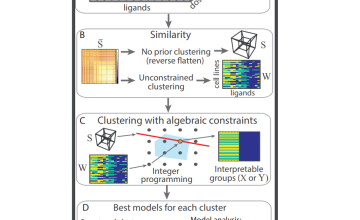
Oxford Mathematicians Anna Seigal, Heather Harrington, Mariano Beguerisse Diaz and colleagues talk about their work on trying to find cancer cell lines with similar responses by clustering them with structural constraints.
Scalable Metropolis-Hastings for Exact Bayesian Inference with Large
Datasets
Cornish, R
Vanetti, P
Bouchard-Côté, A
Deligiannidis, G
Doucet, A
ICML 2019
(13 Jun 2019)
http://arxiv.org/abs/1901.09881v2
Datasets
Tue, 19 Feb 2019
14:00 -
14:30
L3
Stochastic Analysis and Correction of Floating Point Errors in Monte Carlo Simulations
Oliver Sheridan-Methven
(Oxford)
Abstract
In this talk we will show how the floating point errors in the simulation of SDEs (stochastic differential equations) can be modelled as stochastic. Furthermore, we will show how these errors can be corrected within a multilevel Monte Carlo approach which performs most calculations with low precision, but a few calculations with higher precision. The same procedure can also be used to correct for errors in converting from uniform random numbers to approximate Normal random numbers. Numerical results will be generated on both CPUs (using single/double precision) and GPUs (using half/single precision).
Tue, 12 Feb 2019
12:00 -
13:00
C4
Modelling sparsity, heterogeneity, reciprocity and community structure in temporal interaction data
Xenia Miscouridou
(University of Oxford; Department of Statistics)
Abstract
We propose a novel class of network models for temporal dyadic interaction data. Our objective is to capture important features often observed in social interactions: sparsity, degree heterogeneity, community structure and reciprocity. We use mutually-exciting Hawkes processes to model the interactions between each (directed) pair of individuals. The intensity of each process allows interactions to arise as responses to opposite interactions (reciprocity), or due to shared interests between individuals (community structure). For sparsity and degree heterogeneity, we build the non time dependent part of the intensity function on compound random measures following (Todeschini et al., 2016). We conduct experiments on real- world temporal interaction data and show that the proposed model outperforms competing approaches for link prediction, and leads to interpretable parameters.
Link to paper: https://papers.nips.cc/paper/7502-modelling-sparsity-heterogeneity-reci…
Wed, 13 Feb 2019
11:00
11:00
N3.12
Grothendieck Rings of Varieties and Cubic Hypersurfaces
Søren Gammelgaard
(University of Oxford)
Abstract
The Grothendieck ring of varieties over a field is a simple idea that formalizes various cut-and-paste arguments in algebraic geometry. We will explain how this intuitive construction leads to nontrivial results, such as computing Euler characteristics, counting points of varieties over finite fields, and determining Hodge numbers. As an example, we will investigate cubic hypersurfaces, especially the varieties parametrizing lines on them. If time permits, we will discuss some of the stranger properties of the Grothendieck ring.

Differential equations arising in physics and elsewhere often describe the evolution in time of quantities which also depend on other (typically spatial) variables. Well known examples of such evolution equations include the heat equation and the wave equation.
Architecture of a minimal signalling pathway explains the T cell response to a 1,000,000-fold variation in antigen affinity and dose
Lever, M
Lim, H
Kruger, P
Nguyen, J
Trendel, N
Abu-Shah, E
Maini, P
van der Merwe, P
Dushek, O
071878
(27 Aug 2016)
doi:10.1101/071878
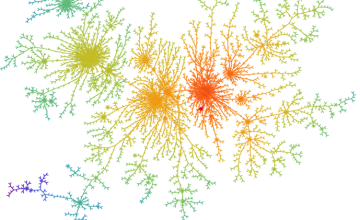
The Mathematics of Random Systems: Analysis, Modelling and Algorithms is our new EPSRC Centre for Doctoral Training (CDT), and a partnership between three world-class departments in the area of probabilistic modelling, stochastic analysis and their applications: the Mathematical Institute, Oxford, the Department of Statistics in Oxford and the Dept of Mathematics, Imperial College London.