

A note on graphs of k-colourings
Hogan, E
Scott, A
Tamitegama, Y
Tan, J
Electronic Journal of Combinatorics
volume 31
issue 4
(29 Nov 2024)
Asparagine availability controls germinal center B cell homeostasis
Yazicioglu, Y
Marin, E
Andrew, H
Bentkowska, K
Johnstone, J
Mitchell, R
Wong, Z
Zec, K
Fergusson, J
Borsa, M
Raza, I
Attar, M
Ali, M
Kronsteiner, B
Furlani, I
MacRae, J
Devine, M
Coles, M
Buckley, C
Dunachie, S
Clarke, A
Science Immunology
volume 9
issue 102
eadl4613
(13 Dec 2024)
Defending Against Diverse Attacks in Federated Learning Through
Consensus-Based Bi-Level Optimization
Trillos, N
Akash, A
Li, S
Riedl, K
Zhu, Y
(03 Dec 2024)
http://arxiv.org/abs/2412.02535v2
Consensus-Based Bi-Level Optimization
Argentine ants regulate traffic flow with stopped individuals
Dobramysl, U
Garnier, S
Poissonnier, L
Dussutour, A
Bruna, M
(09 Dec 2024)
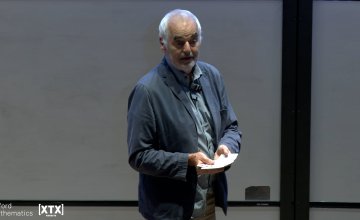
We all have to live with uncertainty. We attribute good and bad events as ‘due to chance’, label people as ‘lucky’, and (sometimes) admit our ignorance. In this Oxford Mathematics Public Lecture David shows how to use the theory of probability to take apart all these ideas, and demonstrate how you can put numbers on your ignorance, and then measure how good those numbers are.
Supplementary Data from Mathematical Model-Driven Deep Learning Enables Personalized Adaptive Therapy
Gallagher, K
Strobl, M
Park, D
Spoendlin, F
Gatenby, R
Maini, P
Anderson, A
(11 Dec 2024)
Triple-gluon and quark-gluon vertex from lattice QCD in Landau gauge
Sternbeck, A
Balduf, P
Kizilersü, A
Oliveira, O
Silva, P
Skullerud, J
Williams, A
Proceedings of Science
volume Part F128557
(01 Jan 2016)
Tubings, chord diagrams, and Dyson–Schwinger equations
Balduf, P
Cantwell, A
Ebrahimi-Fard, K
Nabergall, L
Olson-Harris, N
Yeats, K
Journal of the London Mathematical Society
volume 110
issue 5
(01 Nov 2024)
A dynamical analysis of the alignment mechanism between two interacting cells
Leech, V
Dalwadi, M
Manhart, A
Bulletin of Mathematical Biology
volume 87
issue 2
(03 Jan 2025)