

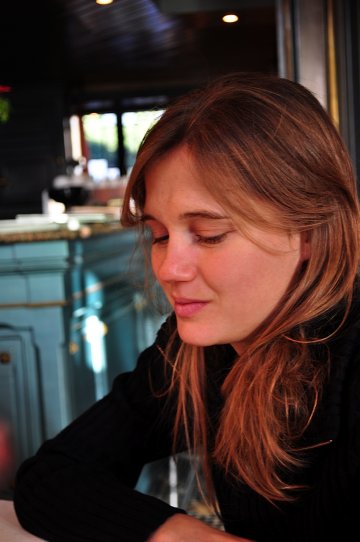
Oxford Mathematician Maria Bruna has won the Women of the Future Science award. The Women of the Future Awards, founded by Pinky Lilani in 2006, were conceived to provide a platform for the pipeline of female talent in the UK. Now in their 11th year they recognise the inspirational young female stars of today and tomorrow.
Tue, 29 Nov 2016
14:00
14:00
L3
Stochastic discrete Hamiltonian variational integrators
Tom Tyranowski
(Imperial College)
Abstract
Stochastic Hamiltonian systems with multiplicative noise are a mathematical model for many physical systems with uncertainty. For example, they can be used to describe synchrotron oscillations of a particle in a storage ring. Just like their deterministic counterparts, stochastic Hamiltonian systems possess several important geometric features; for instance, their phase flows preserve the canonical symplectic form. When simulating these systems numerically, it is therefore advisable that the numerical scheme also preserves such geometric structures. In this talk we propose a variational principle for stochastic Hamiltonian systems and use it to construct stochastic Galerkin variational integrators. We show that such integrators are indeed symplectic, preserve integrals of motion related to Lie group symmetries, demonstrate superior long-time energy behavior compared to nonsymplectic methods, and they include stochastic symplectic Runge-Kutta methods as a special case. We also analyze their convergence properties and present the results of several numerical experiments.
Wed, 30 Nov 2016
11:30
11:30
N3.12
Partition Identities, Q-series and the Quest for Rogers-Ramanujan Involutions
Adam Keilthy
(University of Oxford)
Abstract
This talk will introduce some arguably trivial results about partition identities, and generating functions for various counts of partitions. We will discuss methods of proving q-series identities via bijections of partitions, and proving partition identities via analytic methods. We will then comment on the Rogers-Ramanujan identities, their combinatorial interpretation, and their various methods of proof.
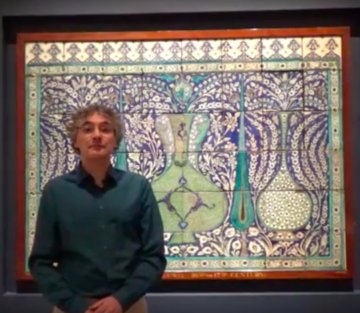
Beauty is in the eye of the beholder, but what about symmetry? In our final feature on mathematicians let loose in the Ashmolean Museum, Oxford Mathematician Balázs Szendrői investigates the beauty of symmetry in the Museum's Islamic art works. As he explains, no matter what the tile pattern may look like, its underlying symmetry configuration belongs to a small set of possibilities.
Tue, 29 Nov 2016
13:00 -
14:00
C4
Elementary Applied Topology
Barbara Mahler, Nina Otter, Bernadette Stolz
(University of Oxford)
Abstract
In this meeting we will talk about the first two chapters of Robert Ghrist's book "Elementary Applied Topology". The book is freely available at the following link: https://www.math.upenn.edu/~ghrist/notes.html
Fri, 25 Nov 2016
15:00 -
16:00
S0.29
Hyperbolic Dehn filling in dimension four
Stefano Riolo
(University of Pisa)
Abstract
By gluing copies of a deforming polytope, we describe some deformations of complete, finite-volume hyperbolic cone four-manifolds. Despite the fact that hyperbolic lattices are locally rigid in dimension greater than three (Garland-Raghunathan), we see a four-dimensional analogue of Thurston's hyperbolic Dehn filling: a path of cone-manifolds $M_t$ interpolating between two cusped hyperbolic four-manifolds $M_0$ and $M_1$.
This is a joint work with Bruno Martelli.
Thu, 24 Nov 2016
11:00
11:00
C5
Tue, 29 Nov 2016
12:45 -
13:30
C5
Community Detection in Annotated Bipartite Networks
Roxana Pamfil
(University of Oxford)
Abstract
A successful programme of personalised discounts and recommendations relies on identifying products that customers want, based both on items bought in the past and on relevant products that the customers have not yet purchased. Using basket-level grocery shopping data, we aim to use clustering ("community detection") techniques to identify groups of shoppers with similar preferences, along with the corresponding products that they purchase, in order to design better recommendation systems.
Stochastic block models (SBMs) are an increasingly popular class of methods for community detection. In this talk, I will expand on some work done by Newman and Clauset [1] that uses a modified SBM for community detection in annotated networks. In these networks, additional information in the form of node metadata is used to improve the quality of the inferred community structure. The method can be extended to bipartite networks, which contain two types of nodes and edges only between nodes of different types. I will show some results obtained from applying this method to a bipartite network of customers and products. Finally, I will discuss some desirable extensions to this method such as incorporating edge weights and assessing the relationship between metadata and network structure in a statistically robust way.
[1] Structure and inference in annotated networks, MEJ Newman and A Clauset, Nature Communications 7, 11863 (2016).
Note: This talk will cover similar topics to my presentation in the InFoMM group meeting on Friday, November 25 but it won't be exactly the same. I will focus more on the mathematical details for my JAMS talk.