

Categorical Quantum Mechanics I: Causal Quantum Processes
Coecke, B
Kissinger, A
(18 Jan 2018)
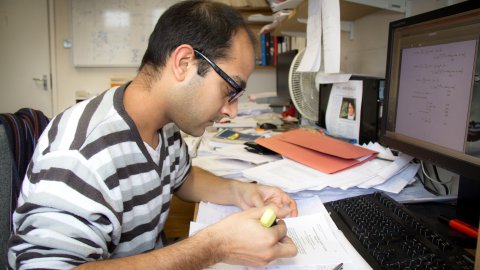
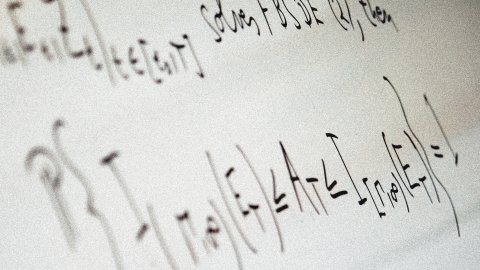
Our research covers the spectrum of fundamental and applied mathematics. Our case studies and films spotlight different aspects of our research.
Mon, 25 Jan 2016
16:00 -
17:00
L4
Global well-posedness of the axisymmetric Navier-Stokes equations in the exterior of an infinite cylinder
Ken Abe
(Kyoto and Oxford)
Abstract
We consider the initial-boundary value problem of the Navier-Stokes equations for axisymmetric initial data with swirl in the exterior of an infinite cylinder, subject to the slip boundary condition. We construct global solutions and give an upper bound for azimuthal component of vorticity in terms of the size of cylinder. The proof is based on the Boussinesq system. We show that the system is globally well-posed for axisymmetric data without swirl.
Thu, 22 Oct 2015
11:00
11:00
C5
Algebraic spaces and Zariski geometries.
Alfonso Guido Ruiz
(Oxford)
Abstract
I will explain how algebraic spaces can be presented as Zariski geometries and prove some classical facts about algebraic spaces using the theory of Zariski geometries.
Tue, 03 Nov 2015
14:30 -
15:00
L5
Block Preconditioning for Incompressible Two-Phase Flow
Niall Bootland
(University of Oxford)
Abstract
Modelling two-phase, incompressible flow with level set or volume-of-fluid formulations results in a variable coefficient Navier-Stokes system that is challenging to solve computationally. In this talk I will present work from a recent InFoMM CDT mini-project which looked to adapt current preconditioners for one-phase Navier-Stokes flows. In particular we consider systems arising from the application of finite element methodology and preconditioners which are based on approximate block factorisations. A crucial ingredient is a good approximation of the Schur complement arising in the factorisation which can be computed efficiently.
Mon, 23 Nov 2015
16:00 -
17:00
C2
Reduction Types of Abelian Varieties
Alexander Betts
(Oxford)
Abstract
Much of the arithmetic behaviour of an elliptic curve can be understood by examining its mod p reduction at some prime p. In this talk, we will aim to explain some of the ways we can define the mod p reduction, and the classifications of which reduction types occur.
Topics to be covered include the classical reduction types (good/multiplicative/additive), the Kodaira-Neron reduction types that refine them, and the Raynaud parametrisation of a semistable abelian variety. Time permitting, we may also discuss joint work with Vladimir Dokchitser classifying the semistable reduction types of 2-dimensional abelian varieties.
Mon, 16 Nov 2015
16:00 -
17:00
C2
IP sets, recurrence, and polynomials
Jakub Konieczny
(Oxford)
Abstract
I will discuss the many appearances of the class of IP sets in classical theorems of combinatorial number theory and ergodic theory. Our point of departure will be the celebrated theorem of Hindman on partition regularity of IP sets, which is crucial for the introduction of IP-limits. We then discuss how existence of certain IP-limits translates into recurrence statements, which in turn give rise to results in number theory via the Furstenberg correspondence principle. Throughout the talk, the methods of ergodic theory will play an important role - however, no prior familiarity with them is required.
Mon, 09 Nov 2015
16:00 -
17:00
C2
Characterising the Integers in the Rationals
Philip Dittmann
(Oxford)
Abstract
Starting from Hilbert's 10th problem, I will explain how to characterise the set of integers by non-solubility of a set of polynomial equations and discuss related challenges. The methods needed are almost entirely elementary; ingredients from algebraic number theory will be explained as we go along. No knowledge of first-order logic is necessary.
Wed, 21 Oct 2015
11:00 -
12:30
N3.12
Some Theorems of the Greeks
Gareth Wilkes
(Oxford)
Abstract
I will give a historical overview of some of the theorems proved by the
Ancient Greeks, which are now taken for granted but were, and are,
landmarks in the history of mathematics. Particular attention will be
given to the calculation of areas, including theorems of Hippocrates,
Euclid and Archimedes.
Thu, 26 Nov 2015
14:45 -
15:45
L4
The moduli stack of tropical curves (COW SEMINAR)
Martin Ulirsch
(University of Bonn)
Abstract
The moduli space of tropical curves (and its variants) is one of the most-studied objects in tropical geometry. So far this moduli space has only been considered as an essentially set-theoretic coarse moduli space (sometimes with additional structure). As a consequence of this restriction, the tropical forgetful map does not define a universal curve
(at least in the positive genus case). The classical work of Knudsen has resolved a similar issue for the algebraic moduli space of curves by considering the fine moduli stacks instead of the coarse moduli spaces. In this talk I am going to give an introduction to these fascinating tropical moduli spaces and report on ongoing work with R. Cavalieri, M. Chan, and J. Wise, where we propose the notion of a moduli stack of tropical curves as a geometric stack over the category of rational polyhedral cones. Using this framework one can give a natural interpretation of the forgetful morphism as a universal curve. The coarse moduli space arises as the set of $\mathbb{R}_{\geq 0}$-valued points of the moduli stack. Given time, I will also explain how the process of tropicalization for these moduli stacks can be phrased in a more fundamental way using the language of logarithmic algebraic stacks.