

Fri, 09 Nov 2018

15:00 - 16:00
C1

Formulating a theory - mathematics in Thomson and Rutherford's collaboration on x-ray ionisation

Isobel Falconer
(University of St Andrews)
Abstract

In 1897 J.J. Thomson 'discovered' the electron. The previous year, he and his research student Ernest Rutherford (later to 'discover' theatomic nucleus), collaborated in experiments to work out why gases exposed to x-rays became conducting. 


This talk will discuss the very different mathematical educations of the two men, and the impact these differences had on their experimental investigation and the theory they arrived at. This theory formed the backdrop to Thomson's electron work the following year. 
Thu, 25 Jan 2018

17:00 - 18:00
L5

Was James Clerk Maxwell’s mathematics as good as his poetry?

Mark McCartney
(University of Ulster)
Abstract

James Clerk Maxwell (1831–1879) was, by any measure, a natural philosopher of the first rank who made wide-ranging contributions to science. He also, however, wrote poetry.

In this talk examples of Maxwell’s poetry will be discussed in the context of a biographical sketch. It will be  argued that not only was Maxwell a good poet, but that his poetry enriches our view of his life and its intellectual context.

Thu, 17 May 2018

16:00 - 17:30
L3

Peeling and the growth of blisters

Professor John Lister
(University of Cambridge)
Abstract

The peeling of an elastic sheet away from thin layer of viscous fluid is a simply-stated and generic problem, that involves complex interactions between flow and elastic deformation on a range of length scales. 

I will illustrate the possibilities by considering theoretically and experimentally the injection and spread of viscous fluid beneath a flexible elastic lid; the injected fluid forms a blister, which spreads by peeling the lid away at the  perimeter of the blister. Among the many questions to be considered are the mechanisms for relieving the elastic analogue of the contact-line problem, whether peeling is "by bending" or "by pulling", the stability of the peeling front, and the effects of a capillary meniscus when peeling is by air injection. The result is a plethora of dynamical regimes and asymptotic scaling laws.

Distributional equivalence and structure learning for bow-free acyclic path diagrams
Nowzohour, C Maathuis, M Evans, R Buehlmann, P Electronic Journal of Statistics volume 11 issue 2 5342-5374 (28 Dec 2017)
Wed, 06 Dec 2017

11:30 - 13:00
L5

Hydrodynamics and acoustics of a free falling drop impact on a quiescent water layer

Yuli Chashechkin
(Russian Academy of Sciences)
Abstract

Using synchronized high-speed video camera, hydrophone and microphone we investigated flow patterns, the impact and secondary sound pulses emitted by oscillating bubbles. On the submerging  drop found short capillary waves produced by small secondary impact droplets. Picturesque filament and grid structures produced by colour drop of mixing fluid registered on the surface of the cavity and crown. Physical model includes discussion of the potential surface energy effects.

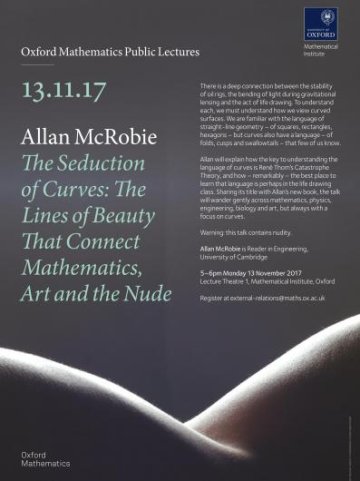
There is a deep connection between the stability of oil rigs, the bending of light during gravitational lensing and the act of life drawing. To understand each, we must understand how we view curved surfaces. We are familiar with the language of straight-line geometry – of squares, rectangles, hexagons - but curves also have a language - of folds, cusps and swallowtails - that few of us know.

Smooth, identifiable supermodels of discrete DAG models with latent variables
Evans, R Richardson, T Bernoulli volume 25 issue 2 848-876 (06 Mar 2019)
Cosmological Parameters and the Baryon Density from CMB and Galaxy Fluctuations
Gaztañaga, E Barriga, J Santos, M Sarkar, S Astrophysics and Space Science Library volume 274 303-308 (2002)
Subscribe to