

Tue, 17 May 2016

10:00 - 11:00
C1

Number theory tools for Cryptographic Applications

Giacomo Micheli
(Oxford University)
Abstract

In this lecture we describe the effective Chebotarev Theorem for global function fields and show how this can be used to describe the statistics of a polynomial map f in terms of its monodromy groups. With this tool in hand, we will provide a strategy to remove the remaining heuristic in the quasi-polynomial time algorithm for discrete
logarithm problems over finite fields of small characteristic.
Tue, 24 May 2016

10:30 - 11:30
L4

On the null string origin of the ambitwistor strings

Dr Piotr Tourkine
(Cambridge DAMTP)
Abstract
The CHY formulae are a set of remarkable formulae describing the scattering amplitudes of a variety of massless theories, as  certain worldsheet integrals, localized on the solutions to certain polynomial equations (scattering equations). These formulae arise from a new class of holomorphic strings called Ambitwistor strings that encode exactly the dynamics of the supergravity (Yang-Mills) modes of string theory.


Despite some recent progress by W. Siegel and collaborators, it remains as an open question as to what extent this theory was connected to the full string theory. The most mysterious point being certainly that the localization equations of the ambitwistor string also appear in the zero tension limit of string theory (alpha’ to infinity), which is the opposite limit than the supergravity one (alpha’ to zero).


In this talk, I’ll report on some work in progress with E. Casali (Math. Inst. Oxford) and argue that the ambitwistor string is actually a tensionless string. Using some forgotten results on the quantization of these objects, we explain that the quantization of tensionless strings is ambiguous, and can lead either to a higher spin theory, or to the ambitwistor string, hence solving the previously mentioned paradox. In passing, we see that the degenerations of the tensile worldsheet that lead to tensionless strings make connection with Galilean Conformal Algebras and the (3d) BMS algebra.

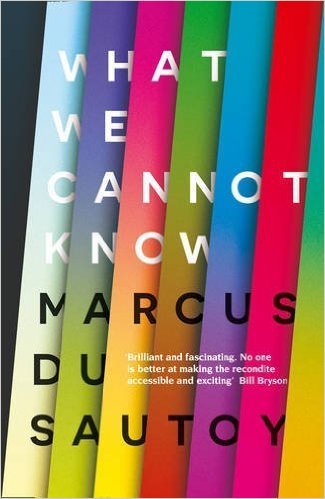
The rolling of dice in a casino, Heisenberg's uncertainty, the meaning of consciousness. All are explored as Marcus takes us on a personal journey into the realms of the scientific unknown. Are we forever incapable of understanding all of the world around us or is it perhaps just a question of language, not having the right words to describe what we see?


Mon, 16 May 2016
16:00
C3

Curves and their fundamental groups

Junghwan Lim
(Oxford University)
Abstract

I will describe a sketch of the proof of Grothendieck conjecture on fundamental groups.
 

Mon, 16 May 2016

12:00 - 13:00
L3

A metric and geometry for heterotic moduli

Jock McOrist
(Surrey)
Abstract

Heterotic vacua, defined with a holomorphic bundle and connection satisfying hermitian Yang-Mills, realise four-dimensional chiral gauge theories. We exploit the rich interplay between four-dimensional physics, supersymmetry and  geometry to construct a natural Kaehler metric for the moduli space, with a shockingly simple Kaehler potential. Along the way, we discover a natural geometric structure for the heterotic moduli.
 

Developmental environment effects on sexual selection in male and female drosophila melanogaster
Morimoto Borges, J Pizzari, T Wigby, S PLoS One volume 11 issue 5 (01 Jan 2016)
Tue, 17 May 2016

12:00 - 13:15
L4

On-shell recursion at one loop in pure Yang-Mills theory, to an extent.

Dr Rutger Boels
(DESY, Hamburg)
Abstract

Loop computations put the 'quantum' into quantum field theory. Much effort has focused on their structure and properties, with most spectacular progress in maximally supersymmetric gauge theories in the planar limit. These theories are however quite far from reality as described for instance in the standard model of particle physics. In this talk I'll report on ongoing work using BCFW on-shell recursion to obtain loop amplitude integrands in a much more realistic theory, pure Yang-Mills theory, using methods which apply directly to the standard model.

Subscribe to