

An international observational study to assess the impact of the Omicron variant emergence on the clinical epidemiology of COVID-19 in hospitalised patients
Gonçalves, B
Hall, M
Jassat, W
Balan, V
Murthy, S
Kartsonaki, C
Semple, M
Rojek, A
Baruch, J
Reyes, L
Dasgupta, A
Dunning, J
Citarella, B
Pritchard, M
Martín-Quiros, A
Sili, U
Baillie, J
Aryal, D
Arabi, Y
Rashan, A
Angheben, A
Caoili, J
Carrier, F
Harrison, E
Gómez-Junyent, J
Figueiredo-Mello, C
Douglas, J
Nor, M
Chow, Y
Wong, X
Bertagnolio, S
Thwin, S
Streinu-Cercel, A
Salazar, L
Rishu, A
Rangappa, R
Ong, D
Hashmi, M
Carson, G
Diaz, J
Fowler, R
Kraemer, M
Wils, E
Horby, P
Merson, L
Olliaro, P
Group, I
Thu, 15 Sep 2022
17:00 -
18:00
Lecture Theatre 1, Mathematical Institute, Radcliffe Observatory Quarter, Woodstock Road, OX2 6GG
A mathematical journey through scales - Martin Hairer
Martin Hairer
(Imperial College)
Further Information
Oxford Mathematics Public Lecture
A mathematical journey through scales - Martin Hairer
The tiny world of particles and atoms and the gigantic world of the entire universe are separated by about forty orders of magnitude. As we move from one to the other, the laws of nature can behave in drastically different ways, sometimes obeying quantum physics, general relativity, or Newton’s classical mechanics, not to mention other intermediate theories.
Understanding the transformations that take place from one scale to another is one of the great classical questions in mathematics and theoretical physics, one that still hasn't been fully resolved. In this lecture, we will explore how these questions still inform and motivate interesting problems in probability theory and why so-called toy models, despite their superficially playful character, can sometimes lead to certain quantitative predictions.
Professor Martin Hairer is Professor of Pure Mathematics at Imperial College London. He was awarded the Fields Medal in 2014.
Please email @email to register.
The lecture will be available on our Oxford Mathematics YouTube Channel on 22 September at 5 pm.
The Oxford Mathematics Public Lectures are generously supported by XTX Markets.

Non-Invertible Symmetries from Holography and Branes
Apruzzi, F
Bah, I
Bonetti, F
Schafer-Nameki, S
(15 Aug 2022)
Review of Particle Physics
Workman, R
Burkert, V
Crede, V
Klempt, E
Thoma, U
Tiator, L
Agashe, K
Aielli, G
Allanach, B
Amsler, C
Antonelli, M
Aschenauer, E
Asner, D
Baer, H
Banerjee, S
Barnett, R
Baudis, L
Bauer, C
Beatty, J
Belousov, V
Beringer, J
Bettini, A
Biebel, O
Black, K
Blucher, E
Bonventre, R
Bryzgalov, V
Buchmuller, O
Bychkov, M
Cahn, R
Carena, M
Ceccucci, A
Cerri, A
Chivukula, R
Cowan, G
Cranmer, K
Cremonesi, O
D'Ambrosio, G
Damour, T
de Florian, D
de Gouvêa, A
DeGrand, T
de Jong, P
Demers, S
Dobrescu, B
D'Onofrio, M
Doser, M
Dreiner, H
Eerola, P
Egede, U
Eidelman, S
El-Khadra, A
Ellis, J
Eno, S
Erler, J
Ezhela, V
Fetscher, W
Fields, B
Freitas, A
Gallagher, H
Gershtein, Y
Gherghetta, T
Gonzalez-Garcia, M
Goodman, M
Grab, C
Gritsan, A
Grojean, C
Groom, D
Grünewald, M
Gurtu, A
Gutsche, T
Haber, H
Hamel, M
Hanhart, C
Hashimoto, S
Hayato, Y
Hebecker, A
Heinemeyer, S
Hernández-Rey, J
Hikasa, K
Hisano, J
Höcker, A
Holder, J
Hsu, L
Huston, J
Hyodo, T
Ianni, A
Kado, M
Karliner, M
Katz, U
Kenzie, M
Khoze, V
Klein, S
Krauss, F
Kreps, M
Križan, P
Krusche, B
Kwon, Y
Lahav, O
Laiho, J
Lellouch, L
Lesgourgues, J
Liddle, A
Ligeti, Z
Lin, C
Lippmann, C
Liss, T
Littenberg, L
Lourenço, C
Lugovsky, K
Lugovsky, S
Lusiani, A
Makida, Y
Maltoni, F
Mannel, T
Manohar, A
Marciano, W
Masoni, A
Matthews, J
Meißner, U
Melzer-Pellmann, I
Mikhasenko, M
Miller, D
Milstead, D
Mitchell, R
Mönig, K
Molaro, P
Moortgat, F
Moskovic, M
Nakamura, K
Narain, M
Nason, P
Navas, S
Nelles, A
Neubert, M
Nevski, P
Nir, Y
Olive, K
Patrignani, C
Peacock, J
Petrov, V
Pianori, E
Pich, A
Piepke, A
Pietropaolo, F
Pomarol, A
Pordes, S
Profumo, S
Quadt, A
Rabbertz, K
Rademacker, J
Raffelt, G
Ramsey-Musolf, M
Ratcliff, B
Richardson, P
Ringwald, A
Robinson, D
Roesler, S
Rolli, S
Romaniouk, A
Rosenberg, L
Rosner, J
Rybka, G
Ryskin, M
Ryutin, R
Sakai, Y
Sarkar, S
Sauli, F
Schneider, O
Schönert, S
Scholberg, K
Schwartz, A
Schwiening, J
Scott, D
Sefkow, F
Seljak, U
Sharma, V
Sharpe, S
Shiltsev, V
Signorelli, G
Silari, M
Simon, F
Sjöstrand, T
Skands, P
Skwarnicki, T
Smoot, G
Soffer, A
Sozzi, M
Spanier, S
Spiering, C
Stahl, A
Stone, S
Sumino, Y
Syphers, M
Takahashi, F
Tanabashi, M
Tanaka, J
Taševský, M
Terao, K
Terashi, K
Terning, J
Thorne, R
Titov, M
Tkachenko, N
Tovey, D
Trabelsi, K
Urquijo, P
Valencia, G
Van de Water, R
Varelas, N
Venanzoni, G
Verde, L
Vivarelli, I
Vogel, P
Vogelsang, W
Vorobyev, V
Wakely, S
Walkowiak, W
Walter, C
Wands, D
Weinberg, D
Weinberg, E
Wermes, N
White, M
Wiencke, L
Willocq, S
Wohl, C
Woody, C
Yao, W
Yokoyama, M
Yoshida, R
Zanderighi, G
Zeller, G
Zenin, O
Zhu, R
Zhu, S
Zimmermann, F
Zyla, P
Progress of Theoretical and Experimental Physics
volume 2022
issue 8
(08 Aug 2022)
Fri, 18 Nov 2022
16:00
16:00
C1
Rigidity of Banach *-algebras
Eduard Ortega
(NTNU. Trondheim)
Abstract
It is well known that two non-isomorphic groups (groupoids) can produce isomorphic C*-algebras. That is, group (groupoid) C*-algebras are not rigid. This is not the case of the L^p-operator algebras associated to locally compact groups ( effective groupoids) where the isomorphic class of the group (groupoid) uniquely determines up to isometric isomorphism the associated L^p-algebras. Thus, L^p-operator algebras are rigid. Liao and Yu introduced a class of Banach *-algebras associated to locally compact groups. We will see that this family of Banach *-algebras are also rigid.
Tue, 01 Nov 2022
16:00
16:00
C1
The noncommutative factor theorem for higher rank lattices
Cyril Houdayer
(Université Paris-Saclay, Orsay)
Abstract
In this talk, I will present a noncommutative analogue of Margulis’ factor theorem for higher rank lattices. More precisely, I will give a complete description of all intermediate von Neumann subalgebras sitting between the von Neumann algebra of the lattice and the von Neumann algebra of the action of the lattice on the Furstenberg-Poisson boundary. As an application, we infer that the rank of the semisimple Lie group is an invariant of the pair of von Neumann algebras. I will explain the relevance of this result regarding Connes’ rigidity conjecture.
Tue, 25 Oct 2022
16:00
16:00
C1
Chaotic tracial dynamics
Bhishan Jacelon
(Czech Academy of Sciences)
Abstract
The classification by K-theory and traces of the category of simple, separable, nuclear, Z-stable C*-algebras satisfying the UCT is an extraordinary feat of mathematics. What's more, it provides powerful machinery for the analysis of the internal structure of these regular C*-algebras. In this talk, I will explain one such application of classification: In the subclass of classifiable C*-algebras consisting of those for which the simplex of tracial states is nonempty, with extremal boundary that is compact and has the structure of a connected topological manifold, automorphisms can be shown to be generically tracially chaotic. Using similar ideas, I will also show how certain stably projectionless C*-algebras can be described as crossed products.
Tue, 18 Oct 2022
16:00
16:00
C1
Equivariant Jiang-Su stability
Lise Wouters
(KU Leuven)
Abstract
Equivariant Jiang-Su stability is an important regularity property for group actions on C*-algebras. In this talk, I will explain this property and how it arises naturally in the context of the classification of C*-algebras and their actions. Depending on the time, I will then explain a bit more about the nature of equivariant Jiang- Su stability and the kind of techniques that are used to study it, including a recent result of Gábor Szabó and myself establishing an equivalence with equivariant property Gamma under certain conditions.
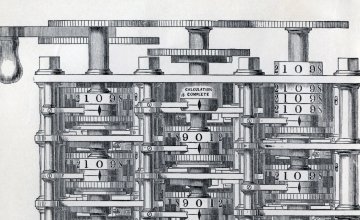
You can't move (or read) for mention of artificial intelligence. And while we may only have a vague idea of what AI is, we know for sure that it is revolutionary and that it is new.
Except it isn't. Think Mary Shelley's creation in ‘Frankenstein’, and how it challenged ideas of what it meant to be human. How about Victorian Charles Babbage's 'Difference Engine' (pictured), feted as the forerunner of the computer. Babbage’s collaborator Ada Lovelace understood how it might weave patterns and compose music, as well as crunch numbers.
Short reachability networks
Groenland, C
Johnston, T
Radcliffe, J
Scott, A
(13 Aug 2022)
http://arxiv.org/abs/2208.06630v2