

Clinical and serological findings of Madariaga and Venezuelan equine encephalitis viral infections: a follow-up study five years after an outbreak in Panama
Carrera, J
Pittí, Y
Molares-Martínez, J
Casal, E
Pereyra Elías, R
Saenz, L
Guerrero, I
Galué, J
Rodriguez-Alvarez, F
Jackman, C
Pascale, J
Armien, B
Weaver, S
Donnelly, C
Vittor, A
Open Forum Infectious Diseases
volume 7
issue 9
(20 Aug 2020)
Endemic and epidemic human alphavirus infections in Eastern Panama; an analysis of population-based cross-sectional surveys
Carrera, J
Neira, K
Pereyra Elías, R
American Journal of Tropical Medicine and Hygiene
volume 103
issue 6
2429-2437
(26 Oct 2020)
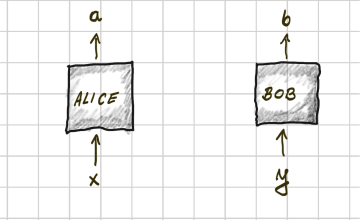
Oxford Mathematician Artur Ekert describes how his research in to using Quantum properties for cryptography led to some very strange results.
Thu, 24 Sep 2020
16:45 -
17:30
Virtual
An introduction to compact quantum metric spaces
David Kyed
(University of Southern Denmark)
Abstract
The Gelfand correspondence between compact Hausdorff spaces and unital C*-algebras justifies the slogan that C*-algebras are to be thought of as "non-commutative topological spaces", and Rieffel's theory of compact quantum metric spaces provides, in the same vein, a non-commutative counterpart to the theory of compact metric spaces. The aim of my talk is to introduce the basics of the theory and explain how the classical Gromov-Hausdorff distance between compact metric spaces can be generalized to the quantum setting. If time permits, I will touch upon some recent results obtained in joint work with Jens Kaad and Thomas Gotfredsen.
Further Information
Part of UK virtual operator algebras seminar: https://sites.google.com/view/uk-operator-algebras-seminar/home
Thu, 10 Sep 2020
16:45 -
17:30
Virtual
A peek into the classification of C*-dynamics
Gabor Szabo
(KU Leuven)
Abstract
In the structure theory of operator algebras, it has been a reliable theme that a classification of interesting classes of objects is usually followed by a classification of group actions on said objects. A good example for this is the complete classification of amenable group actions on injective factors, which complemented the famous work of Connes-Haagerup. On the C*-algebra side, progress in the Elliott classification program has likewise given impulse to the classification of C*-dynamics. Although C*-dynamical systems are not yet understood at a comparable level, there are some sophisticated tools in the literature that yield satisfactory partial results. In this introductory talk I will outline the (known) classification of finite group actions with the Rokhlin property, and in the process highlight some themes that are still relevant in today's state-of-the-art.
Further Information
Part of UK virtual operator algebras seminar: https://sites.google.com/view/uk-operator-algebras-seminar/home
Thu, 10 Sep 2020
16:00 -
16:45
Virtual
Compact quantum Lie groups
Makoto Yamashita
(University of Olso)
Abstract
Quantum groups, which has been a major overarching theme across various branches of mathematics since late 20th century, appear in many ways. Deformation of compact Lie groups is a particularly fruitful paradigm that sits in the intersection between operator algebraic approach to quantized spaces on the one hand, and more algebraic one arising from study of quantum integrable systems on the other.
On the side of operator algebra, Woronowicz defined the C*-bialgebra representing quantized SU(2) based on his theory of pseudospaces. This gives a (noncommutative) C*-algebra of "continuous functions" on the quantized group SUq(2).
Its algebraic counterpart is the quantized universal enveloping algebra Uq(??2), due to Kulish–Reshetikhin and Sklyanin, coming from a search of algebraic structures on solutions of the Yang-Baxter equation. This is (an essentially unique) deformation of the universal enveloping algebra U(??2) as a Hopf algebra.
These structures are in certain duality, and have far-reaching generalization to compact simple Lie groups like SU(n). The interaction of ideas from both fields led to interesting results beyond original settings of these theories.
In this introductory talk, I will explain the basic quantization scheme underlying this "q-deformation", and basic properties of the associated C*-algebras. As part of more recent and advanced topics, I also want to explain an interesting relation to complex simple Lie groups through the idea of quantum double.
Further Information
Part of UK virtual operator algebras seminar: https://sites.google.com/view/uk-operator-algebras-seminar/home
Thu, 24 Sep 2020
16:00 -
16:45
Virtual
Groupoid C*-algebras and ground states
Nadia Larsen
(University of Olso)
Abstract
C*-algebras associated to etale groupoids appear as a versatile construction in many contexts. For instance, groupoid C*-algebras allow for implementation of natural one-parameter groups of automorphisms obtained from continuous cocycles. This provides a path to quantum statistical mechanical systems, where one studies equilibrium states and ground states. The early characterisations of ground states and equilibrium states for groupoid C*-algebras due to Renault have seen remarkable refinements. It is possible to characterise in great generality all ground states of etale groupoid C*-algebras in terms of a boundary groupoid of the cocycle (joint work with Laca and Neshveyev). The steps in the proof employ important constructions for groupoid C*-algebras due to Renault.
Further Information
Part of UK virtual operator algebras seminar: https://sites.google.com/view/uk-operator-algebras-seminar/home