

Search for non-relativistic magnetic monopoles with IceCube: IceCube Collaboration (vol 74, 2938, 2014)
Aartsen, M
Abbasi, R
Ackermann, M
Adams, J
Aguilar, J
Ahlers, M
Altmann, D
Arguelles, C
Arlen, T
Auffenberg, J
Bai, X
Baker, M
Barwick, S
Baum, V
Bay, R
Beatty, J
Tjus, J
Becker, K
Benabderrahmane, M
BenZvi, S
Berghaus, P
Berley, D
Bernardini, E
Bernhard, A
Besson, D
Binder, G
Bindig, D
Bissok, M
Blaufuss, E
Blumenthal, J
Boersma, D
Bohm, C
Bose, D
Boeser, S
Botner, O
Brayeur, L
Bretz, H
Brown, A
Bruijn, R
Casey, J
Casier, M
Chirkin, D
Christov, A
Christy, B
Clark, K
Classen, L
Clevermann, F
Coenders, S
Cohen, S
Cowen, D
Silva, A
Danninger, M
Daughhetee, J
Davis, J
Day, M
de Andre, J
De Clercq, C
De Ridder, S
Desiati, P
de Vries, K
de With, M
DeYoung, T
Diaz-Velez, J
Dunkman, M
Eagan, R
Eberhardt, B
Eichmann, B
Eisch, J
Euler, S
Evenson, P
Fadiran, O
Fazely, A
Fedynitch, A
Feintzeig, J
Feusels, T
Filimonov, K
Finley, C
Fischer-Wasels, T
Flis, S
Franckowiak, A
Frantzen, K
Fuchs, T
Gaisser, T
Gallagher, J
Gerhardt, L
Gladstone, L
Gluesenkamp, T
Goldschmidt, A
Golup, G
Gonzalez, J
Goodman, J
Gora, D
Grandmont, D
Grant, D
Gretskov, P
Groh, J
Gross, A
Ha, C
Haack, C
Ismail, A
Hallen, P
Hallgren, A
Halzen, F
Hanson, K
Hebecker, D
Heereman, D
Heinen, D
Helbing, K
Hellauer, R
Hickford, S
Hill, G
Hoffman, K
Hoffmann, R
Homeier, A
Hoshina, K
Huang, F
Huelsnitz, W
Hulth, P
Hultqvist, K
Hussain, S
Ishihara, A
Jacobi, E
Jacobsen, J
Jagielski, K
Japaridze, G
Jero, K
Jlelati, O
Kaminsky, B
Kappes, A
Karg, T
Karle, A
Kauer, M
Kelley, J
Kiryluk, J
Klaes, J
Klein, S
Koehne, J
Kohnen, G
Kolanoski, H
Kopke, L
Kopper, C
Kopper, S
Koskinen, D
Kowalski, M
Krasberg, M
Kriesten, A
Krings, K
Kroll, G
Kunnen, J
Kurahashi, N
Kuwabara, T
Labare, M
Landsman, H
Larson, M
Lesiak-Bzdak, M
Leuermann, M
Leute, J
Luenemann, J
Macias, O
Madsen, J
Maggi, G
Maruyama, R
Mase, K
Matis, H
McNally, F
Meagher, K
Meli, A
Merck, M
Meures, T
Miarecki, S
Middell, E
Milke, N
Miller, J
Mohrmann, L
Montaruli, T
Morse, R
Nahnhauer, R
Naumann, U
Niederhausen, H
Nowicki, S
Nygren, D
Obertacke, A
Odrowski, S
Olivas, A
Omairat, A
O'Murchadha, A
Palczewski, T
Paul, L
Pepper, J
de los Heros, C
Pfendner, C
Pieloth, D
Pinat, E
Posselt, J
Price, P
Przybylski, G
Quinnan, M
Raedel, L
Rameez, M
Rawlins, K
Redl, P
Reimann, R
Resconi, E
Rhode, W
Ribordy, M
Richman, M
Riedel, B
Robertson, S
Rodrigues, J
Rott, C
Ruhe, T
Ruzybayev, B
Ryckbosch, D
Saba, S
Sander, H
Santander, M
Sarkar, S
Schatto, K
Scheriau, F
Schmidt, T
Schmitz, M
Schoenen, S
Schoeneberg, S
Schoenwald, A
Schukraft, A
Schulte, L
Schulz, O
Seckel, D
Sestayo, Y
Seunarine, S
Shanidze, R
Sheremata, C
Smith, M
Soldin, D
Spiczak, G
Spiering, C
Stamatikos, M
Stanev, T
Stanisha, N
Stasik, A
Stezelberger, T
Stokstad, R
Stoessl, A
Strahler, E
Stroem, R
Strotjohann, N
Sullivan, G
Taavola, H
Taboada, I
Tamburro, A
Tepe, A
Ter-Antonyan, S
Tesic, G
Tilav, S
Toale, P
Tobin, M
Toscano, S
Tselengidou, M
Unger, E
Usner, M
Vallecorsa, S
van Eijndhoven, N
van Santen, J
Vehring, M
Voge, M
Vraeghe, M
Walck, C
Wallraff, M
Weaver, C
Wellons, M
Wendt, C
Westerhoff, S
Whelan, B
Whitehorn, N
Wiebe, K
Wiebusch, C
Williams, D
Wissing, H
Wolf, M
Wood, T
Woschnagg, K
Xu, D
Xu, X
Yanez, J
Yodh, G
Yoshida, S
Zarzhitsky, P
Ziemann, J
Zierke, S
Zoll, M
Collaboration, I
EUROPEAN PHYSICAL JOURNAL C
volume 79
issue 2
(08 Feb 2019)
doi:10.1140/epjc/s10052-019-6582-1
Mon, 04 Mar 2019
12:45
12:45
L5
Gauge Theory and Boundary Integrability
David Skinner
(Cambridge)
Abstract
Costello Yamazaki and Witten have proposed a new understanding of quantum integrable systems coming from a variant of Chern-Simons theory living on a product of two Riemann surfaces. I’ll review their work, and show how it can be extended to the case of integrable systems with boundary. The boundary Yang-Baxter Equations, twisted Yangians and Sklyanin determinants all have natural interpretations in terms of line operators in the theory.
Mon, 25 Feb 2019
12:45
12:45
L5
The Laplacian flow in G_2 geometry
Jason Lotay
(Oxford)
Abstract
Finding Riemannian metrics with holonomy G_2 is a challenging problem with links in mathematics to Einstein metrics and area-minimizing submanifolds, and to M-theory in theoretical physics. I will provide a brief survey on recent progress towards studying this problem using a geometric flow approach, including connections to calibrated fibrations.

The Oxford Mathematics educational experience is a journey, a journey like any other educational experience. It builds on what you learn at school. It is not unfamiliar and we don't want it to invisible. But it has aspects that are different. One of these is the tutorial system. Students have lectures. But they also have tutorials based on those lectures where they sit, usually in pairs, with a tutor, go through their work and, critically, get to ask questions. It is their tutorial.
Tue, 26 Feb 2019
14:30 -
15:00
L3
Multispectral snapshot demosaicing via non-convex matrix completion
Simon Vary
(Oxford)
Abstract
Snapshot mosaic multispectral imagery acquires an undersampled data cube by acquiring a single spectral measurement per spatial pixel. Sensors which acquire p frequencies, therefore, suffer from severe 1/p undersampling of the full data cube. We show that the missing entries can be accurately imputed using non-convex techniques from sparse approximation and matrix completion initialised with traditional demosaicing algorithms.
Fri, 08 Mar 2019
10:00 -
11:00
L3
Mechano-electrophysiological coupling in axonal membrane: theory, controversy and neuromodulation
Antoine Jerusalem
(Department of Engineering Science)
Wed, 20 Feb 2019
17:00 -
18:00
C1
Virtual fibring of manifolds and groups
Dawid Kielak
Abstract
I will discuss Agol's proof of the Virtually Fibred Conjecture of
Thurston, focusing on the role played by the `RFRS' property. I will
then show how one can modify parts of Agol's proof by replacing some
topological considerations with a group theoretic statement about
virtual fibring of RFRS groups.
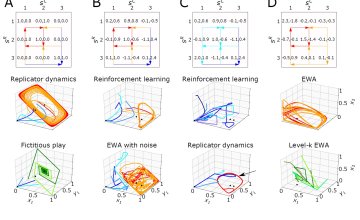
The concept of equilibrium is one of the most central ideas in economics. It is one of the core assumptions in the vast majority of economic models, including models used by policymakers on issues ranging from monetary policy to climate change, trade policy and the minimum wage. But is it a good assumption?
Fri, 10 May 2019
10:00 -
11:00
L3
Developing the Next Generation of Image Reconstruction in Atom Probe Tomography
Charlie Fletcher and Dan Haley
(Department of Materials Science)
Abstract
Atom Probe Tomography is a powerful 3D mass spectrometry technique. By pulsing the sample apex with an electric field, surface atoms are ionised and collected by a detector. A 3D image of estimated initial ion positions is constructed via an image reconstruction protocol. Current protocols assume ion trajectories follow a stereographic projection. However, this method assumes a hemispherical sample apex that fails to account for varying material ionisation rates and introduces severe distortions into atomic distributions for complex material systems.
We aim to develop continuum models and use this to derive a time-dependent mapping describing how ion initial positions on the sample surface correspond to final impact positions on the detector. When correctly calibrated with experiment, such a mapping could be used for performing reconstruction.
Currently we track the sample surface using a level set method, while the electric field is solved via BEM or a FEM-BEM coupling. These field calculations must remain accurate close to the boundary. Calibrating unknown evaporation parameters with experiment requires an ensemble of models per experiment. Therefore, we are also looking to maximise model efficiency via BEM compression methods i.e. fast multipole BEM. Efficiently constructing and reliably interpolating the non-bijective trajectory mapping, while accounting for ion trajectory overlap and instabilities (at sample surface corners), also presents intriguing problems.
This project is in collaboration with Cameca, the leading manufacturer of commercial atom probe instruments. If successful in minimising distortions such a technique could become valuable within the semiconductor industry.
Measuring rank robustness in scored protein interaction networks
Bozhilova, L
Whitmore, A
Wray, J
Reinert, G
Deane, C
BMC Bioinformatics
(29 Aug 2019)
doi:10.1101/502302