

Mon, 29 Jan 2018
12:45
12:45
L3
Compact G2 manifolds and the Duality between M-Theory and Heterotic String Theory
Andreas Braun
(Oxford)
Abstract
M-theory on K3 surfaces and Heterotic Strings on T^3 give rise to dual theories in 7 dimensions. Applying this duality fibre-wise is expected to connect G2 manifolds with Calabi-Yau threefolds (together with vector bundles). We make these ideas explicit for a class of G2 manifolds realized as twisted connected sums and prove the equivalence of the spectra of the dual theories. This naturally gives us examples of singular TCS G2 manifolds realizing non-abelian gauge theories with non-chiral matter.
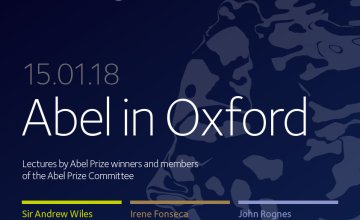
The Abel Prize is the most prestigious prize in Mathematics. Each year, in anticipation of the prize announcement, an afternnon of lectues showcases previous winners and member of the Committee. This year the event will be held in Oxford on Monday 15th January. Andrew Wiles, John Rognes and Irene Fonseca will be the speakers. Full details below. Everyone welcome. No need to register.
Timetable:
Tue, 24 Apr 2018
16:00 -
17:00
L5
Global Reflection Principles
Philip Welch
(Bristol)
Abstract
We reflect on the set-theoretic ineffability of the Cantorian Absolute of all sets. If this is done in the style of Levy and Montague in a first order manner, or Bernays using second or higher order methods this has only resulted in principles that can justify large cardinals that are `intra-constructible', that is they do not contradict the assumption that V, the universe of sets of mathematical discourse, is Gödel's universe of constructible sets, namely L. Peter Koellner has advanced reasons that this style of reflection will only have this rather limited strength. However set theorists would dearly like to have much stronger axioms of infinity. We propose a widened structural `Global Reflection Principle' that is based on a view of sets and Cantorian absolute infinities that delivers a proper class of Woodin cardinals (and more). A mereological view of classes is used to differentiate between sets and classes. Once allied to a wider view of structural reflection, stronger conclusions are thus possible.
Obtaining Woodin's Cardinals
P. D. Welch, in ``Logic in Harvard: Conference celebrating the birthday of Hugh Woodin''
Eds. A. Caicedo, J. Cummings, P.Koellner & P. Larson, AMS Series, Contemporary Mathematics, vol. 690, 161-176,May 2017.
Global Reflection principles,
P. D. Welch, currently in the Isaac Newton Institute pre-print series, No. NI12051-SAS,
to appear as part of the Harvard ``Exploring the Frontiers of Incompleteness'' Series volume, 201?, Ed. P. Koellner, pp28.
Tue, 27 Feb 2018
16:00 -
17:00
L1
Tue, 20 Feb 2018
16:00 -
17:00
L1
Linear orders in NIP theories
Pierre Simon
(Berkeley)
Abstract
A longstanding open question asks whether every unstable NIP theory interprets an infinite linear order. I will present a construction that almost provides a positive answer. I will also discuss some conjectural applications to the classification of omega-categorical NIP structure, generalizing what is known for omega-stable, and classification of models mimicking the superstable case.
Tue, 13 Feb 2018
16:00 -
17:00
L5
Isotrivial Mordell-Lang and finite automata
Rahim Moosa
(University of Waterloo)
Abstract
About fifteen years ago, Thomas Scanlon and I gave a description of sets that arise as the intersection of a subvariety with a finitely generated subgroup inside a semiabelian variety over a finite field. Inspired by later work of Derksen on the positive characteristic Skolem-Mahler-Lech theorem, which turns out to be a special case, Jason Bell and I have recently recast those results in terms of finite automata. I will report on this work, as well as on the work-in-progress it has engendered, also with Bell, on an effective version of the isotrivial Mordell-Lang theorem.
Tue, 06 Feb 2018
16:00 -
17:00
L5
Counting lattice points and O-minimal structures
Fabrizio Barroero
(University of Basle)
Abstract
Let L be a lattice in R^n and let Z in R^(m+n) a parameterized family of subsets Z_T of R^n. Starting from an old result of Davenport and using O-minimal structures, together with Martin Widmer, we proved for fairly general families Z an estimate for the number of points of L in Z_T, which is essentially best possible.
After introducing the problem and stating the result, we will present applications to counting algebraic integers of bounded height and to Manin’s Conjecture.
Mon, 11 Jun 2018
16:00 -
17:00
L1
Pattern formations by large interaction forces in a nonlinear elliptic system
Jaeyoung Byeon
(Korea Advanced Institute of Science and Technology)
Abstract
For a nonlinear elliptic system coming from a nonlinear Schroedinger system, the interaction between components is represented by a symmetric matrix. The construction of possibly lower energy nontrivial solutions and the complete description of dependence of the solutions on the matrix are quite challenging tasks. Especially, we are interested in the case that intra-species interaction forces are fixed and inter-species forces are very large, that is, the diagonal part of the symmetric matric is fixed and the non-diagonal entries are very large. In this case, depending on the network between components by repulsive or attractive forces, several different types of patterns may appear. I would like to explain our recent studies on the problem with three components and touch a possible exploration on the general n-components problem.

Oxford Mathematician Sir John Ball FRS has been awarded the King Faisal Prize for Science. Launched by the King Faisal Foundation (KFF) and granted for the first time in 1979, the King Faisal Prize recognises the outstanding works of individuals and institutions in five major categories: Service to Islam, Islamic Studies, Arabic Language and Literature, Medicine, and Science.