

Garbage in garbage out? Impacts of data quality on criminal network intervention
Yeung, W
Di Clemente, R
Lambiotte, R
EPJ Data Science
volume 14
issue 1
37-37
(12 May 2025)
doi:10.1140/epjds/s13688-025-00553-x
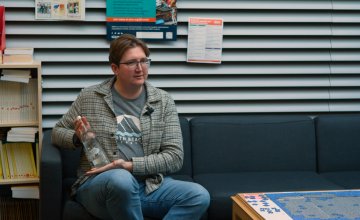
Our latest series of shorts on YouTube sees us asking our mathematicians if they use their mathematics in their everyday lives, either consciously, subconsciously or not at all.
You never quite know what to expect, but geometry as a stress buster, how to empty bottles quicker, not taking the same route round a tree each time you go for a walk?
You can watch the first films via the videos below. First up is Nivedita, Graduate Student in Mathematical Physics. Next to Nivedita is Josh, postdoc in Mathematical Biology.
A User’s Guide to KSig: GPU-Accelerated Computation of the Signature Kernel
Tóth, C
Dela Cruz, D
Oberhauser, H
477-523
(01 Apr 2026)
doi:10.1007/978-3-032-03914-9_16
Anticyclotomic Euler systems for unitary groups
Graham, A
Shah, S
Proceedings of the London Mathematical Society
volume 127
issue 6
1577-1680
(Dec 2023)
doi:10.1112/plms.12566
Ladders and rainbows in Minimal Subtraction
Balduf, P
(03 Mar 2025)
http://arxiv.org/abs/2503.02079v2
The Topological form is the Pfaffian form
Balduf, P
Hu, S
(12 Mar 2025)
http://arxiv.org/abs/2503.09558v1
Random Subspace Cubic-Regularization Methods, with Applications to Low-Rank Functions.
Cartis, C
Shao, Z
Tansley, E
CoRR
volume abs/2501.09734
(Jan 2025)
Tensor-based Dinkelbach method for computing generalized tensor eigenvalues and its applications
Chen, H
Zhu, W
Cartis, C
Applied Numerical Mathematics
volume 224
1-21
(Jun 2026)
doi:10.1016/j.apnum.2026.01.013
The impact of T-cell exhaustion dynamics on tumour-immune interactions and tumour growth
Lai, N
Farman, A
Byrne, H
Bulletin of Mathematical Biology
volume 87
issue 5
(02 Apr 2025)
doi:10.1007/s11538-025-01433-1