

Tue, 17 Nov 2015

15:45 - 16:45
L4

The Grothendieck-Riemann-Roch theorem and the Frobenius morphism

Damian Rossler
(Oxford)
Abstract

Let p>0 be a prime number. We shall describe a short Frobenius-theoretic proof of the Adams-Riemann-Roch theorem for the p-th Adams operation, when the involved schemes live in characteristic p and the morphism is smooth. This result implies the Grothendieck-Riemann-Roch theorem for smooth morphisms in positive characteristic and the Hirzebruch-Riemann-Roch theorem in any characteristic. This is joint work with R. Pink.
Quantum quench within the gapless phase of the spin-12 Heisenberg XXZ spin chain
Collura, M Calabrese, P Essler, F Physical Review B volume 92 issue 12 125131 (01 Sep 2015)
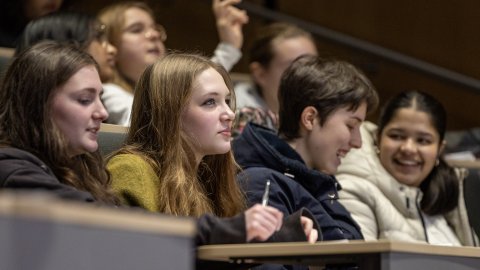
Four attendees watching a lecture
It All Adds Up: three separate one-day conferences for female and non-binary pupils interested in maths, with workshops and talks to inspire students.
Wed, 02 Dec 2015
16:00
C2

Countable dynamics

Chris Good
(Birmingham University)
Abstract

We know that the existence of a period three point for an interval map implies much about the dynamics of the map, but the restriction of the map to the periodic orbit itself is trivial. Countable invariant subsets arise naturally in many dynamical systems, for example as $\omega$-limit sets, but many of the usual notions of dynamics degenerate when restricted to countable sets. In this talk we look at what we can say about dynamics on countable compact spaces.  In particular, the theory of countable dynamical systems is the theory of the induced dynamics on countable invariant subsets of the interval and the theory of homeomorphic countable dynamics is the theory of compact countable invariant subsets of homeomorphisms of the plane.


Joint work with Columba Perez

Tue, 01 Dec 2015

15:45 - 16:45
L4

Applications of theta-stratifications

Daniel Halpern-Leistner
(Columbia)
Abstract

I will survey some applications of a special kind of stratification of an algebraic stack called a theta-stratification. The goal is to eventually be able to study semistability and wall-crossing 
in a large array of moduli problems beyond the well-known examples. The most general application is to studying the derived category of coherent sheaves on the stack, but one can use this to understand the topology (K-theory, Hodge-structures, etc.) of the semistable locus and how it changes as one varies the stability condition. I will also describe a ``virtual non-abelian localization theorem'' which computes the virtual index of certain classes in the K-theory of a stack with perfect obstruction theory. This generalizes the virtual localization theorem of Pandharipande-Graber and the K-theoretic localization formulas of Teleman and Woodward.

Subscribe to