

Optical conductivity of the Hubbard chain away from half filling
Tiegel, A
Veness, T
Dargel, P
Honecker, A
Pruschke, T
McCulloch, I
Essler, F
Physical Review B
volume 93
issue 12
(03 Mar 2016)
doi:10.1103/PhysRevB.93.125108
Thu, 02 Jun 2016
14:00 -
15:00
L5
CUR Matrix Factorizations: Algorithms, Analysis, Applications
Professor Mark Embree
(Virginia Tech)
Abstract
Interpolatory matrix factorizations provide alternatives to the singular value decomposition for obtaining low-rank approximations; this class includes the CUR factorization, where the C and R matrices are subsets of columns and rows of the target matrix. While interpolatory approximations lack the SVD's optimality, their ingredients are easier to interpret than singular vectors: since they are copied from the matrix itself, they inherit the data's key properties (e.g., nonnegative/integer values, sparsity, etc.). We shall provide an overview of these approximate factorizations, describe how they can be analyzed using interpolatory projectors, and introduce a new method for their construction based on the
Discrete Empirical Interpolation Method (DEIM). To conclude, we will use this algorithm to gain insight into accelerometer data from an instrumented building. (This talk describes joint work with Dan Sorensen (Rice) and collaborators in Virginia Tech's Smart Infrastucture Lab.)
Thu, 26 May 2016
14:00 -
15:00
L5
Meanderings through the modelling and simulation of buoyancy-driven flows
Dr Garth Wells
(Cambridge University)
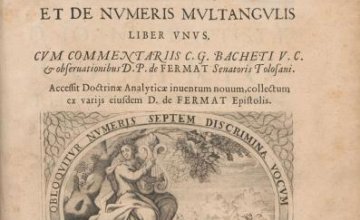
A diophantine equation is an algebraic equation, or system of equations, in several unknowns and with integer (or rational) coefficients, which one seeks to solve in integers (or rational numbers). The study of such equations goes back to antiquity. Their name derives from the mathematician Diophantus of Alexandria, who wrote a treatise on the subject, entitled Arithmetica.
Quench dynamics and relaxation in isolated integrable quantum spin chains
Essler, F
Fagotti, M
JOURNAL OF STATISTICAL MECHANICS-THEORY AND EXPERIMENT
(24 Jun 2016)
doi:10.1088/1742-5468/2016/06/064002
Vascular phenotype identification and anti-angiogenic treatment recommendation: A pseudo-multiscale mathematical model of angiogenesis.
Hutchinson, L
Gaffney, E
Maini, P
Wagg, J
Phipps, A
Byrne, H
Journal of theoretical biology
volume 398
162-180
(14 Jun 2016)
doi:10.1016/j.jtbi.2016.03.002
Vascular phenotype identification and anti-angiogenic treatment recommendation: A pseudo-multiscale mathematical model of angiogenesis.
Hutchinson, L
Gaffney, E
Maini, P
Wagg, J
Phipps, A
Byrne, H
Journal of theoretical biology
volume 398
162-180
(14 Jun 2016)
doi:10.1016/j.jtbi.2016.03.002
Homogenized boundary conditions and resonance effects in Faraday cages.
Hewett, D
Hewitt, I
Proceedings. Mathematical, physical, and engineering sciences
issue 2189
(01 May 2016)
doi:10.1098/rspa.2016.0062
Possibilities determine the combinatorial structure of probability polytopes
Abramsky, S
Mansfield, S
Kishida, K
Lal, R
Barbosa, R
Journal of Mathematical Psychology
volume 74
58-65
(17 May 2016)
doi:10.1016/j.jmp.2016.03.006
Quantum capacitance modifies interionic interactions in semiconducting nanopores
Lee, A
Vella, D
Goriely, A
EPL
volume 113
issue 3
(02 Mar 2016)
doi:10.1209/0295-5075/113/38005